Donald Trump is a man of much cunning but limited intelligence. Throughout his business career he displayed an instinctive talent for bluff and for escaping situations that would have ruined less adaptable men. What he has never shown is the capacity for sustained strategic thought. He understands transactions better than systems and personal advantage better than the slow interaction of military, diplomatic and economic forces. This matters little in property speculation or television entertainment. It matters a great deal when one finds oneself directing the foreign policy of the world’s largest military power.
The latest American announcement concerning the Strait of Hormuz shows the distinction. Read on its own, the President’s declaration appears merely absurd. Read alongside the Memorandum of Understanding signed last month, and beside the courteous response from the Iranian Foreign Minister, it becomes something more revealing. It explains how a President who began this war promising unconditional victory has arrived, step by reluctant step, at the public rebranding of surrender.
For months Mr Trump has been trapped between political pressures that cannot simultaneously be satisfied. On one side stands the organised Israeli lobby, which regards the destruction of the Iranian state as an existential necessity and possesses numerous well-established mechanisms for influencing American politics. There is nothing mysterious about this. Lobbying organisations, campaign finance, media influence, think tanks and long-established institutional relationships have shaped American Middle Eastern policy for decades. Any President who attempts to depart significantly from that consensus rapidly discovers how narrow his room for manoeuvre really is.
On the other side stand the millions of Americans who voted for Mr Trump because he repeatedly promised that he would not begin another Middle Eastern war. His electoral appeal rested, in large measure, upon the argument that Iraq, Afghanistan, Libya and Syria had consumed enormous quantities of American blood and treasure while serving no identifiable American interest. His supporters believed him when he declared that the United States should cease acting as the armed custodian of every quarrel in the Middle East. They expected fewer foreign adventures and a government concerned primarily with domestic prosperity.
These constituencies demand opposite policies. One demands permanent confrontation with Iran until the present regime disappears. The other demands that America disengage from wars that have little or nothing to do with the security of the United States. Mr Trump imagined that both could somehow be accommodated. Events have demonstrated otherwise.
From the beginning, the military advice reaching the White House appears to have been consistent. Iran could be bombed. Individual leaders could be murdered. Military installations could be destroyed. Civilian infrastructure could be reduced to rubble. None of these actions, however, would necessarily produce the political collapse upon which the entire strategy depended. The Joint Chiefs reportedly warned that any assault on Iran carried a serious probability that the Strait of Hormuz would become unusable for international commerce. They also understood what every student of maritime geography already knew: the United States could not simply declare the Strait open if Iran retained the capacity to make commercial shipping prohibitively dangerous.
This distinction between tactical success and strategic success appears never to have penetrated the President’s thinking. He continued to confuse the destruction of targets with the achievement of political objectives. Military briefings showing demolished facilities became evidence that the war itself was being won. Yet the political position steadily deteriorated. The Iranian state survived. Its leadership was rapidly replaced. The Revolutionary Guards emerged politically stronger than before. The closure of Hormuz destabilised world energy markets. American allies declined to participate in further escalation. The war succeeded militarily in numerous local engagements while failing strategically in almost every important respect.
It was against this background that the Memorandum of Understanding emerged last month. Properly understood, it was not the framework of an American victory. It was the framework of an American escape. Faced with a conflict that could neither be escalated safely nor concluded successfully, Mr Trump accepted an arrangement that allowed hostilities to subside while preserving enough ambiguity to present the outcome as a diplomatic achievement. His military advisers had long concluded that there was no realistic path to outright victory. The Memorandum offered the least humiliating route towards ending a war that should never have been begun.
Only afterwards did its implications become politically obvious. The document recognised, implicitly though unmistakably, that Iran remained the decisive local power. It accepted realities that could not comfortably be reconciled with months of presidential boasts about total victory and complete domination. More importantly, it alarmed those interests in Washington and Tel Aviv that regarded any negotiated settlement as unacceptable. The pressure upon the White House intensified almost immediately. The President appears to have realised, rather belatedly, that what he had embraced as a diplomatic success looked, to many observers, remarkably like an instrument of surrender.
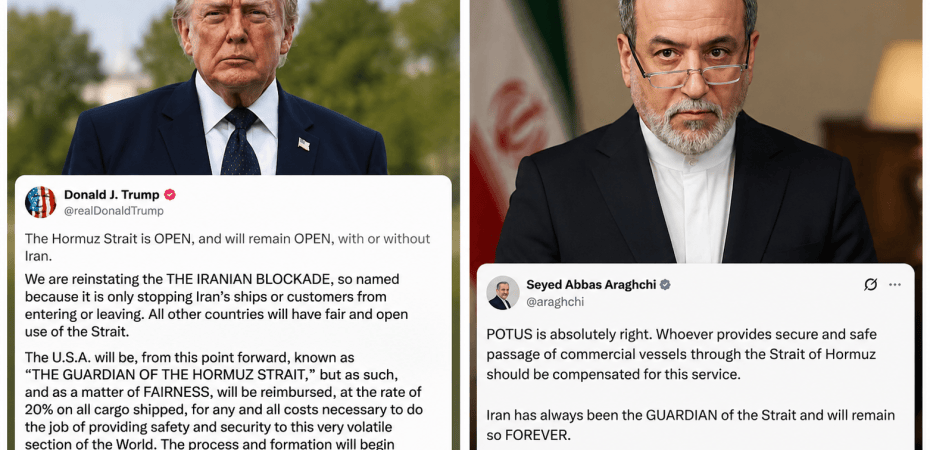
His response was characteristic. Rather than alter the underlying reality, he attempted to alter the language describing it. Hence the extraordinary proclamation now circulating under presidential authority. America, Mr Trump announced, would become “THE GUARDIAN OF THE HORMUZ STRAIT.” Commercial shipping would enjoy safe passage under American protection. In return, however, the United States would receive reimbursement amounting to twenty per cent of the value of every cargo transiting the Strait.
One scarcely knows whether to admire the audacity or the desperation of the proposal. The United States prolonged this war because Iran allegedly intended to impose an unacceptable charge upon commercial navigation through an international waterway. Washington denounced this as extortion. Its allies spoke solemnly about freedom of navigation. Editorial writers rediscovered the United Nations Convention on the Law of the Sea. We were informed, repeatedly, that no state could legitimately convert an international strait into a source of revenue. America has now proposed the same outcome on a vastly larger scale.
The arithmetic is comical. Iran was contemplating a transit charge measured in millions of dollars per vessel. Mr Trump’s proposed twenty per cent levy would, for many fully laden crude carriers, amount to something approaching thirty million dollars for a single voyage. The toll that supposedly justified military intervention has been replaced by one perhaps fifteen times larger. Only the collector has changed.
I find the legal implications almost as remarkable as the political ones. Article 38 of the United Nations Convention on the Law of the Sea guarantees transit passage through international straits. Article 26 states plainly that charges may not be imposed merely because ships exercise the right of passage. Article 42 permits certain limited regulations but expressly prohibits measures that impair or condition transit itself. These provisions were cited endlessly when Iran floated its proposal. They have not ceased to exist because Washington has decided that tribute is more respectable when collected by the United States.
For generations American diplomats condemned the Danish Sound Dues as an obsolete form of maritime extortion incompatible with the freedom of the seas. Earlier still, the creation of the United States Navy was celebrated as a refusal to pay tribute to the Barbary States. Millions for defence, but not one cent for tribute, became part of the American national mythology. Two centuries later America has not merely agreed to tribute. It has reinvented itself as the party collecting it.
The most telling response, however, came not from maritime lawyers or foreign governments but from Tehran itself. The Iranian Foreign Minister responded with studied courtesy. President Trump, he observed, was absolutely correct. Whoever genuinely provides safe and secure passage through the Strait should indeed receive compensation. Iran, he gently reminded the world, has always been the guardian of the Strait and always will be. Twenty per cent, however, seemed rather excessive. Iran would be fairer.
The elegance of the reply lies in what it leaves unsaid. It accepts Mr Trump’s own vocabulary while quietly stripping away every political advantage the White House hoped to obtain from it. Washington proclaims itself guardian. Tehran calmly replies that guardianship has always belonged to Iran. America announces a new international order. Iran thanks the President for finally recognising an old geographical reality.
The exchange reveals how completely the diplomatic initiative has passed from Washington to Tehran. A confident hegemonic power does not seek to rename defeat. It does not attempt to disguise retreat by inventing new titles for itself. Above all, it does not discover that its principal adversary can respond with irony rather than alarm. Mr Trump hoped to recover the appearance of authority. Instead he invited the Iranian Government to demonstrate, before the whole world, who now possesses the greater confidence.
The American President has spent five months discovering the oldest lesson in strategy. A state cannot make facts true simply because it wishes them true. Dominance belongs to the power that possesses the practical ability to determine events. The latest exchange between Washington and Tehran suggests that this distinction, unlike many others, is understood in Iran. It is understood rather less well inside the White House.
Addendum: The Difficulty of Commenting on a Disintegrating Presidency (15th July 2026)
There comes a point when political commentary begins to resemble the work of a psychiatrist rather than that of a historian. Following Donald Trump’s conduct of the Iran War is becoming a thankless occupation because the central problem is no longer military or diplomatic. It is the progressive inability of the President himself to maintain a coherent line of policy for more than a day or two. Yesterday’s declaration is contradicted today. Today’s threat is forgotten tomorrow. One is left not analysing strategy but attempting to chart the fluctuations of a mind that appears steadily less capable of distinguishing impulse from policy.
Only a few days ago Mr Trump announced that the United States would become the “Guardian of the Hormuz Strait” and would collect twenty per cent of the value of all cargo passing through it. This extraordinary proposal amounted to the public embrace of the conduct for which America had claimed to be continuing its war against Iran. Having denounced Iranian tolls as piracy, Washington proposed a vastly larger toll of its own. Within hours, however, that policy had quietly disappeared. The proposed levy has now been abandoned in favour of vague promises of future trade and investment with the Gulf States.
The retreat suggests that even those around the President have grasped that one cannot proclaim freedom of navigation while simultaneously imposing the largest transit charge in modern maritime history. Faced with ridicule from lawyers, diplomats and shipping interests, and virtually everyone not watching American television, the White House quietly withdrew the proposal without ever acknowledging that it had done so.
The abandonment of piracy, however, has not produced moderation. It has been replaced by renewed threats to commit acts that international humanitarian law has long regarded as war crimes. Mr Trump now declares that unless Iran returns to negotiations next week, the United States will destroy its bridges and electrical generating stations. These are not casual remarks made at a campaign rally. They were delivered during a televised interview as statements of intended policy. Earlier in the conflict he made similar threats. At the time, the United Nations High Commissioner for Human Rights reminded all parties that deliberately attacking civilian infrastructure essential to the civilian population violates the Geneva Conventions and may constitute war crimes. That legal position has not altered because the threat now comes from the President of the United States.
Nor is the military logic any more convincing than the legal position. Destroying bridges and power stations does little to defeat a government determined to continue fighting. It does, however, impose great hardship on civilians who have no influence over strategic decisions. It interrupts hospitals, water supplies, communications, sanitation and ordinary commerce. Such measures belong to the long and unhappy history of collective punishment. They may satisfy a desire for revenge. They rarely produce durable political success.
One is therefore struck less by the content of these threats than by their inconsistency. The same President who accepted a Memorandum of Understanding because it offered an escape from an unwinnable war now threatens renewed escalation. The same administration that speaks of negotiations simultaneously threatens devastation if negotiations do not proceed exactly as Washington demands. One day the emphasis falls on commerce and investment. The next it falls on destroying civilian infrastructure. The day after that it may be something different again.
This oscillation makes rational diplomacy impossible. Negotiation depends on each side believing that the other possesses both authority and consistency. Governments may dislike one another while still concluding durable agreements because each trusts that the other is capable of honouring yesterday’s commitments tomorrow. That confidence is difficult to maintain where the present American administration is concerned. Foreign governments must now ask themselves whether any undertaking given by Washington will survive the next presidential interview.
The damage therefore extends beyond the immediate conflict. Credibility is among the most valuable assets possessed by any great power. Military strength matters. Economic strength matters. Yet both depend on other governments believing that one’s declarations possess some reasonable permanency. If every announcement is liable to reversal within forty-eight hours, diplomacy degenerates into speculation about the President’s latest mood.
Perhaps this explains the increasingly calm tone emerging from Tehran. Iranian ministers no longer appear alarmed by American rhetoric. Instead, they respond with measured irony, occasionally even with humour. They have learned that today’s ultimatum may become tomorrow’s forgotten press release. That is not a position any American administration would once have tolerated. It is now apparently accepted as normal.
Running commentary on this conflict has therefore become difficult. The subject is no longer the Iran War. The military balance has altered little during the past several weeks. The real story is the progressive erosion of presidential rationality and, alongside it, the steady evaporation of American credibility. Great powers usually decline through economic exhaustion or military defeat. The United States appears to be adding a new mechanism to the historical catalogue: the public collapse of confidence in the judgement of the man occupying the White House.
That, more than any missile strike or naval deployment, is becoming the defining feature of this unhappy conflict.

Discover more from The Libertarian Alliance
Subscribe to get the latest posts sent to your email.
Related posts:
 The Dollar as a Weapon: How Washington Uses Economic Terrorism to Topple Regimes
 Iran, Biden, Trump: Senile and Braindead vs Senile but Demented
 What the @#!* is Going Going on?
 A War of Depraved Atrocity
 Trump’s War on Iran: The Same Old Lies That Led America into Iraq
 Murder as Policy of State: Reply to Bjornson
 The Islamabad Standoff: America’s Strategic Defeat Disguised as Diplomacy
 The “Rescue Mission” That Wasn’t: How Washington Repackaged a Failed Iran Operation into a Manufactured Triumph
 The Joyful Spectacle of American Humiliation: Goliath Slaughtered by Persia
 The Real Defeat of America
 Did Trump Win the Iran War? A Critique of Brandon Smith
Powered by YARPP.