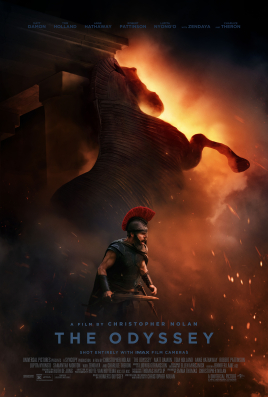
The Odyssey (2026)
Director: Christopher Nolan
Based on: The Odyssey by Homer
Screenplay: Christopher Nolan
Cinematography: Hoyte van Hoytema
Music: Ludwig Göransson
Production Year: 2026
Country: United States / United Kingdom
Genre: Action, Adventure, Drama, Fantasy, Historical Epic
Running Time: 172 minutes
Cast: Matt Damon, Tom Holland, Anne Hathaway, Robert Pattinson, Himesh Patel, Andrew Howard, John Leguizamo, Jon Bernthal, Charlize Theron, Lupita Nyong’o, Zendaya
Having already seen some of the reviews, I had no intention of watching Christopher Nolan’s The Odyssey. Homer has occupied enough of my life that I can pick up the original Greek and read long stretches without difficulty. When you have spent years wrestling with Homeric particles, irregular verbs, and those magnificent similes that roll on for half a page before quietly returning to the main narrative, the prospect of paying to see Hollywood explain what Homer “really means” holds limited appeal.
As matters turned out, I never had to pay. You may recall the offer that I made on Christmas Day to the fatter boys in my year: give up on those horrid slimming injections; instead put yourselves absolutely in my hands; eat as I tell you; move as I tell you. Give me all your pocket money. In return, I will make you into someone who would not have been laughed out of an Athenian gymnasium. I had more takers than I expected. The results have been more encouraging than I expected. Intending a reward for saving him, one of my followers has a talent for obtaining films before they become generally available. I will not discuss his methods. It is enough to say that, one evening before the end of term, several of us found ourselves before the 95 inch television in his parents’ council flat watching Christopher Nolan’s latest attempt to improve on three thousand years of civilisation. It is not an entirely successful attempt, and I am glad I did not hand over money for it. But I feel obliged to review it, if only to discourage anyone else from wasting money on what amounts to psychological warfare.
One of the advantages of quarrying the ancient world for plotlines is that few people can contradict you. The number of Britons who can read Homer in the original is tiny. This gives film directors great freedom. They can compress episodes, invent motivations, alter personalities, and rearrange themes, secure in the knowledge that almost nobody in the audience will realise quite how much has been changed. Most viewers know The Odyssey only as “that story about the Trojan Horse chap trying to get home.” Once you know no more than that, almost anything becomes permissible. Christopher Nolan takes full advantage.
The broad outline remains familiar enough. Troy has fallen. Odysseus begins his long journey back to Ithaca. He blinds the Cyclops, resists the Sirens, visits Circe, descends into the Underworld, loses his companions one by one, and eventually returns home disguised as a beggar to reclaim his kingdom from the suitors who have infested his palace. Any schoolboy familiar with the poem will recognise the sequence of events. Recognition, however, is not the same as fidelity. The difficulty lies not in what happens but in why it happens, and above all in the character of Odysseus himself.
Modern cinema has become suspicious of competence. Every hero must now carry some visible psychological wound that dominates his personality. Physical danger is no longer enough; every adventure must also become a therapeutic journey towards self-acceptance. The result is that Christopher Nolan’s Odysseus is less Homer’s incomparable survivor than yet another modern protagonist burdened by introspection and guilt.
Odysseus is not Achilles. Achilles overwhelms obstacles by force. Odysseus survives because he thinks more quickly than everyone else around him. The Greeks admired this quality enough to give it a name: mētis. It is intelligence expressed through cunning, flexibility, deception, improvisation and practical judgement. Odysseus lies brilliantly. He disguises himself effortlessly. He studies other people with almost scientific precision before deciding how best to manipulate them. His victories are intellectual long before they become physical. Homer delights in this. Christopher Nolan seems embarrassed by it.
Instead of celebrating intelligence as the supreme heroic virtue, the screenplay repeatedly redirects attention towards emotional struggle. There are long moments where the original poem’s exuberant confidence in human ingenuity disappears beneath modern anxieties about trauma and inner conflict. These themes are not wholly absent from Homer, but they are not what the poem is about. Nolan has taken one thread and woven an entirely different tapestry.
The same flattening affects Penelope. In lesser hands she becomes little more than the faithful wife waiting patiently for her husband’s return. Homer never makes that mistake. Penelope is almost as intelligent as Odysseus himself. While he survives monsters abroad, she survives politicians at home. Her famous weaving trick, delaying the suitors by unpicking each night’s work, is one of the great acts of strategic deception in literature. She is not passive. She is conducting a prolonged campaign of resistance under impossible circumstances. Anne Hathaway gives the role dignity, but the screenplay rarely allows Penelope to demonstrate the intelligence that makes her such an equal partner to Odysseus.
Helen fares little better. Homer’s Helen is one of the most remarkable women in literature. She is conscious of the disaster she has caused, but she remains intelligent enough to prevent grief from overwhelming judgement. At the feast in Sparta she quietly pours nepenthe into the wine so that Menelaus, Telemachus and the others can speak calmly about Troy. The scene matters because it allows memory to become knowledge. Nolan reverses its purpose. His Helen generates conflict instead of calming it, breaking up the conversation instead of preserving it. It is a small alteration, perhaps, but a revealing one. Homer uses Helen to demonstrate civilisation asserting itself over suffering. Nolan turns her into another source of dramatic noise.
Telemachus suffers similarly. One of the most satisfying aspects of the original poem is watching him grow from an uncertain youth into a man capable of standing beside his father. His education forms an essential part of Homer’s design. Here that development is abbreviated, and consequently loses its emotional force. Tom Holland conveys the awkward uncertainty of adolescence without making the character just weak, yet the gradual acquisition of confidence that should form the emotional spine of the homecoming is truncated into something thinner.
None of this should be taken as criticism of the acting. The performances are among the film’s strengths. Matt Damon brings genuine authority to Odysseus. Even where the script diminishes the character, Damon consistently suggests depths that the dialogue neglects. He never quite becomes Homer’s king of Ithaca, but you always sense the actor trying to reach him. Anne Hathaway is perhaps the most successful of the principal cast; she lends Penelope an intelligence that survives even when the screenplay underuses it. Several scenes almost succeed because of the restraint with which she plays them. The supporting cast are uniformly competent. Robert Pattinson, Himesh Patel and Jon Bernthal all contribute memorable moments.
Annoyingly, the most Homeric scene in the entire film lasts all of three minutes. Lupita Nyong’o also appears as Clytemnestra, and her murder of Agamemnon briefly restores the tragic grandeur that the rest of the film keeps at arm’s length. Her cry as she plunges the knife into her husband conveys years of accumulated hatred for the man who sacrificed their daughter. For just a moment you remember what Greek tragedy feels like. Then it is over almost before it has begun. That brief scene summarises the whole production. Christopher Nolan’s own inventions dominate the film. Homer’s characters and Homer’s themes repeatedly find themselves reduced to supporting roles.
Technically the film is handsome. Hoyte van Hoytema’s cinematography is frequently magnificent. The Mediterranean world possesses an austere grandeur that modern digital filmmaking rarely captures so successfully. The ships look like ships rather than floating theme-park attractions. The landscapes possess genuine scale. The battle scenes avoid the frantic editing that has become almost obligatory in modern action cinema. Ludwig Göransson’s score avoids drowning every conversation beneath orchestral self-importance; silence is allowed to carry dramatic weight. Nolan is one of the few directors capable of making large productions look physically substantial rather than computer-generated. There are moments—the arrival among the Phaeacians, the approach to Ithaca, the vast Mediterranean horizons—that do approach the epic dignity you hope for from Homer. Unfortunately, beautiful photography cannot entirely disguise an uncertain interpretation of its source material. For all its technical cleverness, the film never trusts Homer to be Homer.
The same pattern repeats itself throughout the adventures. Polyphemus ceases to be the articulate and terrifying son of Poseidon and becomes little more than a roaring monster. Circe loses much of the dangerous ambiguity that makes her unforgettable in the poem and is reduced towards the familiar stereotype of an embittered witch. The descent into the Underworld is hurried through as though Nolan were impatient to return to his own inventions. Homer delights in the marvellous because the marvellous enlarges his moral universe. Nolan repeatedly domesticates it into something more psychologically familiar.
If there is one fault above all others that afflicts modern adaptations of the classics, it is a lack of confidence in the original. Directors seem unable to believe that works which have survived for two or three thousand years might already possess the dramatic qualities that enabled them to survive. They feel obliged to improve them. Shakespeare is rewritten to satisfy contemporary politics. Jane Austen becomes a vehicle for discussions she never had. Homer is reshaped into something psychologically familiar to a twenty-first-century audience. The result is always diminution.
Homer does not require modernisation because Homer is already modern in every way that matters. Human beings have not changed in three thousand years. They still love, envy, lie, boast, despair, cheat, hope and kill for reasons that Homer would immediately recognise. His greatness lies in his ability to uncover permanent features of human nature beneath the changing accidents of history. What has changed is not mankind but the confidence of those adapting him. Modern filmmakers are embarrassed by straightforward heroism. They prefer ambiguity to clarity, uncertainty to resolution, introspection to action. Even courage must be hedged about with self-doubt. The audience is invited to admire heroes only after first being reassured that they possess an approved catalogue of emotional vulnerabilities.
Homer needs none of this. His characters are psychologically rich because they are allowed to act as they ought to act. Their personalities emerge from decisions rather than speeches. Odysseus reveals himself through deception, patience, calculation and sudden violence. He does not continually explain himself. Homer expects the audience to judge him from what he does. Contemporary cinema rarely shows such confidence. Nolan’s adaptation repeatedly pauses where Homer presses forward. Conversations become longer than they need to be. Emotional beats are laboriously underlined that Homer leaves implicit. The poem moves with astonishing momentum because every episode draws us towards Ithaca. Even its apparent digressions strengthen the central movement. The film, by contrast, too often pauses to admire its own cleverness.
The result is curious. A film lasting nearly three hours nevertheless manages to hurry through many of the finest episodes of the poem while lingering over scenes that Homer never wrote. You have the constant impression that Nolan is impatient whenever Homer is speaking and most enthusiastic when speaking himself.
The same uncertainty appears in the visual conception of the film. Rather than entering Homer’s world on its own terms, Nolan repeatedly reminds us that we are watching a twenty-first-century production. Historical drama succeeds when it persuades us, however briefly, that another civilisation really existed and possessed its own standards of beauty, honour, family and kingship. Here there is too often the sense that antiquity has been filtered through contemporary assumptions before being handed back to us. The world becomes less strange, but also less convincing. Instead of allowing Homer to speak in his own voice, the production continually translates him into ours.
Nolan also insists on imposing a modern interpretation on the Bronze Age itself. The repeated references to civilisational collapse and the end of an age feel less like Homer than like contemporary editorialising projected backwards through three thousand years. Troy already represents the destruction of a civilisation. Homer requires no assistance in making that point. When characters begin speaking in ways that seem suspiciously aware of historical processes they could not possibly perceive, the illusion collapses.
The same lack of confidence appears in the casting decisions that treat a specifically European foundational poem as raw material for contemporary inclusivity exercises. Helen of Troy—the face that launched a thousand ships, whose beauty is inseparable from the catastrophe of the Trojan War—is given to Lupita Nyong’o. Athena, grey-eyed and particular in Homer’s imagination, is given to Zendaya. These choices are not neutral. They are not “opening the story up.” They are a deliberate decision to detach the poem from the particular people and particular world that produced it, and to replace that particularity with a modern insistence that every classic must be made to look more like the present day. The result is not enrichment of Homer; it is an act of quiet contempt for the civilisation that created him. You do not improve a European classic by sanding away the features that made it European. You simply produce something else and pretends the name still fits.
This is a pity because Homer has much to teach a civilisation that has largely forgotten him. The Greeks understood that excellence is never accidental. Odysseus survives because he prepares, observes and thinks. Penelope survives because intelligence defeats brute force over years of patient resistance. Telemachus becomes a man because responsibility changes him. Even the gods, capricious though they are, inhabit a universe in which courage, endurance and self-command possess objective value. These ideas are unfashionable. Our own age believes that fulfilment consists in authenticity rather than achievement, self-expression rather than discipline. Homer would have regarded such notions with amused incomprehension.
You leave Nolan’s film occasionally impressed, but also conscious that something essential has been lost in translation. It is like listening to an accomplished pianist perform Bach after deciding that several of the fugues would benefit from a little jazz improvisation. The technical skill is undeniable. The confidence is admirable. But you cannot quite suppress the thought that Bach probably knew what he was doing.
I have no doubt that many viewers will enjoy this film. It is ambitious and considerably more intelligent than the average blockbuster currently emerging from Hollywood. Whether it respects Homer is another matter. Whether it respects us is also another matter. But I have said enough in a woke police state to indicate why I see the film as psychological warfare.
After watching it, I found myself doing what I always seem to do after encountering a modern adaptation of a great classical work. I took my Greek text from the shelf and reread Book Nine. Within half a dozen lines the real Odysseus had returned: shrewd, dangerous, endlessly resourceful, delighting in deception while never forgetting home. Christopher Nolan’s interpretation receded immediately from my mind. That is not simply because Nolan has made a bad film. It is because Homer wrote a masterpiece. And masterpieces resist improvement.
Discover more from The Libertarian Alliance
Subscribe to get the latest posts sent to your email.
Related posts:
 Stephen Fry’s Odyssey: The Case for Not Reading
 A Review of Satyricon (1969)
 Curse of the Sin Eater (2023): A Thoughtful Exploration of Temptation and Responsibility
 Suicide Squad (2016): An Exercise in American Delusion
 Children of the Night (2023): Gay Vampires, But Nothing to Suck On
 I Care a Lot (2020): A Libertarian Satire in Disguise
 Callas (2024): The Diva Reduced to a Shuffle
 Mortal Engines: A Wasted Allegory
 What You Wish For (2024) A Commentary on the Epstein Scandal?
 Hounded (2022) Review – Class War and Middle Class Leftist Hypocrisy
 Baban Baban Ban Vampire: Farce, Blood, and Moral Panic
 Intelligence Without Grace: A Review of Hunt (헌트, 2022)
Powered by YARPP.