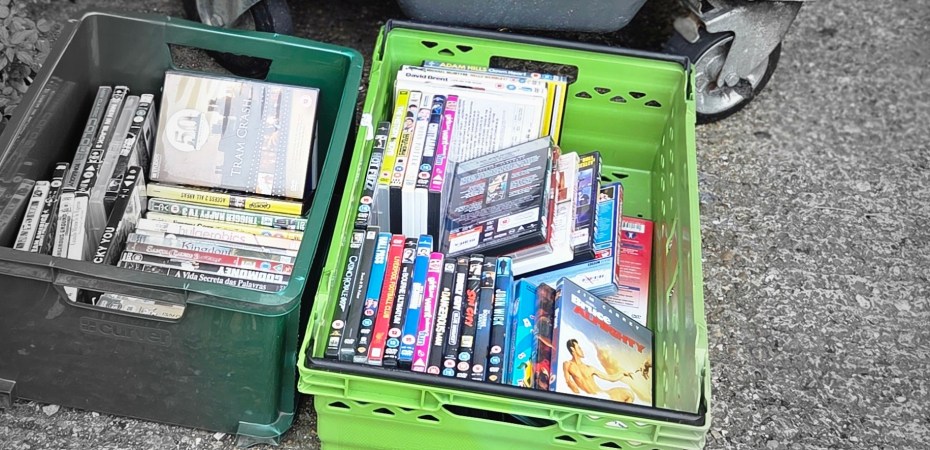
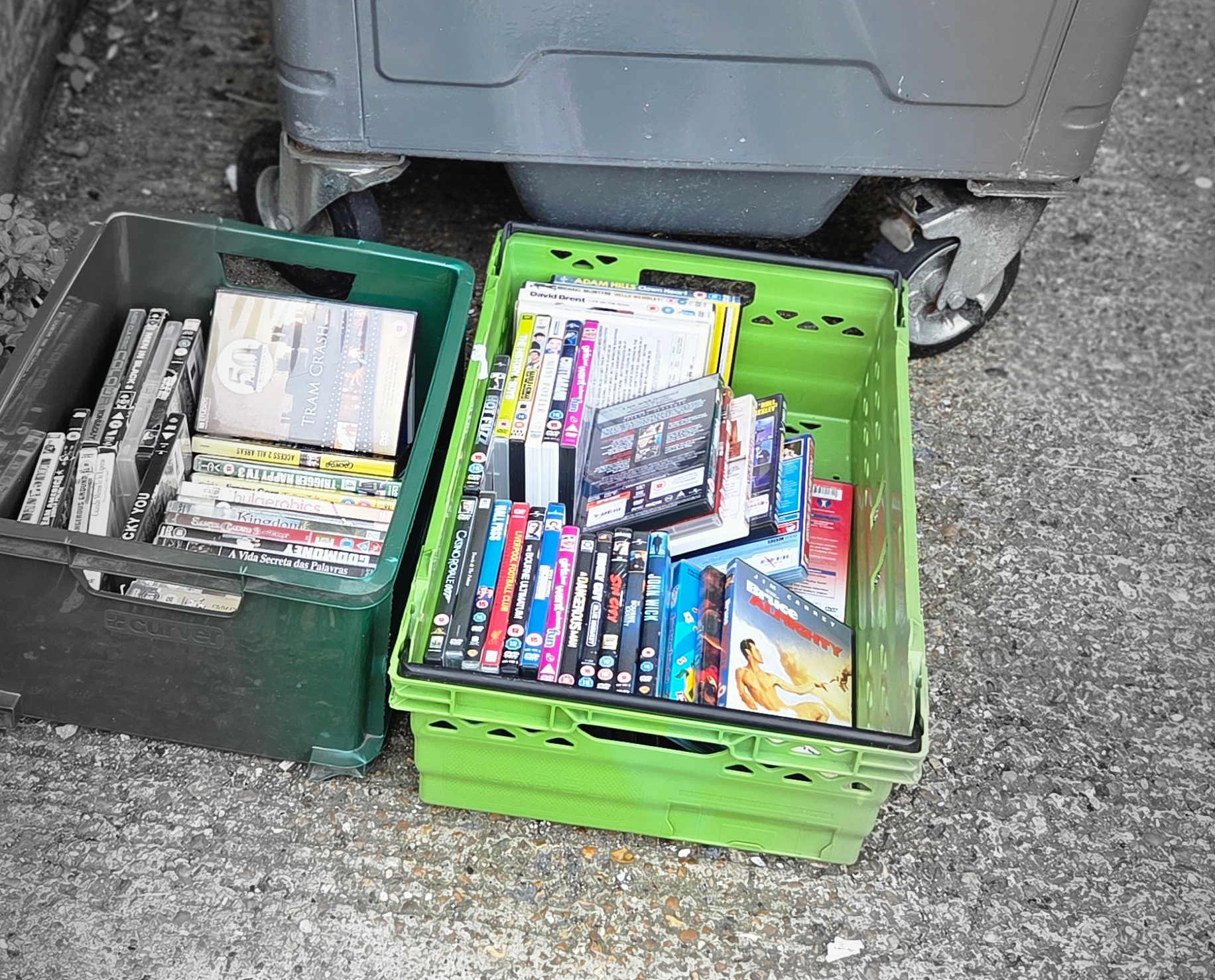
The other day, I cut across the Asda car park and found two green plastic crates beside the bins at the back. They were full of DVDs. I counted roughly, and there were several dozen, stacked with the spines upward as they would be on a shop shelf. The cases were clean and the discs, so far as I looked, were unscratched. The photograph shows them as I found them.
I cannot prove where they came from. My guess is one of the charity shops that, with the vape shops and the bookmakers, have taken over our High Street. Charity shops are given more of these things than they can sell. Last year, Cornwall Hospice Care complained that about 2,500 DVDs had been dumped at its donation centre in Bodmin, and said that around forty per cent of everything it is given cannot be sold. A shop that cannot shift a film for pennies has a choice. It can pay a contractor to take the stock away as commercial waste, or one of the volunteers can carry it round to the supermarket after closing and leave it for anyone who wants it. The law has a name for the second course, and I cannot say I care. It struck me as the more public-spirited of the two.
I went through both crates, and it took less time than it should have. What they held was a fair sample of what the British and American entertainment industries have produced in my lifetime and a little before, and I would place it somewhere between unwatchable trash and psychological warfare against the traditional population of this country. The trash needs no explanation. By the other thing I mean the kind of film and television drama in which the ordinary English, and the northern English above all, are there to be thugs, bigots or comic relief, and in which every story arrives with a lesson attached in case we missed it at school. I do not say that a committee sat down and planned this. None was needed. The people who commission these things went to the same universities and hold the same opinion of the rest of us, and the product comes out as you would expect. I took nothing home. I am not sure, in any case, that anyone at my school owns a machine that would play a DVD.
The approved reaction to a sight like this is shame. An environmentalist will see a couple of stone of plastic on its way to a hole in the ground. A certain kind of conservative will see a civilisation that manufactures rubbish at vast expense and then throws the rubbish away. Both have a point. The plastic is a real cost, and I would rather it were melted down and used again. As for the conservative, I have just agreed with him about the contents. But both are looking at the crates and missing what the crates are evidence of.
Take the worst film in the pile. Somebody paid millions to make it. It kept several hundred skilled people in work for months. The picture is sharp and the sound comes in six channels. The people who make these things have never lacked technical competence. They can light a scene superbly. Their trouble is that they can think of nothing worth lighting. Then consider what it once cost to watch the result. DVD players first went on sale in this country in June 1997 at about £600, and the first British discs appeared the year after at about £20 each. At those prices, the two crates would have set you back more than £2,000, and you would have needed the £600 machine before any of it was more than a set of shiny coasters. This was less than thirty years ago. The same goods are now left beside a bin because they cannot be sold at any price.
Go further back and the comparison becomes absurd. In about AD 86, Martial told a man who kept asking to borrow his poems to go and buy them from the bookseller Atrectus, who would hand over a copy rasum pumice purpuraque cultum—smoothed with pumice and dressed in purple—for five denarii (1.117). A legionary at the time was paid three hundred denarii a year before stoppages. One short book of epigrams, in a good edition, therefore cost a soldier about six days’ pay. Martial makes the obvious joke himself: “Tanti non es” ais? Sapis, Luperce. You say I’m not worth it? You are a sensible man, Lupercus. Nineteen centuries later, I stood beside a supermarket bin and turned down, free of charge, something like two hundred hours of professionally made entertainment. I am with Lupercus on the merits. But the fact that the offer could be made at all tells you more about our civilisation than anything on the discs.
Only a very rich society throws things like this away. A poor one throws away nothing, because everything it has is still the best it can get. And notice what has been discarded. The films themselves have not been lost. They sit on servers, and can be watched for a subscription or, by the less scrupulous, for nothing, at several times the resolution of the discs. What went into the crates was yesterday’s packaging. The discs were dumped because something better had replaced them, and that is a different matter from being dumped because nobody could be bothered to look after them.
This is how abundance has always reached people without money. First, the rich pay £600 for the machine. Then everyone pays £30. Then it is left beside a bin for whoever wants it. The thing itself is no worse at the end than at the start. Its price falls to nothing because something better has arrived for those willing to pay. Cars work like this, and so do telephones. The poorest boy in my year carries a second-hand phone that no millionaire could have bought in 2007.
Now apply this to something that matters more than films. Amazon, Alphabet, Microsoft and Meta are between them spending about seven hundred billion dollars this year, most of it on data centres and the processors to fill them. Their accountants write this equipment off over five or six years. The engineers seem to regard it as out of date in about three. I do not know where several hundred billion dollars’ worth of processors will go when their owners no longer want them, but they will have to go somewhere. On a small scale, it has already started. The Nvidia Tesla P40 is a card with 24 gigabytes of memory that was sold to data centres in 2016 at data-centre prices. You can now have one on eBay for between two and three hundred dollars. It has no fan of its own, having been built for the gale that blows through a server rack, and you must strap one on. Do that, and it will run a respectable open-weight language model in a bedroom. These free models are not the best. Epoch AI estimated last October that the best of them trail the best of the closed commercial models by about three months. I can put up with being three months behind.
I should say where fact ends and guessing begins. The spending figures and the eBay prices are facts. That today’s data-centre hardware will reach ordinary people in the same way is a guess, and there are reasons to doubt it. These machines want more electricity and cooling than a house can supply. Their owners may prefer to scrap them. Governments may decide, for our own safety, that powerful computers have no business in private hands, and I have said elsewhere that this is the danger I take seriously. Nothing of the kind is beside the bins at Asda yet, and I cannot promise that it ever will be. Then again, nobody paying £600 in 1997 expected to see the same goods left out for the dustmen.
So I draw the opposite lesson from the one I am supposed to draw. The crates are a sign of how rich we are and of how fast we are getting richer, and they are a reason to be hopeful. We are moving towards a world in which everything is available to everyone, with the single exception that what is given away will not be quite as good as what must still be bought. The rich will have this year’s model and the rest of us the model before. Every earlier kind of inequality was between those who had and those who went without. I can live with one between the best and the nearly best.
None of this means that what is abundant will be any good. The crates settle that question as well. A civilisation can be technically superb and have nothing to say, and ours has spent my whole lifetime proving it. But films like these needed millions of pounds and the consent of the people who control the millions. When the equipment for making things is itself left out beside the bins, that consent stops mattering, and the rest of us can find out whether we have anything better to say. I suspect we do.
I left the crates where I found them. Somebody may want what is in them, and he is welcome to it. In ten years, I expect to find something better beside the same bins, and I shall take that home.
Discover more from The Libertarian Alliance
Subscribe to get the latest posts sent to your email.
Related posts:
 Artificial Intelligence and the Future of Mankind – Republication with Thoughts on Universal Basic Income
 Artificial Intelligence and the Wealth of Nations
 The Artificial Intelligence Bubble Will Burst — and That Is Why We Shall All Become Richer
 Nick Griffin and the Demographic Winter That Need Not Come
 The AI Mirage: How America’s Economy is Built on a Trillion-Dollar Scam
 AI and the Euthanasia of the Parasitic Middle Class
Oil Shocks and the Acceleration of Economic Change
AI and the Euthanasia of the Parasitic Middle Class
Oil Shocks and the Acceleration of Economic Change
 Looking Beyond Net Zero: An Energy Policy for British Recovery
 Looking Beyond Net Zero: Reply to Bryan Mercadente
 Looking Beyond Net Zero: Reply to Neil Lock
 AI: The Financial Adviser Is Next
 The Most Important Skill in the Age of Artificial Intelligence: Learning to Distrust It
Powered by YARPP.