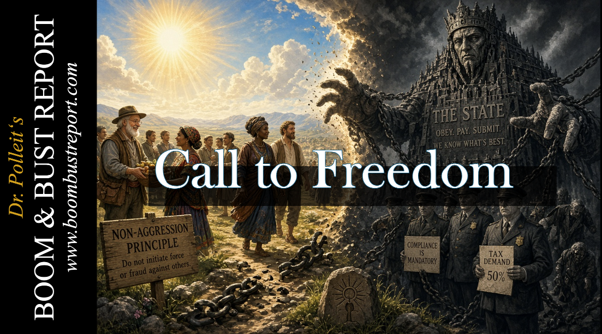
by Thorsten Polleit
Our freedom (yours and mine) is not only being increasingly undermined, restricted, it actually gets destroyed more and more, every day, piece by piece. By whom?
By politicians, bureaucrats, and state-paid experts; and also by our fellow human beings who believe (or made to believe) that we need all these politicians, bureaucrats, and state-paid experts, that we must elevate them to positions of power and influence, and that what they impose on the public must be slavishly followed.
The loss of freedom is ominous and dangerous. Because if you and I lose our freedom (whether out of convenience or because we are cheated out of it), then literally everything is lost. For without freedom, everything is nothing.
Even if you were to reply now that “freedom is not everything”, I tell you: In order to express exactly that (that is, to deny my statement), you need the very freedom you wish to deny. You thus entangle yourself in a logical contradiction and say something false. The sentence that without freedom everything is nothing cannot be refuted.
Not only economic well-being, a better life, cultural achievements, and peace depend on freedom. Freedom is above all inseparably connected with being human. Friedrich von Schiller (1759–1805) formulated this particularly impressively in 1797:
“Man is created free, is free,
And were he born in chains,
Let not the rabble’s cry mislead you,
Nor the abuse of raging fools.
Before the slave, when he breaks his chain,
Before the free man do not tremble.”
But what is freedom? Much ink has already been spilled over answering this question. And it is indeed not so easy to provide an answer. Here is a meaningful explanation of what freedom is: A peaceful person lives in freedom when he or she is not subjected to uninvited coercion or uninvited violence by others.
It is very important to know what freedom is and what it is not. Only then can one recognize whether one is living in freedom or not, and whether it is being taken away secretly or quite openly. As Johann Wolfgang von Goethe (1749–1832) already said: “None are more hopelessly enslaved than those who falsely believe they are free.”
Therefore, once again regarding the understanding of freedom: The American economist and social philosopher Murray Newton Rothbard (1926–1995) explained by logical means that every human being fully and completely owns himself and does not belong to other persons or to the feudal lord, king, emperor, or state; that each person therefore has self-ownership.
Rothbard justifies precisely this freedom through the so-called non-aggression principle, which is also grounded in logic: No one—not even a group of persons (not even the state)—may apply physical violence or the threat thereof against peaceful persons or their property.
The non-aggression principle is an ethical norm: It applies to everyone at all times and without restriction, here and today and tomorrow, and all those who adhere to the non-aggression principle can live productively and peacefully with one another.
As noted earlier, the problem is the state as we know it today. It is the state that increasingly restricts and dismantles people’s freedom. This statement may surprise one or another, for he may think that the state is something like “Father State,” or “all of us,” or a well-meaning dictator; that it is the state that first makes freedom possible. But that is not correct.
The state is the territorial coercive monopolist with the ultimate decision-making power over all conflicts on its territory. It is built on coercion and violence. Those who sit at the levers of state power make use of coercion and violence. This is evident in rising taxes, the growing number of regulations and laws; it is unmistakably shown by the fact that the state is penetrating and advancing into all areas of the economy and society: education (schools, universities), retirement provision, health, transport, law and security, money and credit, the environment—everywhere the state is rising to become the dominant actor—at the expense of freedom.
And the state is growing ever larger. Hans-Hermann Hoppe has captured this insight in a memorable formula: Even a minimal state will sooner or later become a maximal state.
When the state grows, freedom inevitably dwindles. And freedom is now dwindling rapidly in the Western world.
For in the Western world the state has been on an expansion course for decades. And the damage it causes in the process unfortunately still acts like a growth elixir for it—because many people still think that only the state can remedy the problems: such as weak growth, inflation, bankrupt social systems, crushing debt burdens, open borders, growing social unrest, etc.—even though it is the state that causes all these problems.
The state does not solve the problems it pretends to solve; it creates and worsens them, and also causes new problems. More state means more unfreedom.
That said, returning to the path of freedom is the challenge of the Western world, and for this the “culture war” against the West that socialist-communist ideologues have been waging for years and days must be won.
The path to freedom goes via the truth. For the truth sets free, because it liberates from lies, illusion, and manipulation; the truth lets us see things as they actually are. As it says in the Gospel of John: “The truth will set you free” (John 8:32).
Freedom, in turn, is the prerequisite for truth to be sought, spoken, and defended. Without freedom of speech and of thought, truth withers; without truth, freedom quickly becomes arbitrariness or deception.
The decline of freedom in the Western world has already progressed far. There is therefore no more time to lose if it is to be stopped and reversed.
Whoever wants freedom must recognize that the state, the government, and politicians systematically and deliberately manipulate people spiritually, oppress them politically, and exploit them economically—as Murray Rothbard formulated it. Whoever recognizes these truths immediately knows where and how his freedom is being attacked and destroyed; and he then also knows how freedom can be regained.
Human freedom is an “indisputable given”. One does not need to justify it vis-à-vis the opponents of freedom. For they, who bear the burden of proof, cannot justify their position—namely that of uninvited coercion and uninvited violence—without contradiction.
Freedom is preserved where people see reality clearly and can act on that basis. The call to freedom must therefore always also be a call to oppose lies, self-deception, and information control—thus: The call to freedom is first and foremost a call to truth.
Discover more from The Libertarian Alliance
Subscribe to get the latest posts sent to your email.
Related posts:
 Three Cheers—Or Perhaps Two—for the Adam Smith Institute’s Freedom of Speech Bill
 The Business Case for the Euro is Falling Apart
 Oil Price Shock and Inflation
 First Crash. Then Chaos. Or Worse.
 The Call of Orthodoxy
 The Pension as Pretext: How the Blairite Clerisy Proposes to Loot the Old and Call It Reform
 Whitmore-Mercadente-Lock-Wang-Kinsella: What this argument is really about
 The Quiet Strangling of English Liberty
 Immanuel Kant and Libertarianism
 Natural Rights: Kinsella v Mercadente
 Why the Libertarian Alliance Must Now Read Itself Before the Police Do
 Chris R. Tame and the Long War Against the Enemy Class
Powered by YARPP.