
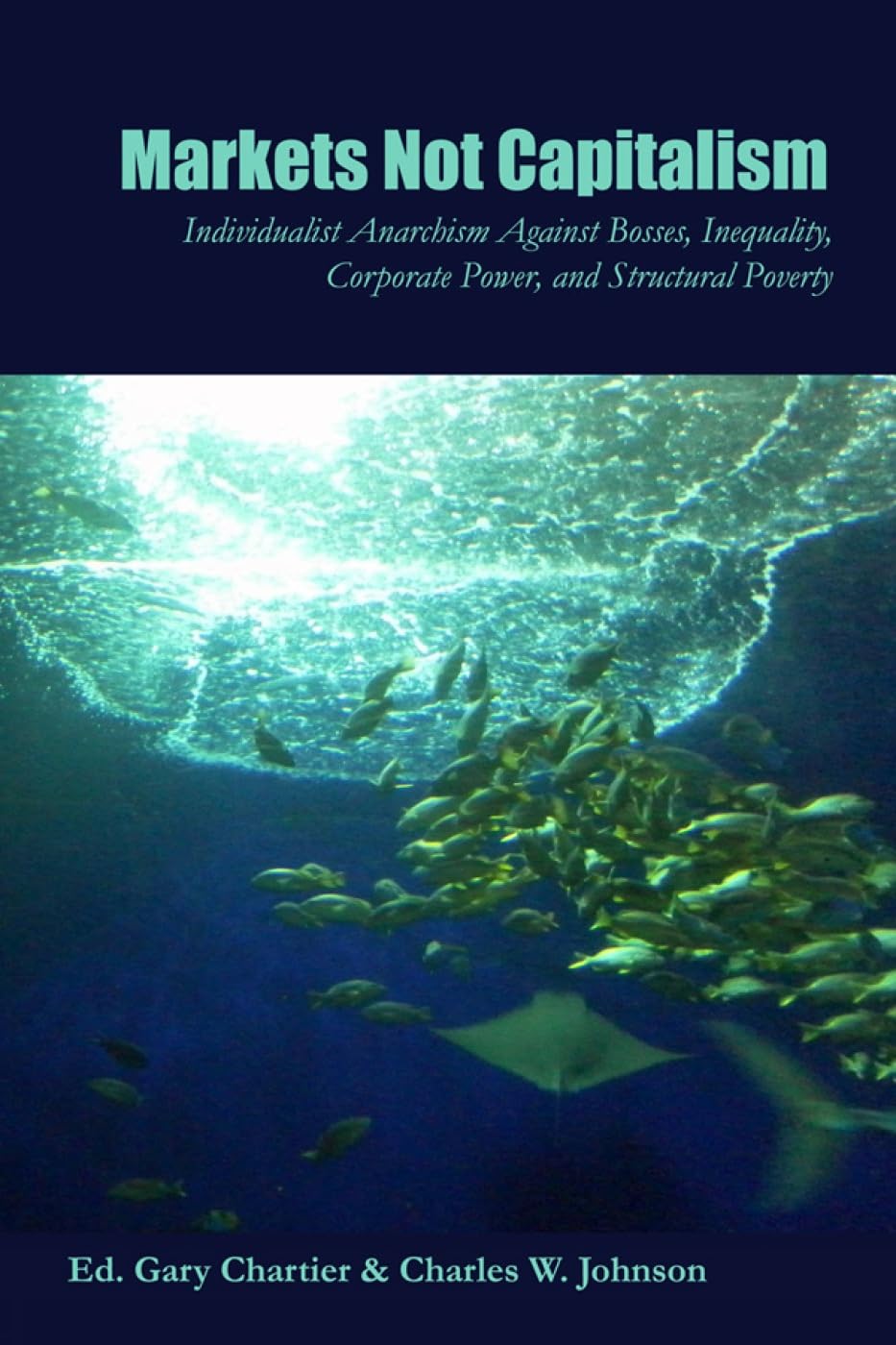
A motel desk on a slow week is a good place to read a long book, and I have just finished one that I should have read years ago. Its title is Markets Not Capitalism, and the subtitle tells you what the editors are about: Individualist Anarchism against Bosses, Inequality, Corporate Power, and Structural Poverty. Gary Chartier and Charles W. Johnson put it together in 2011. It runs to forty-eight pieces by about twenty writers, arranged in eight parts, and it covers a hundred and sixty years, from Proudhon in 1851 to blog posts written while the bank bailouts were still warm. It is dedicated to the memory of Karl Hess, the Goldwater speechwriter who decided in middle age that he had “lost my faith in capitalism” and went off to build community workshops in Washington, D.C. That dedication is the key to the whole thing. This is a book by people who believe in free markets as hard as anybody at Cato or the Mises Institute, and who think the system we live under is not a free market at all and ought not to be defended as one.
I should say at the start that I liked it a great deal, and that I have some quarrels with it, which I will come to. I should also say what sort of book it is, because the editors are honest about this themselves. Most of the contemporary pieces began life as blog posts, and they read like it. The preface admits that many of them “begin in the middle of a dialogue,” and that the commonest opening is some version of “In a recent issue of such-and-such, so-and-so said that . . . .” The editors argue, with some justice, that this is the natural habitat of the tradition. Benjamin Tucker’s best-known book, Instead of a Book, by a Man Too Busy to Write One, was a pile of replies to letters from readers of his paper Liberty. The individualist anarchists have always done their thinking in small papers and quarrels, and never in treatises. So you should not expect a tidy textbook. You get an argument conducted over a century and a half, with the old voices and the new ones answering each other across the decades. Once I stopped wanting it to be something else, I found that the most exciting thing about it.
Part One, “The Problem of Deformed Markets,” opens with a one-page post by William Gillis that I enjoyed more than I expected to. His point is that libertarians should talk about a “freed market” and not a “free market,” because the second phrase suggests we already have one. “You’d be surprised how much of a difference a change of tense can make,” he writes, and he is right. Once you say “freed,” you are no longer on the hook for every rotten thing Goldman Sachs does under the protection of the Treasury. Then comes Tucker’s “State Socialism and Anarchism” from 1888, which is still the best short statement of the whole position. Tucker names four monopolies held up by the government: money, land, the tariff and the patent. Strike those down, he says, and the usurer, the landlord and the protected manufacturer lose the privileges that let them collect income without working for it. He calls the anarchists of his day “simply unterrified Jeffersonian Democrats,” which is as good a description as I have read, and he ends with a long passage from Ernest Lesigne that contrasts the two socialisms line by line. One of them says “The land to the State” and “The tool to the State.” The other says “The land to the cultivator” and “The tool to the laborer.” You can see why a man might want to keep the word socialism after reading that.
The extracts from Proudhon’s General Idea of the Revolution in the Nineteenth Century are harder going, as Proudhon always is. But they contain the program in a sentence: “In place of laws, we will put contracts.” And they contain a line every Republican who ever proposed a public-private partnership should have tattooed on his arm. Writing of the socialist dream of a state bank, Proudhon says: “No, no, I want no State, not even for a servant; I reject government, even direct government.”
The part closes with the longest original essay in the book, Charles Johnson’s “Markets Freed from Capitalism,” and this is where the argument is brought up to date. Johnson’s opening claim is that “the political economy of state capitalism is so deep as to be invisible,” and he spends the rest of the essay making it visible. He brings Tucker’s four monopolies forward and adds new ones: agribusiness, the security industry that lives on war and prison contracts, the infrastructure monopoly of tax-built roads and cartelized transport, the communications monopoly handed out by the FCC, and the jungle of licensing and red tape that keeps the small fry out of every trade. He is especially good on what he calls “captive markets,” where the government makes you buy something. His example is compulsory car insurance, and his summary of it is the best sentence in Part One: “The space of social experimentation contracts, but the cash nexus fattens on what government has killed.” He meets the obvious objection, that government also hands out welfare and small-business loans, with a line I will remember: “even if government is putting its finger on both sides of the scale, one finger is pushing down a lot harder than the other.” And he gives the book its central picture. The economy we have, he says, is modeled on “a commercial strip mall: sanitized, centralized, regimented, officious, and dominated by a few powerful proprietors and their short list of favored partners, to whom everyone else relates as either an employee or a consumer.” A freed market would look more like a bazaar. I run a business on the frontage road beside a strip mall, and I can tell you he has described it exactly.
Here I have to stop and argue, because the first of Tucker’s monopolies is money, and money is the subject on which my regular readers know I am a crank. Tucker puts the money monopoly first in importance. He believed that if anybody could open a bank and issue notes, competition would drive the price of a loan down to the cost of running the bank, which he put at under one percent. “Thus interest will fall at a blow,” he writes, and with interest would go rent and most of profit. Proudhon goes further. His plan for credit ends by proposing “to gradually retire specie from circulation, depriving gold and silver of their privilege as money.” Johnson, writing in 2010, still lists “government-imposed specie requirements” among the ways the state keeps the workingman from cheap credit.
I think this is wrong, and the best refutation of it is in the same book. In Part Four, Roderick Long explains the 2008 crash in standard Austrian terms. “Interest rates are a kind of price also,” he writes; “they signal the extent to which consumers are willing and able to defer present satisfactions for the sake of greater future satisfactions.” When the Federal Reserve pushes rates below what people’s real willingness to save would set, investors build things the economy can’t finish, and the bust follows. That is a theory in which interest is not usury squeezed out by a privileged class. It is the price of time, and it would exist in a society of perfectly equal farmers trading wheat. If Long is right, and I think he is, then a world of free banks would not see interest fall to the cost of bookkeeping. It would see interest settle wherever people’s patience put it. Tucker was writing in the shadow of the labor theory of value, which says a thing is worth what it cost to make. Brad Spangler admits in Part Two that this theory has been replaced by “subjective value theory and the Austrian school generally,” but the book never quite sits down with its first-wave writers and says which of their economics still stands. A newcomer could easily come away believing both Tucker and Long, and they can’t both be right about interest.
On gold I am happy to make the market anarchists an offer. Let anybody issue notes. Let the mutual banks print their labor money and the Proudhonians issue paper against land. I will keep taking gold and silver at my front desk, and in twenty years we will see which notes my night clerk still wants to be paid in. That is a free market in money, and it is all a gold man has ever asked for. The privilege I object to is the one that makes me take the Federal Reserve’s paper at par. On that the editors and I agree completely.
Part Two, “Identities and Isms,” is about words, and some readers will find it the least necessary part of the book. I didn’t, mainly because of Gary Chartier’s “Advocates of Freed Markets Should Oppose Capitalism.” Chartier separates three meanings of capitalism. Capitalism1 is “an economic system that features personal property rights and voluntary exchanges of goods and services.” Capitalism2 is “a symbiotic relationship between big business and government.” Capitalism3 is rule over workplaces and society “by capitalists.” When Ayn Rand defended capitalism she meant the first, and when a man in a Bolivian street shouts against it he means the second and third. Chartier’s point is that most people run all three together, so that a defense of free exchange comes out sounding like a defense of Exxon. Sheldon Richman’s “What Laissez Faire?” backs this with history. Alexander Hamilton complained in Federalist 12 that the states’ tariffs were too low, and the first economic act of the new Congress, on July 4, 1789, was a protective tariff. Richman quotes the historian Robert Lively’s verdict on nineteenth-century American policy: “King Laissez Faire, then, was according to these reports not only dead; the hallowed report of his reign had all been a mistake.” Richman’s own summary is kinder to us than the facts strictly require: “Grass sprouts through the cracks in the sidewalk. A little economic freedom goes a long way.”
The book then takes the argument further than I can follow. Brad Spangler says that Rothbard himself was “a visionary socialist” and ends his post: “We’re socialists. Get over it.” Chartier, in “Socialist Ends, Market Means,” and Tucker, in two short pieces, make the more careful version of the claim. Tucker defines socialism broadly enough to cover anyone who wants to abolish “every privilege whereby the holder of wealth acquires an anti-social power to compel tribute,” and he puts it as plainly as anyone could: “For there are at bottom but two classes,-the Socialists and the Thieves.” As history I accept all this. Tucker was a socialist by the meaning of his day, and the word did not yet belong to Lenin. But I have to sell ideas in a country where most people over fifty think socialism means bread lines, and I doubt that any argument about the 1880s will win that word back. The editors are fighting for ground the twentieth century took from them.
The gem of this part is older than the arguments about labels. It is a dialogue written in 1891 by Rosa Slobodinsky and Voltairine de Cleyre between an individualist and a communist. When the communist sneers at private charity, the individualist answers: “You change the name, but the character of an action is not altered by the number of people participating in it.” De Cleyre’s follow-up, “A Glance at Communism,” imagines the census-taker of the planned economy asking a mother how many balls her boys lose over the neighbors’ fence each year, and finishes with a sentence I intend to steal: “I had rather a few thousand cabbages should rot, even if they happened to be my cabbages.” Karl Hess, in “Anarchism without Hyphens,” offers the peace treaty: anarchism says only that people can be free, and after that “it’s all choice and chance.” Charles Johnson’s “Libertarianism through Thick and Thin” is the most philosophical essay here. He asks whether libertarians, as libertarians, have reason to care about things like poverty, racism and bossy workplaces that involve no force. His answer is yes, for several distinct reasons, and the most persuasive is strategic. A free society in which a few tycoons own nearly everything will not stay free for long, because the tycoons will buy themselves privileges again. “Otherwise we will find ourselves trying to fight with slingshots while our enemies haul out bazookas.” To his credit, Johnson admits that the same form of argument is used by Hoppe’s paleolibertarians to reach the opposite conclusions, and that the fight has to be settled on the particulars.
Part Three, “Ownership,” shows the tradition arguing with itself, and it is the most uneven section. Roderick Long’s “A Plea for Public Property” is excellent. He is not defending government property, which he thinks illegitimate. He is defending property owned by “the unorganized public,” like a path to the lake that a village wore through the brush by walking it every day for years. Nobody owns that path, and anybody who put a toll gate across it would be stealing from all of them. Long takes the three standard arguments for private property, from natural rights, from autonomy and from the tragedy of the commons, and shows that each one also supports some public space. A man evicted from one private lot onto the next, with no public road between, “exist[s] only by the sufferance” of the owners. He also has the funniest passage in the book. Private malls will suit people who value safety and put up with rules (“call them the Little Old Ladies”), while the public places will suit people who want freedom and accept risk (“call them the Gun-Toting Pot-Smoking Nudist Bikers”). His conclusion is sensible: “An all-private system can be oppressive, just as an all-public one can be.” He admits honestly that he has no full answer to how public property could ever be turned back into private.
William Gillis’s “From Whence Do Property Titles Arise?” and Shawn Wilbur’s “The Gift Economy of Property” are for the specialist. Gillis starts from anarcho-communism and gets to private property by way of reputation and goodwill, and he writes in the language of the internet; his first paragraph says that a certain kind of property theory “rightfully bugs the crap out of many anarcho-communists.” Wilbur takes us into Proudhon’s late philosophy of the self, with stops at Leibniz and Deleuze, and confesses: “I have often joked that Derrida’s claims about identity might be reduced to ‘property is theft.'” I read his essay twice and I am still not sure what it would mean for the price of a room. Gary Chartier’s “Fairness and Possession” is much plainer. It grounds property in the Golden Rule, “avoid treating others in ways you wouldn’t be willing to be treated in relevantly similar circumstances,” and works out a set of rules from there. It is honest enough to say you may break into an abandoned mountain cabin to escape an avalanche, so long as you pay for the damage.
The section ends with Long’s “The Libertarian Case against Intellectual Property Rights,” which converted me years ago when I first read it on the internet and reads just as well in print. “You cannot own information without owning other people,” he writes. If you memorize my poem, the copy in your head is yours, and so is the copy you write out with your own pen and ink. His thought experiment about a man in a ravine who can’t build the patented levitation device that would save him from the saber-tooth tigers ends with the best four words in the book: “And so the tigers dine well.” He is not leaving authors to starve, either. He proposes voluntary protection through boycott and private courts, and he tells the story of how Tolkien saw off Ace Books’ unauthorized paperback of The Lord of the Rings by asking his American fans not to buy it. They didn’t, and the Ace edition went out of print.
Part Four, “Corporate Power and Labor Solidarity,” is the heart of the book and the part I would hand to any young libertarian who thinks the job is to defend Walmart. Roderick Long’s “Corporations versus the Market, or Whip Conflation Now” says that “genuine competition is big business’s worst nightmare,” and then lists the ways the state spares big business from it: cartel enforcement through regulation, licensing costs that fall hardest on the newcomer, tax breaks for the favored firm, eminent domain, cheap money for whoever gets the new dollars first. Long then gives the blame for the confusion between free markets and corporate power to three culprits: the left, the right, and libertarians themselves. The libertarians get it for calling big business a “persecuted minority” with Ayn Rand and for rushing to defend every Walmart as a hero of the free market.
Long’s paragraph on Walmart made me put the book down for a while. Taxpayers build the highways, he says, so the chain’s freight costs are partly socialized, and “the low prices we enjoy at Wal-Mart in our capacity as consumers are thus made possible in part by our having already indirectly subsidized Wal-Mart’s operating costs in our capacity as taxpayers.” I agree, and I have to be honest about what follows from it. My own motel sits a quarter-mile from an Interstate exit. Every trucker and every family on vacation who stops with me came down a road the federal government built with fuel taxes. If Long is right about Walmart, he is right about me too, and a freed market would have put my business somewhere else or nowhere. I don’t think that refutes him. I think it shows how deep the thing goes, which is what Johnson said in Part One.
Kevin Carson’s “Economic Calculation in the Corporate Commonwealth” turns Mises’s argument against socialist planning onto the big corporation. Mises assumed the boss could steer a giant firm by reading the books of each division. Carson replies that “Mises’s entrepreneur was a brooding omnipresence, guiding the actions of every employee from CEO to janitor,” and that in real life the people at the top can’t tell real profit from a division that is being milked. His examples include the Home Depot chief executive who walked away with a $210 million severance package, and a hospital chain that laid off nurses to save money while buying a surgical robot for the prestige. Roy Childs’s 1971 essay “Big Business and the Rise of American Statism” summarizes Gabriel Kolko’s history of the Progressive Era, and it is the sort of history every conservative ought to read. The big Chicago meat packers wanted federal inspection to bring their small competitors under control; their spokesman told Congress, “We are now and have always been in favor of the extension of the inspection.” Elbert Gary of U.S. Steel told a congressional committee in 1911, “I believe we must come to enforced publicity and governmental control even as to prices.” Childs’s conclusion is that “it has been and remains big businessmen who are the fountainheads of American statism.” His closing lines are worth putting over any libertarian’s desk: “Our day has not come and gone. It has never existed at all.”
Long’s “Regulation: The Cause, Not the Cure, of the Financial Crisis” I have already praised for its theory of interest. It ends with a sentence that would have saved us a lot of grief in 2008: “Monopoly cannot be ‘reformed’; it has to be abolished.” Dyer Lum’s “Industrial Economics” from 1890 adds the formula “Competition is the exact opposite, not parent of monopoly.”
Then comes Kevin Carson’s “Labor Struggle in a Free Market,” which was the hardest chapter in the book for me to read, because I have employees. Carson argues that the New Deal labor laws were wanted by big industry to tame the unions, and that they worked: “The New Deal labor agenda had the same practical effect as telling the militiamen at Lexington and Concord to come out from behind the rocks, put on bright red uniforms, and march in parade ground formation.” He wants labor to go back to slowdowns, working to rule and what the Wobblies called “open mouth sabotage,” which in the internet age means telling the whole world what goes on behind the kitchen door. My first reaction was the one he predicts, that this is theft of my time. His answer is hard to get around. If the labor contract is a deal between equals, then “The worker has every bit as much of a right to attempt to minimize his effort per dollar of wages as the boss has to attempt to maximize it.” I can’t fault the logic, and I notice that the employers who complain loudest about it are often the ones with a lawyer on retainer and a government that will send in the police. Carson offers the bosses a trade: repeal the Wagner Act and every workplace regulation, and repeal Taft-Hartley and the right-to-work laws too. Tucker’s short piece “Should Labor Be Paid or Not?” puts the individualist goal better than anybody in the book: “Not to abolish wages, but to make every man dependent upon wages and to secure to every man his whole wages is the aim of Anarchistic Socialism.”
Part Five, “Neoliberalism, Privatization, and Redistribution,” deals with a question every libertarian has met on a college campus: if you love free markets, why do you not love the IMF? Kevin Carson’s “Free Market Reforms and the Reduction of Statism” gives the best answer I know. He divides state intervention into the primary kind, which sets up privilege, and the secondary kind, which limits the damage. Corporate “reformers” always propose cutting the second and keeping the first, and libertarians should insist on the opposite order. Carson borrows a phrase from the blogger Jim Henley for it: “remove the shackles before the crutches.” He also borrows Brad Spangler’s picture of state capitalism as a stickup with two robbers, one holding the gun while the other holds the bag. Cut the welfare while you keep the subsidies, and you have merely told the bagman to stop giving the victim his cab fare home. Carson’s example from history is British free trade in the 1840s, adopted once the Royal Navy and a century of mercantilism had already made the world safe for British manufacturers. It is a strong argument, and it ought to make every libertarian look twice at any “free market reform” with a corporate lobby behind it.
Joe Peacott’s “Free Trade is Fair Trade” makes the same point about the WTO and NAFTA, which manage trade and do not free it, and contains a line I have since quoted to two guests: “If democracy, like voting, really changed anything, it would be prohibited.” Charles Johnson’s “Two Words on ‘Privatization'” asks us to stop calling the sale of state monopolies to connected oligarchs “privatization.” He suggests “privateering” for the Blackwater kind, and for the real thing, the handing of state property back to the people who use it, he proposes a phrase meant to make conservatives choke: “socialization of the means of production.” Neighborhood streets to the neighbors, he says; government factories to the workers; “the soil to those who till it.”
The part ends with an exchange from 1969 between Karl Hess and Murray Rothbard, and this is where the book’s radicalism gets serious enough to worry me. Hess says that much property now called private “is stolen” and asks libertarians for specific proposals, including what should happen to General Motors in a liberated society and how to finish the unfinished business of slavery. Rothbard answers with the homestead principle. Property stolen by the state belongs to whoever has been using it without sharing in the crime, so state universities should go to their students, and Tito’s Yugoslavia was right to give its factories to the workers. Then he turns to the defense contractors. A company like General Dynamics, which lives on government contracts, has credentials to private property that are “less than zero,” and Rothbard is willing to have it nationalized on the way to giving it back to the taxpayers. He suggests that any firm getting more than half its revenue from the government should count as public. This is consistent, and I find it hard to argue against in the case of a missile maker. But it leaves a question the book never answers. Where does the line fall for a small man? I took an SBA-guaranteed loan to put a new roof on the motel twelve years ago, and I am not sure what Rothbard’s homesteaders would make of that. To be fair, Rothbard ends with the right principle: “It is justice vs. injustice, innocence vs. criminality that must be our major libertarian focus.” His remarks on the freed slaves, who were denied the plantations they had worked and the reparations they were owed, are the most powerful passage in the part, and they show that libertarian property theory, taken seriously, can say things no Republican would dare to.
Part Six, “Inequality and Social Safety Nets,” asks whether a freed market would keep the rich rich and what would happen to the poor without a welfare state. Jeremy Weiland’s “Let the Free Market Eat the Rich!” argues that great fortunes are expensive to guard and that today the taxpayer pays most of the guarding: the police patrols in rich neighborhoods, the public registry of land titles, the regulators who keep the banks steady, and limited liability for shareholders. Take the state away and the rich man has to pay his own security bill, and watch his own servants. In Weiland’s words, “Having a lot of stuff becomes more trouble than it’s worth.” I find this half persuasive. He is right that the state socializes the cost of protecting large estates. But his leveling force is, when you come down to it, theft. He writes that “it is easier to steal a million dollars worth of cash or property from one location such as a bank or mansion than it is to rob a thousand or so common people.” I have been held up at this desk once, and I would rather the case for equality did not rest on the prospects of the man who did it. The stronger version of the argument is Chartier’s, back in Part Two, that dominance by a few rich men is likely only when force and fraud hold markets back. He calls it “plausible, even if contestable,” and that is the honest description. The book asserts it often and never quite proves it. I believe it, but I would like to see the economic history that shows firms shrinking where privilege was cut, and this anthology is not the place to find it.
Joe Peacott’s “Individualism and Inequality” is a calm and decent piece. He accepts that a free society would have some inequality, because people work different hours and have different talents, and he points out that the communes some anarchists want would have their own inequality, of freedom rather than of money: “in many a collective or commune no one will be poorer than another, but some will certainly be less free.” His “The Poverty of the Welfare State” tells fellow anarchists to stop cheering for government welfare and ends: “We don’t need state welfare, we need state abolition.”
The best piece in the section is the shortest. Roderick Long’s “How Government Solved the Health Care Crisis” was written in 1993, and it describes the fraternal societies that a quarter of adult Americans belonged to as late as 1920. Their “lodge practice” put a doctor on contract to the members, at a cost of a dollar or two a year. “A day’s wage would pay for a year’s worth of medical care.” The medical establishment was outraged that tradesmen should set doctors’ fees. In Britain the state took over health care, and in America the doctors’ societies used their control of licensing to cut the supply of physicians and punish doctors who took lodge contracts. Then the fraternal societies lobbied for minimum rates on themselves and priced themselves out of business. Long’s last line deserves a frame: “Why do we have a crisis in health care costs today? Because government ‘solved’ the last one.”
Part Seven, “Barriers to Entry and Fixed Costs of Living,” shows how the state makes working people desperate by pushing up what they must spend and cutting off the ways they might earn. It opens with Kevin Carson’s “How ‘Intellectual Property’ Impedes Competition,” which is good on the history, and weak where it tries to read the future. The history is that patents built General Electric, Westinghouse and the Bell system, and that a patent lawyer in 1906 called them “the best and most effective means of controlling competition.” Carson is good on the printer sold at cost and the ink cartridge sold at a robber’s markup, and on appliances designed so they can’t be repaired. His rule for any business that needs the law to survive is one I share: “A business model that isn’t profitable without government intervention should fail.” But he also says flatly that “this business model is doomed,” because file-sharing and cheap equipment would make copyright unenforceable, and he quotes a blogger imagining how the big corporations would look to “a future historian in 2015.” It is now 2026. Disney and Pfizer are doing fine, the copyright terms have not shrunk, and the music business learned to rent you songs by the month instead of selling them. Carson underrated how much a determined state can still enforce. The argument against intellectual property doesn’t depend on his prophecy, but a reader in 2026 will notice that the prophecy failed.
Joseph Stromberg’s two essays are the best history in the book. “The American Land Question” shows that the Homestead Act was the exception in our land policy, and that the best land went to speculators and railroads. My favorite line is his dry comment on the buyers of tens of thousands of acres: “large-scale buyers had mixed their money with federal land officers, and that no doubt counts for something.” He gathers colonial administrators from Okinawa to the Cape Colony complaining that natives with land would not work for wages, and setting taxes and laws to fix the problem. “English Enclosures and Soviet Collectivization” should be read by every British reader of this site, since it is about your country. Stromberg treats Parliamentary enclosure as a collectivization of agriculture for the benefit of a narrow class, carried out by commissions of landowners on petitions from landowners. He quotes the Hammonds’ famous description of the result, the labourer “with no corporate rights to defend, no corporate power to invoke, no property to cherish,” and he puts the outcome in a sentence: “in 1500 England had a large peasantry but by 1820 that class had virtually disappeared.” He then sets Stalin’s war on the kulaks beside it as the same anti-peasant method in a different uniform. Stromberg is also honest about why free-market historians have dodged this: “Fear of conceding anything to Marx (who, after all, must occasionally be right).”
Carson’s “Health Care and Radical Monopoly” brings Long’s lodge-practice story up to date. A New York doctor offering a flat-fee practice was told by the state insurance department that he was running an unlicensed insurance company. Dental hygienists can’t open their own cleaning practices, and nurse practitioners have to work under a doctor. Carson’s image for it is grocery insurance gone mad: “we’ve got a regulatory system that outlaws hamburger and compels you to buy porterhouse if you’re going to buy anything at all.” The result, he says, is that “decent, comfortable poverty becomes impossible.”
The section closes with Charles Johnson’s “Scratching By: How Government Creates Poverty as We Know It,” and it is the most moving piece in the collection. He tells the story of Umoja Village, a shantytown that homeless people built on a lot the city of Miami had left empty for years. Their one demand was “leave us alone.” The city cleared them out and put up a fence. He tells of a ninety-three-year-old Indiana man evicted from the van he lived in, under the housing code, after a newspaper ran a friendly story about him. And he describes the New York taxi medallion, which in 2006 had a minimum auction price of $189,000, so that a poor man with a car was forbidden to earn money with it. Here history has run an experiment for us. After this essay was written, medallions went past a million dollars, and then Uber and Lyft arrived and broke the cartel, and the price fell through the floor. Johnson was right that the medallion system was a wall around a trade. But the people who knocked it down were not the bazaar of small hustlers he hoped for. They were two venture-funded corporations that broke the law first and hired lobbyists afterward. The editors could hardly have seen that coming in 2011, but the book has no place for this kind of case, where a cartel is broken by a bigger company and not by the little man, and I expect it will happen more often than the book supposes.
Part Eight, “Freed-Market Regulation: Social Activism and Spontaneous Order,” answers the question every leftist asks a libertarian sooner or later: without the government, who stops the bad guys? Sheldon Richman’s “Regulation Red Herring” says there is no such thing as an unregulated market, only markets regulated by bureaucrats or by competition, and asks the question I have since used on a county commissioner: “Whom would you have to bribe to be exempt from the law of supply and demand?” Charles Johnson’s “We Are Market Forces” adds that the regulating need not be left to the invisible hand alone. Strikes, boycotts, fair-trade labels and mutual aid are all part of a freed market, and his advice to people who want to check corporate power is “don’t lobby-organize!” He ends with “All power to the people!” which I never expected to read in a libertarian book and which I found I didn’t mind.
Long’s “Platonic Productivity” takes on the Austrian claim, made by Walter Block among others, that the wage gap between men and women must reflect a gap in productivity, since otherwise competitors would hire the underpaid women. Long’s reply is that employers seldom know any one worker’s output with precision, that firms survive by being less foolish than their rivals and not by maximizing profit, and that a manager can treat his prejudices as a perk of the job. I think he is right, and his conclusion is the book’s whole attitude in a line: “Such failure is merely our failure. Instead, we need to fight the power-peacefully, but not quietly.”
Sheldon Richman’s two essays on civil rights, “Libertarianism and Anti-Racism” and “Context-Keeping and Community Organizing,” handle the subject that has embarrassed more libertarians than any other, and they handle it well. Richman defends freedom of association, including for the bigot: “Defending the freedom of the virtuous is easy. The test is in defending it for the vicious.” But he points out that the segregated lunch counters of the South were not businesses in a free market. A man who opened an integrated diner across the street would have met the zoning board, the White Citizens’ Council and then the Klan, and, as Richman says, there would have been no need to call the cops, because they were probably there already. And the sit-ins were desegregating lunch counters several years before the Civil Rights Act of 1964. So when someone asks whether whites should have been allowed to keep blacks from their lunch counters, Richman says the libertarian can answer “No,” and that they “should have been stopped-not by the State, which can’t be trusted, but by nonviolent social action on behalf of equality.” He sums it up: “The libertarian answer to bigotry is community organizing.” I would add that the movement Richman praises also had federal courts and federal troops behind it at the decisive moments, and I would have liked him to deal with that. But his is still the best short libertarian treatment of the question I have read.
The environmental pieces are lighter. Mary Ruwart’s chapter from Healing Our World tells how taxpayers paid bounty hunters to shoot hawks and sea lions while private owners at Hawk Mountain and Sea Lion Caves protected them, and how the city of Seattle took over a privately run park of giant Douglas firs in 1911 and had cut them all down by 1925. Charles Johnson’s “The Clean Water Act versus Clean Water” tells of volunteers in Colorado who could stop poisonous runoff from old mines with a few shovels and concrete plugs, but who would become legally liable for the mines forever if they did. His advice is to go up at night with a flashlight, “and some bolt-cutters, if you need them,” since “What they need are some good honest outlaws.” I laughed, and I suspect Johnson would approve of the laugh, but a reader who wants to sell this book to a skeptical neighbor should know that the advice to cut fences is in there.
So what is wrong with the book? Some of it I have said already. The economics of the first-wave writers is mixed in with the Austrian economics of the modern ones without any warning to the reader about where they disagree, and the disagreement over interest is fundamental. The central claim, that freed markets would break up big firms and spread wealth around, is stated in a dozen ways and argued from history and incentives, but it is never shown as fully as its importance requires. Some of the predictions have aged badly. And the blog origins show. The same points come round again and again: Johnson’s strip mall and bazaar appear in two essays almost word for word, Walmart turns up in half a dozen, and the phrase “vulgar libertarianism” gets worked very hard. Some of the posts are aimed at quarrels of 2008 that nobody remembers, and a few of them spend more energy on Mises.org and Cato than on the state. A good editor could have cut fifty pages without losing an argument. Finally, the book is more willing to confiscate than it is to say who will decide what gets confiscated. Hess asked for specifics in 1969, and the book is still short of them.
None of this changes my verdict. Markets Not Capitalism is the most useful libertarian anthology I have read, because it makes a case that almost nobody in our politics wants made. The system we live under is not a free market that needs taming. It is a privileged market that needs freeing, and the people who profit from the privilege are mostly the ones who wear Adam Smith neckties and praise free enterprise in their speeches. Libertarians who have spent their lives defending big business against the regulators will find in this book that the big businessmen wrote most of the regulations. Leftists who think the trouble is the market will find a tradition that hates the bosses as much as they do and has a better idea of how to get rid of them. And readers in Britain will find, in Stromberg’s chapter, that the story of how England lost its peasantry is the same story from the other side of the Atlantic.
Freight is picking up ahead of the holidays, and the lot was full last night for the first time in a month. One of my regulars, an owner-operator with his own rig, saw the book on the counter and asked what it was. I told him it was a book by anarchists who say the free market would be the end of the big companies. He thought about that and said that every rule the government ever wrote for truckers made it easier for the big fleets and harder for him. I told him he should write for the book. He said he was too busy, and I told him that was the tradition.
Discover more from The Libertarian Alliance
Subscribe to get the latest posts sent to your email.
Related posts:
 The Fiction of the U.S. Treasury Market
 The Return of Honest Money: Why the Great Bull Market in Gold and Silver Has Barely Begun
 Bond Market Crash: The Scenarios Investors Need To Know Now
 Free Trade and the Foundations of Liberty: Another Response to Duncan Whitmore
 Free Trade, Protection, and an Occupation Government: Whitmore v. Mercadente on the Foundations of Liberty
 Tax the Rich, Free the Middle Class
 The Insoluble Debate on Fractional Reserves
 Libertarian Delusions and the Machinery of Empire: Welfare as Alibi, Not Engine
 The Business Case for the Euro is Falling Apart
 Oil Price Shock and Inflation
 Distributivism: Property, Liberty, and the Common Good
 The AI Recession We Have Been Waiting For
Powered by YARPP.