
Every few months a letter arrives from my energy supplier to explain, in the bright and slightly infantile tone that companies now reserve for bad news, that the price of keeping warm has changed. I cannot remember being told that it has changed downwards. I have learned to read these letters as a medieval villein might have read a notice from the bishop’s reeve, not for information, which is never given, but for some hint of what new obligation has been discovered on my part. I think I now know what the next one will say. If the Government has its way, I may one day be told that I am paying more for my electricity than my neighbour because a computer in Whitehall has looked at my tax records and concluded that I can afford it.
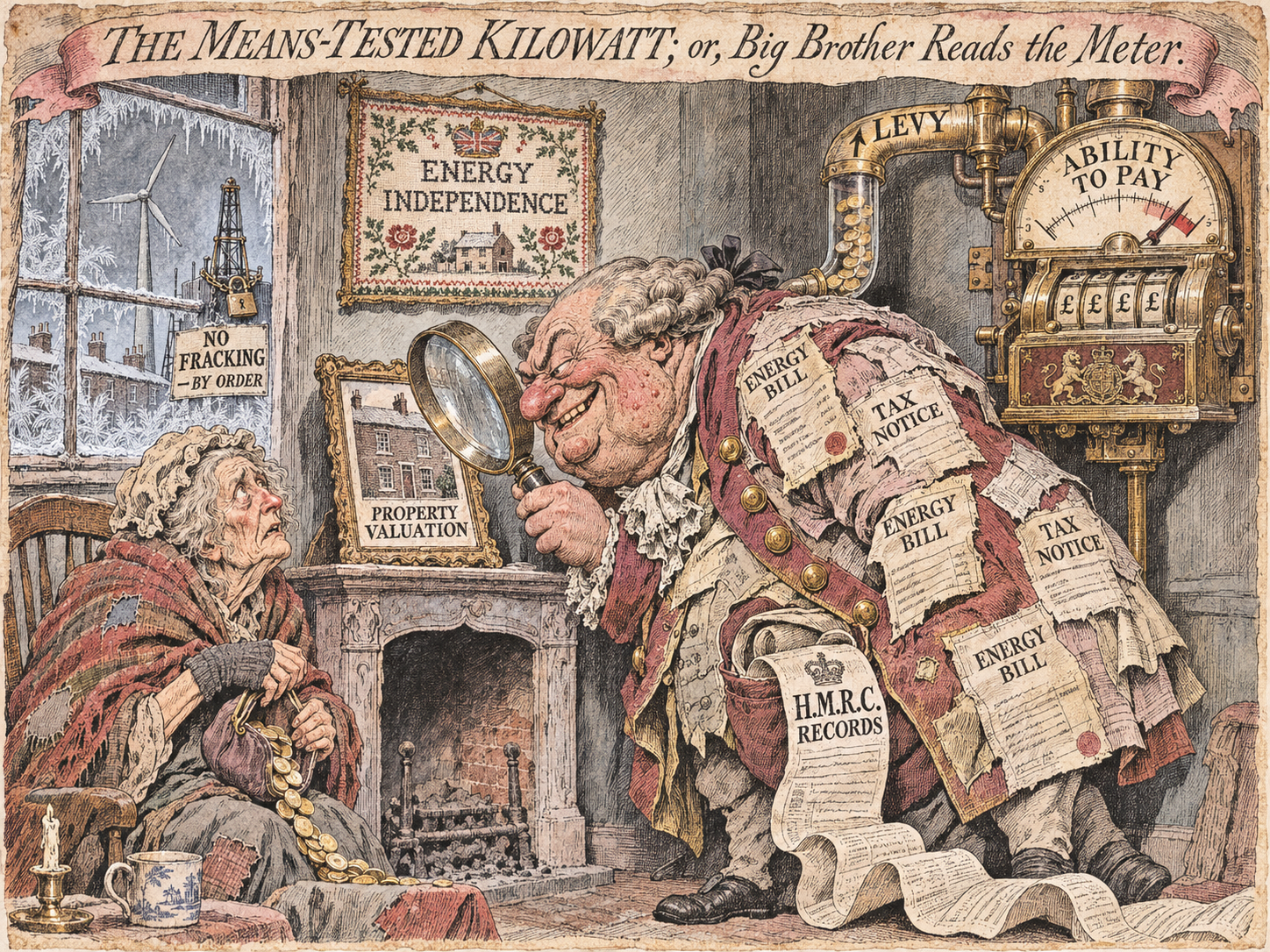
This is the effect of what look like two modest provisions in the Energy Independence Bill, laid before Parliament at the start of this month. The first amends sections 36 and 37 of the Digital Economy Act 2017, which already allow official data to be shared with energy suppliers for the relief of fuel poverty. In the Department’s own words, the amendment “broadens the legal gateway for data sharing beyond fuel poverty”. Information may now be shared to help households with “wider energy challenges”, and may go not only to suppliers but to network operators and other bodies involved in designing or delivering future schemes. Ministers have reportedly identified eight official databases that might be opened in this way, among them HMRC income tax and child benefit records, property valuations, and benefit and pension records. The second provision gives the Secretary of State power to create and amend schemes of bill support by regulation, with what are called “flexible funding arrangements” to let suppliers recover the cost. The impact assessment is unusually candid about whose pocket that means. “Progressivity is a key principle for any targeted energy bills support scheme,” it says, and the result would be “a transfer from primarily high-income households to low-income households”.
The Opposition has denounced all this as the work of a big brother state. The Department calls the criticism “misleading”, insists that none of the safeguards in the 2017 Act is being altered, and reminds us that misuse of the data is a criminal offence. On the narrow question I am inclined to believe the Department. I doubt that anyone at a call centre in Solihull will be leafing through my tax return over his lunch. What is more likely is a process of automated matching, in which the supplier sends a list of account numbers, the Government sends back a list of flags, and no human being is troubled by the sight of another human being. But this is a very thin defence. The objection was never that some junior employee might pry. It is that the Government intends to turn the price of a necessity into an instrument of taxation, and needs the data because a price cannot be graduated by income unless somebody knows the income.
Consider what is being built. A tax is a compulsory payment, fixed by the State, taken from some people so that the money can be spent on others. That is an exact description of what the impact assessment proposes. Yet it will not be called a tax. It will not appear among the receipts in the Budget, and no Chancellor will have to stand at the despatch box and defend the rate. It will be collected by private companies, shown on the bill as part of the price of gas and electricity, and spent through schemes devised by ministerial regulation long after the Bill itself has passed. Parliament will have voted for the power and never for the amount. It is taxation with every feature of a tax except the accountability.
None of this is wholly new, and that is the most damning thing about it. The Warm Home Discount, introduced by the Coalition in 2011, has always been paid for by a levy on everyone else’s bills. For years the bill has also carried the cost of the renewables subsidies, which is why so much of what we pay for electricity has had nothing to do with generating it. The Government now boasts that the Bill will remove “around £90 a year of costs on average from household bills”, and its own factsheets explain that the Renewables Obligation is to be moved to the Exchequer. In other words, the Department has accepted that a subsidy paid through energy bills ought really to be paid through general taxation, where it can be seen and argued about. Having made that admission with one hand, it is using the other to build a new and larger levy of exactly the same kind, with the added refinement that this one will charge different customers different amounts according to what the State knows about them.
It is worth asking why a scheme of this kind should be thought necessary at all. Energy is expensive in Britain partly because of world gas prices, which no government controls. It is also expensive because of choices that governments have made, and continue to make. We price electricity from the most expensive gas plant on the system, then add carbon charges to that plant. We pay for wind and solar capacity and for the grid connections they need, and for the gas-fired power stations that must stand by to cover their intermittency. And we decline to produce our own gas. The same Bill that is called Energy Independence ends new licensing for oil and gas exploration and bans fracking outright. A country that forbids itself to look for energy under its own fields is not pursuing independence in any sense that a dictionary would recognise. It is pursuing dependence on foreign suppliers, together with a set of policies that guarantee high prices, and it then discovers, with every appearance of surprise, that poorer households cannot pay them.
This is where the redistribution comes in. Its function is less to help the poor than to protect the policy. If high prices fell on everyone alike, the political pressure to reconsider their causes would become irresistible. If they are softened for those most likely to complain, and the cost loaded onto those least likely to be pitied, the policy survives. The middling household becomes the shock absorber of Net Zero. It pays once through the levies that raise the price, and again through the surcharge that relieves others of the price, and is told on both occasions that it is behaving responsibly.
Who, in any case, are “those most able to pay”? The phrase belongs to the vocabulary of income tax, where it has at least the merit of referring to income. Here the State proposes to use property valuations as well. The widow who bought her house in the south of England in 1978, and now finds it valued at a figure that would have bought half her street when she moved in, is rich on paper and lives on a pension. She will do very well out of any scheme that uses wealth as a proxy for ability to pay, provided she does not mind being cold. The use of child benefit records is equally instructive. The State already claws child benefit back from families above a certain income, so that a parent who earns a little more each year can find much of the increase confiscated. Add a surcharge on the gas bill that rises with income, and you have created yet another hidden marginal rate on the people whom every party claims to want to work harder. Nobody will ever see the combined figure, because no single department will ever have to publish it.
There is also an economic point that ought to trouble anyone who still believes that prices mean something. A price tells buyers what a thing costs to provide, and tells them to use less of it when it is scarce. A price that varies with the buyer’s tax return tells nobody anything about the cost of energy. It tells you only how the State has classified you. The means-tested kilowatt is a ration book with better software.
And it will not stop where it begins. We are told that data will be shared “on a case-by-case basis, depending on the design of future schemes”, and that the measure “provides the Government with a wider range of options” for future crises. I do not need to speculate about how such powers grow, because the Bill itself is the evidence. In 2017 Parliament opened a data gateway for one purpose, the relief of fuel poverty. Nine years later the purpose is being widened to whatever ministers decide by regulation counts as an energy challenge, and the recipients are being widened to bodies not yet named. There is no reason to think that the next amendment will be more restrained than this one.
The strongest argument on the other side deserves a fair hearing, because it is a good one. When prices rose sharply in 2022, the Government subsidised every household’s energy, at a cost of many billions, and a large share of that money went to people who had no need of it. If help is going to be given, it is less wasteful to give it to those who need it than to everyone, and targeting requires information. I accept the premise. I do not accept the conclusion. The State already has a machinery for identifying people in need and giving them money. It is called the benefits system. If ministers believe that some households need help with their bills, they can pay it through Universal Credit and pension credit, vote the money in Parliament, and raise it through taxes that appear in the public accounts. The reason they would rather not is obvious. Spending of that kind would count as spending. It would have to be found, and defended against every other claim on the Treasury. A levy on bills avoids all of that. The choice of method is not an administrative convenience. It is the point.
The End Fuel Poverty Coalition, to its partial credit, dislikes the levy too. Its co-ordinator says that “asking households to pay for support for other households should be the last resort, not the first”, and suggests that the energy companies should bear the cost themselves. This is a pleasing thought, and a confused one. Energy companies do not pay for anything. What they are made to pay comes back from their customers through prices, or from their shareholders through the investment they decide not to make. Nor do I have much patience with the Conservative front bench and its talk of “class warfare”. It was the Coalition that created the Warm Home Discount, and Theresa May’s government that wrote the net zero target into law in 2019. The present Government is following a road the Conservatives built and surveyed, and has merely decided to put up more tollbooths.
What should happen instead is not complicated, though it would require a government willing to give up power rather than collect it. Take every policy levy off energy bills and put whatever survives scrutiny into general taxation, where it can be voted on. Let Britain produce its own gas. If some households still need help, help them openly through the benefits system, and leave energy companies to do the one thing they exist for, which is to sell energy. My supplier needs to know where I live and how much electricity I use. It has no business knowing what I earn or what my house is worth, and the State has no business telling it.
I await the next letter with interest. I expect it will be as cheerful as the others. Somewhere in the second paragraph, I imagine, it will say that my tariff has been “adjusted to reflect my circumstances”, and I shall know exactly what that means. It will mean that my circumstances are now the Government’s business, and that the Government has decided I can be made to pay for its mistakes.
Discover more from The Libertarian Alliance
Subscribe to get the latest posts sent to your email.


