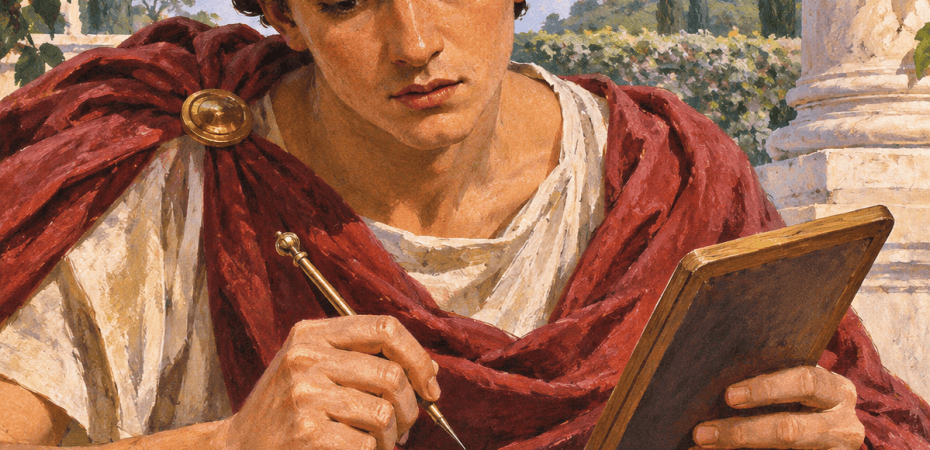
Valerii Catulli Carmina, recognovit brevique adnotatione critica instruxit R.A.B. Mynors
Oxford Classical Texts. Oxford: Clarendon Press, 1958; reprinted 1960, 1967, 1972 and 1976, ISBN 9780198146049
 Among my birthday presents this year was a small blue book, bought secondhand, whose title page, preface and notes are entirely in Latin. Whoever chose it knew me well enough to be sure I would not mistake it for an insult, and well enough, I now realise, to suspect that I needed it. It was the Oxford Classical Text of Catullus, edited by Sir Roger Mynors and first published in 1958. Most people would find nothing to look at in it. There is no introduction for the general reader, no translation and no commentary. There is the text, and beneath the text, in small type, a band of abbreviations and Latin notes recording what the manuscripts say, where they disagree, and which scholar of the past six hundred years first had the wit to see what Catullus must really have written. It is the most austere kind of book that classical scholarship produces, and I have come to think it the right way to meet a poet for the first time.
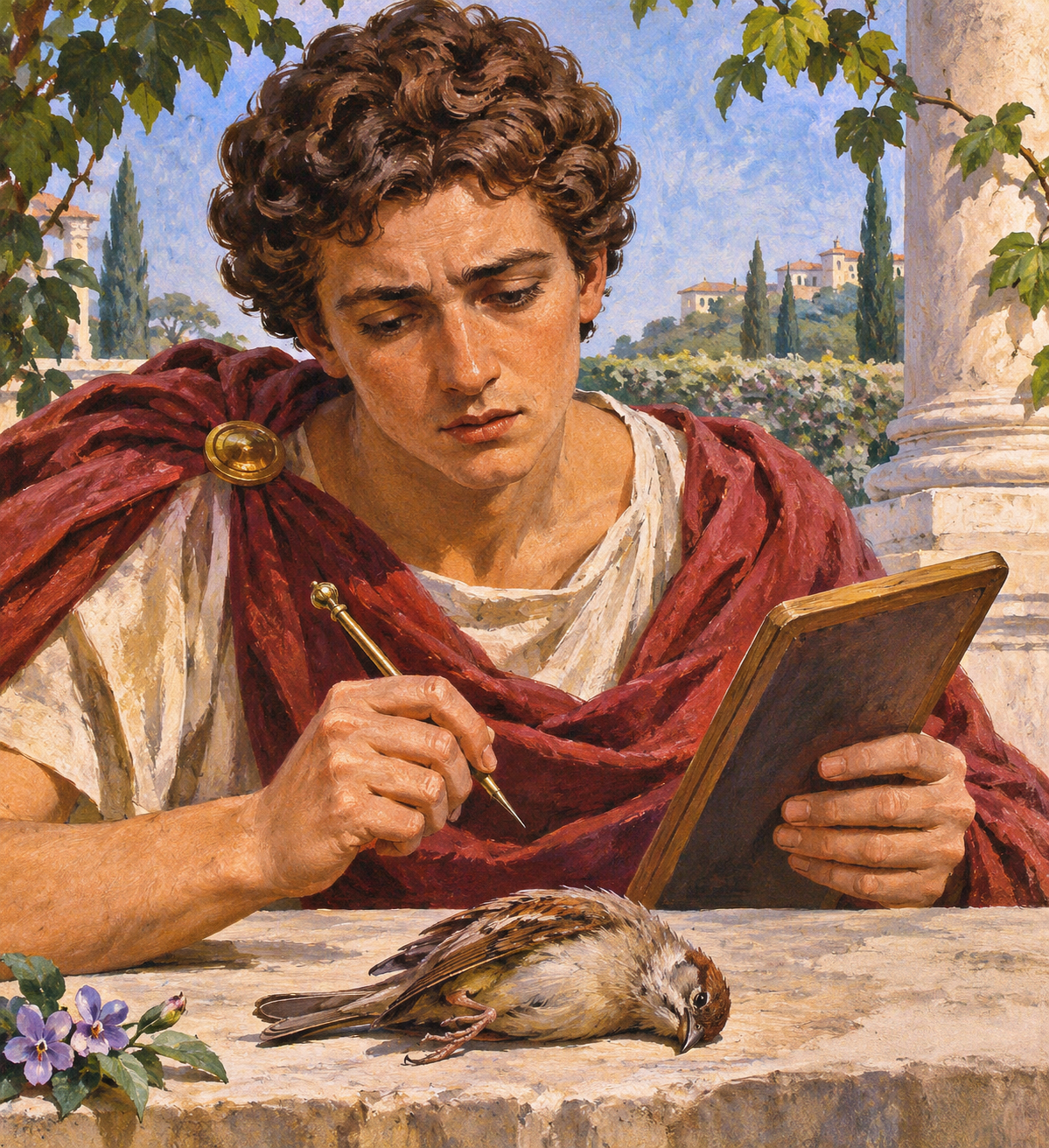
I should explain my state of mind when I unwrapped it. I have given a great deal of my life to Greek, and I have always regarded most Latin poetry as a series of respectful copies. The Romans conquered Greece and then spent several centuries trying to write as well as the people they had conquered. Virgil succeeded. Lucretius succeeded in his own rough and peculiar way. The rest seemed to me the work of clever men translating their betters. Horace is a polished imitation of the Lesbian poets, without the heat. Ovid is a brilliant entertainer, and I do not doubt that he knew it. As for Catullus, I knew him as the author of two poems about a sparrow belonging to his girlfriend: the first in which he envies the bird its place in her lap, the second in which the bird has died and her eyes are red with weeping. Having read these in a school anthology, I filed Catullus under the heading of mannered silliness and gave him no further thought. A grown man writing a dirge for his mistress’s pet seemed to me about as serious as a greetings card.
But the book was in my hands, and it would have been ungracious not to open it. I am only ungracious about presents when they come with Stephen Fry’s name on the cover.
The Dedication
The first poem is the dedication of the whole collection. Here it is as Mynors prints it:
Cui dono lepidum nouum libellum
arida modo pumice expolitum?
Corneli, tibi: namque tu solebas
meas esse aliquid putare nugas
iam tum, cum ausus es unus Italorum
omne aeuum tribus explicare cartis
doctis, Iuppiter, et laboriosis.
quare habe tibi quidquid hoc libelli
qualecumque; quod, <o> patrona uirgo,
plus uno maneat perenne saeclo.
In my own plain English:
To whom shall I give this charming new little book, just now polished smooth with dry pumice? To you, Cornelius: for you were always one to think my bits of nonsense worth something, back in the days when you alone of Italians dared to unroll the whole of time in three volumes—learned volumes, by Jupiter, and very hard work. So take this little book, whatever it is and whatever it is worth; and, O maiden my patron, may it last beyond a single age.
The man addressed is Cornelius Nepos, an older writer who, like Catullus, came to Rome from Italy north of the Po, and who had compiled a universal history in three books. Notice already what the edition gives me that a school anthology does not. The angle brackets around o in the ninth line tell me that the word is not in the manuscripts at all: it has been supplied by an editor because the line will not scan without it. The notes at the foot of the page tell me that the manuscripts read arido, masculine, in the second line, and that the Italian humanists corrected this to arida on the authority of Servius, who remarked in his commentary on Virgil that Catullus made pumex feminine. The notes also record that Pliny the Elder, who was himself from that part of Italy, quoted the third and fourth lines in the preface to his Natural History and called Catullus his fellow countryman. Within ten lines I was being shown the poem and also the long labour by which it has been kept alive. I will come back to that labour.
The poem itself is a small masterpiece of social comedy. Catullus calls his book lepidus, charming, and nouus, new, and libellus, which is a diminutive, a little book. He calls his poems nugae, trifles. He then describes Nepos’s history in language that ought to be praise: it is learned, it is laborious, it covers all of time. But the oath Iuppiter falls into the middle of the praise like a raised eyebrow. Julia Gaisser, in the Blackwell introduction that I read alongside Mynors, asks whether Catullus is admiring Nepos or teasing him (Catullus, Blackwell, 2009, pp. 22–3). I think he is doing both, and that the double effect is the point. The Alexandrian poets whom Catullus admired despised long books; Callimachus is supposed to have said that a big book is a big evil. Here is a young poet with a slim volume of polished trifles dedicating it to an older man who has written three fat volumes about everything that has ever happened. He means the dedication. He also means you to smile at the contrast. The final prayer to the Muse, that the little book should outlast a single age, is half a joke against his own modesty. It has turned out to be a very modest request. The book has lasted for more than twenty centuries, though only just.
The Metre
What caught me first was the sound. The poem is in what is called the phalaecean hendecasyllable, an eleven-syllable line named after Phalaecus, a Hellenistic Greek poet who used it heavily, though it is found in Greek lyric from much earlier. Its pattern is this:
× × – ˘ ˘ – ˘ – ˘ – ×
Here – is a long syllable, ˘ a short one, and × a syllable that may be either. Catullus normally opens with two longs, a spondee, though he sometimes allows an iamb (˘ –) or a trochee (– ˘). The traditional analysis breaks the line into a spondee, a dactyl and three trochees. The first line of the dedication scans:
– – – ˘ ˘ – ˘ – ˘ – –
Cui dō nō lĕ pĭ dūm nŏ vūm lĭ bēl lūm
In Greek the metre is light and cheerful. It trips along. Greek in the classical period had an accent of pitch rather than stress, and this seems to have had little effect on the rhythm of verse, which was carried by the pattern of longs and shorts alone. Latin is different. A Latin word carries a stress, which falls on the next to last syllable if that syllable is long, and otherwise on the one before it. Latin verse therefore has two patterns working at the same time. There is the quantitative pattern borrowed from the Greeks, which an educated Roman ear could hear plainly enough. There is also the pattern of stresses that the words carry in ordinary speech. The Romans, so far as we can tell, recited their verse with the ordinary stresses, while taking care to sound the longs and shorts; and a good poet arranged his words so that the two patterns made a satisfying effect together.
Mark the stresses on that first line and you get:
cúi dóno lépidum nóuum libéllum
In the first half of the line the stresses fall on syllables that the metre treats as short—lé of lépidum, nó of nóuum—and fight against the quantitative pattern. At the end of the line they fall back into agreement with it, because the long tenth syllable is almost always the stressed penultimate of the last word: libéllum, puéllae, amóres. Every line therefore has a small stumble followed by a firm landing. The Greek original skips; the Latin version bounces. And because the end of every line lands with such certainty, the last word is a natural place for a sting. Catullus learnt this very quickly. When he wanted to hurt Julius Caesar, he wrote:
Pulcre conuenit improbis cinaedis,
Mamurrae pathicoque Caesarique.
Which is to say: “They make a lovely match, these shameless sodomites, the catamite Mamurra and Caesar.” In the first of those lines, unusually, nearly every stress coincides with a long syllable—púlcre cónuenit ímprobis cinaédis—so that the line does not bounce at all. It marches. Then, in the second line, the name of the most powerful man in Rome arrives at the end with a cheap little -que attached to it, like a tin can tied to the tail of a dog. Suetonius tells us that Caesar did not conceal his belief that these verses had branded him permanently. He also tells us that, when Catullus apologised, Caesar asked him to dinner that same day. I find it hard to decide which of them comes better out of the story.
So the dedication left me more hopeful than I had expected to be. Here was a poet who knew exactly what he was doing with his language, and who had found in a borrowed Greek metre something that the Greeks had not put there.
What Followed
Nothing in the dedication prepared me for what followed. I read the poems one after the other, and kept reading, in a state that I can only describe as helpless admiration. I do not say this often. I am not much given to helpless admiration of anything I did not do myself.
The sparrow poems, read in their place and in the original, turned out to be nothing like the drawing-room verses I remembered from skimming that school anthology. The second of them is a parody of a funeral lament, swollen with diminutives—miselle passer, turgiduli ocelli, poor little sparrow, swollen little eyes—and it sends the dead bird down the dark road to the underworld from which, as the poet solemnly assures us, no one returns. It is a joke, and it is also an exact observation of how a person can be ridiculous and genuinely grieved at once. Then comes the poem that begins Viuamus, mea Lesbia, atque amemus, which tells the gossiping old men of Rome that their opinions are worth a single copper, and demands kisses by the thousand and the hundred until no one can count them. A few pages later Catullus is lecturing himself in the third person to stop being a fool and let the woman go, in a metre deliberately made to limp. There are poems of friendship and poems of filth, poems of greeting and poems of hatred so naked that I was briefly embarrassed to be reading them in company. Some of these I will mention later. For the present I will simply set down my conclusion. I had never seen Latin used like this. In their originality, in the perfection of their form and in their psychological intensity, these poems outclass the Greek poets who inspired them. They outclass anything I have read in any other language I can read.
That is an extravagant thing to say, and I will try to justify it. The best way is to take one poem and look at it closely.
Poem VII: How Many Kisses?
I have chosen the seventh poem. It is not the most intense of the poems, nor the most shockingly beautiful. Those distinctions belong elsewhere in the book. But it seems to me the most typical of the best poems, in that nearly everything Catullus can do is visible in it at once. Here it is as Mynors prints it:
Quaeris, quot mihi basiationes
tuae, Lesbia, sint satis superque.
quam magnus numerus Libyssae harenae
lasarpiciferis iacet Cyrenis
oraclum Iouis inter aestuosi
et Batti ueteris sacrum sepulcrum;
aut quam sidera multa, cum tacet nox,
furtiuos hominum uident amores:
tam te basia multa basiare
uesano satis et super Catullo est,
quae nec pernumerare curiosi
possint nec mala fascinare lingua.
My own rough version:
You ask, Lesbia, how many kissifications of yours would be enough for me, and more than enough. As great as the number of the Libyan sands that lie at silphium-bearing Cyrene, between the oracle of sweltering Jupiter and the sacred tomb of old Battus; or as many as the stars that, when the night is silent, watch the stolen loves of men: to kiss you so many kisses is enough, and more than enough, for mad Catullus—so many that busybodies could not count them all, nor an evil tongue put a spell on them.
The Two Patterns
Following the method I have described, here is the poem with its quantities above each line and the spoken stresses marked on the words:
– – – ˘ ˘ – ˘ – ˘ – –
quaéris quót mihi básiatiónes˘ – – ˘ ˘ – ˘ – ˘ – ˘
túae, Lésbia, sínt sátis supérque.– – – ˘ ˘ – ˘ – ˘ – –
quám mágnus númerus Libýss(ae) harénae– – – ˘ ˘ – ˘ – ˘ – –
lasarpicíferis iácet Cyrénis– – – ˘ ˘ – ˘ – ˘ – –
oráclum Ióuis ínter aestuósi– – – ˘ ˘ – ˘ – ˘ – –
et Bátti uéteris sácrum sepúlcrum;– – – ˘ ˘ – ˘ – ˘ – –
aut quám sídera múlta, cum tácet nóx,– – – ˘ ˘ – ˘ – ˘ – –
furtíuos hóminum uídent amóres:– – – ˘ ˘ – ˘ – ˘ – ˘
tam té básia múlta basiáre– – – ˘ ˘ – ˘ – ˘ – –
uesáno sátis et súper Catúll(o) est,– – – ˘ ˘ – ˘ – ˘ – –
quae néc pernumeráre curiósi– – – ˘ ˘ – ˘ – ˘ – ˘
póssint néc mala fascináre língua.
Two things stand out once the poem is set out in this way. The first is that every line opens with a spondee except the second, which opens with an iamb: tŭae. The one irregularity in the poem falls on the word “your”, in the line that names Lesbia. I would not build much on this, but I notice it, and I suspect Catullus did.
The second is more striking. In eleven of the twelve lines the stress at the end falls on the long tenth syllable, exactly as it should: -iónes, supérque, harénae, Cyrénis and so on down the page. The exception is the seventh line. Cum tácet nóx puts the stress on the short ninth syllable and then ends on a monosyllable, which takes a stress of its own. For one line only, the firm landing that the ear has been led to expect does not come. The rhythm stops short, on a single heavy syllable. And this is the line that says the night is silent.
You can test whether this is design or accident by rewriting the line. Suppose Catullus had written aut quam sidera multa nocte muta, “or as many stars in the silent night”. It scans perfectly. It means much the same. The stresses fall where they ought—nócte múta—and the line lands as smoothly as every other line in the poem. It is also dead. What makes the real line work is that the hush is enacted in the rhythm before it is understood from the words.
Imagery Old and New
The comparisons themselves are not original. Sand and stars as images of what cannot be counted are older than Greek literature. Gaisser notes, following Fordyce’s commentary, that they appear together in Genesis, where God promises to multiply the seed of Abraham as the stars of heaven and the sand of the seashore (Gaisser, pp. 111–12). Homer’s Achilles uses sand and dust in the ninth book of the Iliad to describe the gifts that would not move him even if Agamemnon gave him as many as there are grains. In the hands of a lesser poet, a man asked how many kisses he wants who answers “as many as the sands of the desert and the stars of the sky” would be talking in clichés, and could expect to be laughed at.
Catullus avoids this by being absurdly specific. His sand is Libyan sand, and it lies at a particular place, Cyrene, which is defined by an epithet so long that it fills more than half the line: lasarpiciferis, silphium-bearing. Silphium, the Latin lasarpicium, was the famous plant of Cyrene, a resin used in cooking and medicine and valuable enough to be put on the city’s coins. The sand is then fenced in between two landmarks. On one side is the oracle of Jupiter Ammon in the desert, and on the other the tomb of Battus, the legendary founder of Cyrene. Gaisser points out the learned joke here. Battus was the supposed ancestor of Callimachus, who called himself Battiades, the son of Battus, and was the poet Catullus and his friends most admired. So the answer to a lover’s question has turned into a piece of Alexandrian geography, with a nod to the great Alexandrian himself. And Jupiter is aestuosus, sweltering. The desert is hot, of course, but Jupiter was also notorious for his passions, and the word carries both senses.
The two landmarks are in reality several hundred miles of desert apart. The sand that Catullus measures is not a beach. It is half of Libya.
Word Order and the Locative
The word order is a game in itself. Look at the fifth and sixth lines. The two landmarks, oraclum and sepulcrum, are the first word of the one line and the last word of the other, so that the stretch of desert between them is laid out across two whole lines. And in the middle of this, the preposition inter, “between”, is itself placed between Iouis and its adjective aestuosi. The word order acts out the meaning: the word for “between” is itself wedged between two other words.
Then there is Cyrenis. Cyrene is a plural name in Latin, Cyrenae, and Cyrenis is its locative: “at Cyrene”, with no preposition. This is perfectly regular for the name of a town. What is not quite regular is to load a locative with an epithet. The ordinary practice, when the name of a town acquires an adjective, is to reach for in with the ablative. Catullus instead hangs a six-syllable compound on his locative, a word with the grand sound of old Roman epic about it, the kind of word that Ennius might have coined for a battle. It is used here to describe a vegetable. Then he puts the verb iacet, “lies”, between the adjective and the noun. Sand lies, naturally. But iacet is also the verb used of the dead lying in their tombs, and the next line ends with sepulcrum. I do not want to press this too hard, but I think the shadow is there, and that it prepares for what follows.
Lesbia’s Word and Catullus’s Word
The poem is built as a ring. The first two lines report Lesbia’s question; the ninth and tenth lines give Catullus’s answer in almost the same words, satis superque returning as satis et super. But the ring does not quite close. Gaisser notices that the word for kisses changes. In the first line Lesbia asks about basiationes, which seems to be a coinage of Catullus’s own, a pompous abstract noun that fills the last six syllables of the line as though it were a legal term. I have translated it “kissifications”, which is the best I can do. In the ninth line Catullus answers with basia, which was a word of ordinary speech and was making its first appearance in literary Latin in these poems. In the first line he says “for me”; in the tenth he says “for mad Catullus”, uesano Catullo, which sounds very like what Lesbia might have called him when she asked. He is quoting her back to herself. The poem is half a conversation in bed.
Listen also to the ninth line: tam te basia multa basiare. The noun and the verb are formed from the same root, so that the kisses are kissed. Read it aloud and your lips close on m, on b, on m and on b again. It is a line that cannot be spoken without performing what it describes.
The False Ending
The poem could stop at the tenth line, and would be a neat and satisfying epigram if it did. Instead it goes on, and the last two lines bring us down from the desert and the stars to the streets of Rome. The kisses must be too many for the curiosi, the busybodies, to count, and too many for an evil tongue to bewitch. The Romans took the evil eye seriously. To know the exact number of a man’s blessings was to have power over them, and the gossips of the city, like the strict old men of the fifth poem, are imagined as hostile magicians. Fascinare means to cast the evil eye; it is the source of our word “fascinate”. So the stars, which watch stolen loves in silence and say nothing, are set against the neighbours, who watch and talk. And furtiuos, “stolen”, tells us what the busybodies would be talking about. If Lesbia was the Clodia whom most scholars think she was, she was another man’s wife.
A Joke, or the Greatest of Love Lyrics?
I have read this poem perhaps thirty times now, and I still cannot say whether it is an elaborate joke or one of the greatest love lyrics ever written. Taken one way, it is a performance. A woman asks her lover, teasingly, how much is enough, and he answers with a geography lesson, a learned reference to Callimachus, a solemn compound adjective about a medicinal plant and a joke about Jupiter’s appetites. He is showing off, and showing off to someone who could appreciate the showing off, since nothing in the poem works for a reader who has not read the Alexandrians. Taken another way, the seventh line is as beautiful as anything I know, and the ending is genuinely frightened. The lovers are surrounded by people who would harm them if they could, and all the learning in the world is a defence put up against those people.
I have come to suspect that the question is the wrong one. The joke and the love poem are the same poem. People who are in love are usually ridiculous, and know it, and do not stop. What Catullus has done is to write the kind of thing that a very clever young man would actually say in bed to a very clever woman, and to make it perfect. I cannot think of a Greek poem that does this. I cannot think of an English one either.
The Life
Appreciation of individual poems is no substitute for a proper account of a man I now have to accept as one of the greatest poets in any language I know. So I must say something about his life and times, and I must say at once how little that is.
The ancient evidence fits on a postcard. St Jerome, writing in the fourth century and probably drawing on a lost work of Suetonius, records under the year 87 BC that Gaius Valerius Catullus, the lyric poet, was born at Verona, and under 58 BC that he died at Rome in his thirtieth year. The dates cannot both be right, because the poems mention events of 55 and 54 BC, including a speech by his friend Calvus that was delivered in August 54. Scholars usually keep Jerome’s age at death and move his dates, giving something like 84 to 54 BC, or 82 to 52 (Gaisser, pp. 2–3). Suetonius supplies the story about Caesar that I have already told, and its real value lies in what it assumes: that Catullus’s father was a man of enough standing in Verona to have Caesar as a regular guest. The family is traditionally placed at Sirmio on Lake Garda, which Catullus greets in one poem as his own home, and where the ruins of a great Roman villa still stand. Apuleius, in the second century AD, tells us that Lesbia was a pseudonym for a woman called Clodia. This makes her a sister of Publius Clodius Pulcher, the most notorious street politician of the age, and therefore a member of one of the oldest and grandest patrician houses in Rome. There were three sisters of that name. The one usually chosen is Clodia Metelli, the wife of Quintus Metellus Celer, whom Cicero savaged in his speech for Caelius in 56 BC. But the identification rests mainly on Cicero’s slanders, and the other sisters cannot be ruled out.
The poems add a little more. Catullus served on the staff of Gaius Memmius, governor of Bithynia, in 57 and 56 BC, and came home complaining that he had not made any money. A brother died near Troy, and Catullus mourns him in three poems, one of them written at the graveside. At some point he moved to Rome, and he says plainly that Rome was where he lived: Romae uiuimus. That is almost the whole of it. A dozen or so of the poems can be dated, and they all fall within the last three or four years of his life. He was born a provincial, from a region north of the Po whose free inhabitants did not receive full Roman citizenship until 49 BC, probably after his death. He lived among the young, rich and dissolute of the capital in the last decade before the Republic fell to pieces, and he died before Caesar crossed the Rubicon.
We should be careful even with this. The Catullus of the poems is a character, and Gaisser warns more than once that we cannot tell where the man ends and the persona begins. A poet who calls himself mad, miserable and ruined in his verse may have been perfectly comfortable at dinner. I find this warning salutary, though I also notice that nobody invents a dead brother for literary effect.
How the Romans Learnt to Write Poetry
To see what Catullus achieved, you have to see what he was working with. The Romans did not begin as a literary people. They had native verse of their own, in the Saturnian metre, of which barely a hundred lines survive and of which nobody can now say for certain whether it was measured by quantity, by stress or by some mixture of both. But Italy had been full of Greeks for centuries. The cities of the south and of Sicily were Greek colonies, and the Etruscans, from whom the Romans borrowed so much, had themselves borrowed heavily from Greece. By 264 BC, on the eve of the first war with Carthage, Rome had conquered the Greek cities of southern Italy. The wars with Carthage then made Rome a Mediterranean power, with envoys in every Greek capital, and the wealth that followed produced at Rome a leisured class with time to discover what it lacked. What it discovered was that the Greeks had everything: epic, tragedy, comedy, lyric, history, philosophy and rhetoric, all brought to a perfection that nothing Latin could approach.
The Romans then made a choice that strikes me as one of the strangest and most admirable in history. They did not abandon their own language and turn themselves into Greeks, as the Macedonians and the upper classes of Egypt and Syria had done. Nor did they shut the door. They decided to take the whole of Greek civilisation and to reproduce it in Latin. In literature this meant forcing Latin into Greek metres, and Latin did not fit easily. It has more long syllables than Greek, shorter words, more final consonants and a strong stress accent of its own.
The first efforts were translations and adaptations. Livius Andronicus, a Greek from Tarentum, turned the Odyssey into Latin Saturnians. Naevius wrote an epic on the first Punic War in the same native metre. Plautus and Terence adapted Greek comedy for the Roman stage, and Plautus at least made something wonderfully coarse and vigorous of his own out of it. But the decisive step in poetry was taken by Ennius, who wrote the Annales, an epic history of Rome, in hexameters, at the start of the second century BC. Only fragments remain, and they are uneven. Some lines are magnificent. Others are so clumsy that they read like a Victorian schoolboy’s exercise, and one of them, O Tite tute Tati tibi tanta tyranne tulisti, sounds like a typewriter falling down the stairs. Ennius showed that it could be done, though not yet that it could be done well. The Romans admired him for centuries, and Hadrian preferred him to Virgil, but nobody could set the Annales beside Homer and keep a straight face.
The first complete success that has come down to us is the De Rerum Natura of Lucretius, an older contemporary of Catullus who seems to have died in the middle 50s BC. It is a poem in six books expounding the philosophy of Epicurus: that the universe consists of atoms moving in the void, that the gods take no interest in us, that the soul dies with the body, and that we have therefore nothing to fear in death. It is an astonishing thing to attempt in verse, and Lucretius knew it. He says that he uses poetry as doctors use honey, smearing it round the rim of the cup so that children will drink the bitter medicine. His Latin is archaic in places and rough by later standards, and he complains more than once of the poverty of his native tongue for philosophy. But the poem has a grandeur and a moral seriousness that nothing in Greek of its kind can match, partly because the Greek philosophical poems it might be compared with have mostly perished, and partly because Lucretius had a passion for his subject that philosophers rarely bring to verse. When he describes the terror of children in the dark, and tells us that we adults are just as frightened in the daylight of things no more real—nam ueluti pueri trepidant atque omnia caecis / in tenebris metuunt, sic nos in luce timemus—he is doing what only a great poet can do, which is to make an argument felt. Cicero, writing to his brother, said that the poems of Lucretius had many flashes of genius and much art as well. That is about right, and generous coming from Cicero, who did not much like Epicureans.
What Catullus Did
Catullus took a different road. Lucretius and Ennius had looked to Homer and Empedocles, to the grand old poets of the Greek past. Catullus and his friends, whom Cicero called with a sneer the “new poets” and the “chanters of Euphorion”, looked instead to the scholar-poets of Alexandria in the third century BC: to Callimachus above all, and to his followers. These poets wrote short, highly finished, allusive poems for readers as learned as themselves. They valued wit and polish over size. They wrote about love, about friendship, about obscure myths and about themselves. Some of this taste seems to have reached Rome through Parthenius of Nicaea, a Greek poet brought to Italy as a prisoner of war, who appears to have come into the hands of Catullus’s friend Cinna. Catullus’s friend Cinna spent nine years on a miniature epic called Zmyrna, which Catullus praised and which has almost entirely disappeared.
I have already said something about Catullus’s achievement in discussing the dedication and the seventh poem, and I apologise if I now repeat myself in places. But the general point needs to be made directly. Catullus did not merely imitate the Alexandrians. He beat them at their own game, and then went on to do things that they had never attempted.
Consider first the range. In a collection that would fit in a slim modern paperback he writes in hendecasyllables, in limping iambics, in Sapphic stanzas, in the wild galliambic metre of the poem about Attis castrating himself in the service of the goddess Cybele, in a long hexameter narrative about the wedding of Peleus and Thetis with the abandonment of Ariadne embroidered into its middle, and in elegiac couplets. He also translated Callimachus’s poem on the Lock of Berenice, and where we can compare the two the Latin holds its own. He moves from the smuttiest invective to the most delicate grief without any sense of strain, and he keeps the same voice throughout.
Consider next what he did with Sappho. His fifty-first poem is a translation of her famous poem about the symptoms of desire: the tongue that fails, the thin fire under the skin, the ringing in the ears. Catullus follows her closely for three stanzas. Then, in the fourth, he does something that she does not do, at least in what survives of her poem. He turns on himself. Idleness, otium, he says, is your trouble, Catullus; idleness has destroyed kings and wealthy cities before now. The Greek poem is an overwhelming description of a state of mind. The Latin poem describes the same state and then judges it, in the hard, practical voice of a Roman who knows that he ought to be doing something more useful. I think the Latin poem is the greater, though I know that many better judges would disagree, and I admit that we do not have Sappho’s poem complete.
Then there is the elegiac couplet. In Greek this had been the metre of epitaphs, dedications and neat little epigrams. Catullus made it into an instrument of self-analysis so exact that it still has no equal. His eighty-fifth poem is the most famous example:
Odi et amo. quare id faciam, fortasse requiris?
nescio, sed fieri sentio et excrucior.
“I hate and I love. Why do I do it, perhaps you ask? I do not know; but I feel it happening, and I am crucified.” There are fourteen words and not one noun. There are eight verbs. The poem is entirely about what is done and suffered, and nothing in it can be seen or touched. And its last word, excrucior, is built on crux, the cross. For a Roman that was not a figure of speech. Crucifixion was something you could watch being done to slaves outside the city.
Finally, and this is the achievement that most impressed me, Catullus created the love affair as a subject for a sequence of poems. The Greeks had written love poems by the thousand, but they are separate poems, addressed to different people on different occasions. The Lesbia poems, read together, tell a story: infatuation, happiness, jealousy, betrayal, rage, attempted renunciation, collapse and contempt. The story is not told in order, and we have to piece it together, but it is there, and the man telling it is recognisably the same man at every stage. Propertius, Tibullus and Ovid all built their careers on this discovery, and through them it passed into the love poetry of Europe.
All this was done in Latin, which a few generations before had been the language of farmers and soldiers and lawyers. Catullus made it supple, quick and colloquial. He brought in the words of the street—basium is the obvious example—and placed them beside the most recondite Greek learning. He made the diminutive, which can be merely cute, into a precise instrument of tenderness and of mockery. He gave Latin a lightness that it had never had before and that it would rarely have again. And he managed the double rhythm of quantity and stress so naturally that the poems still sound like speech two thousand years later. Virgil, who was about sixteen when Catullus died, learnt from him. I can see that now.
Underground for a Thousand Years
It is a wonder that we have any of this. The poems were widely read for a while after Catullus’s death. Martial imitated him constantly, and Pliny the Younger quoted him. But the imitators were part of the problem. They turned Catullus into a writer of light and naughty epigrams, which was the side of him that was easiest to copy, and readers who wanted light and naughty epigrams soon found that Martial supplied them more smoothly. By the end of the second century AD, Gaisser says, Catullus had essentially disappeared from view (pp. 174–5). Texts must already have been scarce when, around the fourth century, the literature of antiquity was copied from papyrus rolls into the parchment codex, and whatever was not copied then was lost for good. After that, for about a thousand years, we can name almost nobody who certainly read him except the scribes who copied him. One of his wedding poems, the sixty-second, survived separately in a ninth-century anthology now in Paris. A tenth-century bishop of Verona, Rather, mentions in passing that he has been reading Catullus, though he says nothing about what he read. That is all.
Then, around the year 1300, a single manuscript surfaced in Verona. Nobody knows where it came from or who found it. It was celebrated in an epigram by a certain Benvenuto Campesani of Vicenza, which Mynors prints at the end of his text. The poet is made to speak:
Ad patriam uenio longis a finibus exul;
causa mei reditus compatriota fuit…
“An exile, I come home to my country from distant lands; the cause of my return was a fellow countryman.” The epigram goes on to give a clue to the finder’s name in the form of a riddle, which nobody has yet solved, and it ends by urging the people of Verona to celebrate their Catullus, cuius sub modio clausa papirus erat, whose book had been hidden under a bushel.
This manuscript, which scholars call V for Verona, was copied and then lost again. Everything we have descends from it. Mynors explains in his Latin preface that there are some hundred and ten later manuscripts, but that three copies made in northern Italy in the fourteenth century outrank all the rest. One is in the Bodleian at Oxford, one in the Bibliothèque Nationale in Paris, one in the Vatican. The Paris manuscript, known as G, is dated 1375, and its scribe added a note that I found more moving than I expected. He asks the reader’s pardon if the text seems corrupt, because he copied it a corruptissimo exemplari, from a most corrupt exemplar, and non enim quodpiam aliud extabat, no other copy existed. He had decided that it was better to have a corrupt Catullus than none at all, sperans adhuc ab alliquo alio fortuite emergente hunc posse corigere: hoping that some other copy might turn up by chance and allow his own to be corrected. He adds that he finished on 19 October, while Cansignorio della Scala, the lord of Verona, lay dying. I like this man. He spelt badly, and he cared about the right thing.
No other copy turned up. For more than six centuries since, scholars have been trying to do from the inside what that scribe hoped would be done from outside: to reconstruct the lost archetype from its imperfect descendants and then, where the archetype itself was wrong, to guess what Catullus wrote. The band of notes at the bottom of each page of Mynors is the record of that labour. On almost every page there are corrections credited to the Italian humanists, to Antonio Partenio and Avantius and the Guarini, to Scaliger, to Lachmann and to dozens of others. Some lines are still beyond repair. In the sixth poem Mynors prints the twelfth line between daggers, as hopelessly corrupt, and lists in the notes several attempts to mend it, none of which he is prepared to accept. The second poem breaks off and is followed by three lines that do not belong to it, with asterisks to show that something has fallen out between. A note by a Renaissance commentator, recorded by Mynors, claims that a very ancient manuscript showed a huge gap at this point.
We also know that we have lost whole poems. Mynors prints at the end of the text a page of fragments, lines quoted by ancient grammarians and commentators that are not in our manuscripts: a dedication of a grove to Priapus, a threat that the victim “will not escape my iambics”, a report by Servius that Catullus somewhere sneered at a variety of grape that Cato had praised. Pliny the Elder mentions an imitation by Catullus of the love-charms of Theocritus, and we have nothing of the sort. Gaisser argues that what we have was probably not the little book given to Nepos at all, but several books brought together at some later date, perhaps when the poems were copied into the codex (pp. 29–30). If so, the collection that came out of Verona was itself a fragment of a larger whole, and we have been reconstructing the remains of a remnant.
A Hope
I do not think this need be the end of the story. There are two places where more of Catullus might yet be found.
The first is Herculaneum. When Vesuvius erupted in AD 79, it buried a great villa outside the town together with its library, and the eighteenth-century excavators pulled about eighteen hundred carbonised papyrus rolls out of it. The villa is usually thought to have belonged to Lucius Calpurnius Piso, Caesar’s father-in-law, and the library is dominated by the works of Philodemus, an Epicurean philosopher who lived under Piso’s protection. Most of the rolls have looked for two and a half centuries like lumps of charcoal. Until very recently, any attempt to unroll them destroyed them. But the Vesuvius Challenge, a prize competition begun in 2023, has been reading them without opening them, using X-ray scans and machine learning to find the carbon ink on the carbon papyrus. In June 2026 the team announced that it had virtually unwrapped the whole surviving part of one roll and read it from beginning to end, and more than six hundred rolls remain unopened. Most of what has been read so far is Greek philosophy. A few Latin texts have turned up among the fragments over the years, and parts of the villa have never been excavated.
I will admit that I have a particular reason to hope. In his forty-seventh poem Catullus abuses two men called Porcius and Socration as duae sinistrae Pisonis, the two left hands of Piso, who are the scab and famine of the world. Many scholars identify this Piso with the owner of the villa, and it has even been suggested that “Socration”, little Socrates, is a nickname for Philodemus himself. I cannot prove any of this, and there is no particular reason to think that an Epicurean’s library contained a book of Latin love poetry. But there would be a pleasing justice if the best surviving copy of Catullus turned out to have been sitting all this time on the shelves of a man he had insulted.
The second hope is the palimpsest. Parchment was expensive, and medieval monks often scraped old books clean and wrote over them. Cicero’s De Re Publica was recovered in this way from beneath a commentary on the Psalms in the Vatican early in the nineteenth century, and the methods of imaging erased writing have improved beyond recognition since then. Somewhere in a monastic library there may be a prayer book written over a copy of Catullus that some fourth-century scribe made before the losses began. I do not expect it. But I would give a great deal to see it, and since the Herculaneum rolls were thought unreadable until about three years ago, I am not ready to call it impossible.
Conclusion
I have spent most of my life so far preferring the manly poetry of Homer and Virgil: wars, voyages, the founding of nations, men facing death and choosing honour. I still think it the greatest poetry there is. But I had assumed, without ever quite saying so, that it was the beginning and the end of what classical poetry had to offer, and that a Roman who wrote about kisses and dead sparrows had chosen a smaller subject and must therefore be a smaller poet. I was wrong. Catullus chose to write about the thing that most people spend most of their lives thinking about, and he wrote about it with more intelligence and more technical mastery than anyone I have read in any language. He did it in a language not made for it, in metres borrowed from another people, in the few years before he died at thirty.
I now have a small blue book with a great many pencil marks in it. Whoever gave it to me was right.
Discover more from The Libertarian Alliance
Subscribe to get the latest posts sent to your email.
Related posts:
 Sex and the Ancient City: Reading About Sex Is Almost as Good as Having It
 The Life of a Language: Reviewing Christidis’ A History of Ancient Greek
 Greek: Ancient, Modern and in-Between
 Women in the Roman West: An Epigraphic Case for Equality
 The Century of Humiliation and Britain’s Forgotten Mirror
Britain Through Xi Jinping’s Eyes
 America Hijacked: An Honest Indictment That Lets Trump Off the Hook
 Empire of Lies: Restoring the History the Warlords Need Us to Forget
 Pope and Patriarch: A Review of Their Joint Declaration
 Reclaiming a Better Future: A Christian Vision for True Environmental Stewardship
 The “Far Right,” as Explained by Its Enemies
Powered by YARPP.