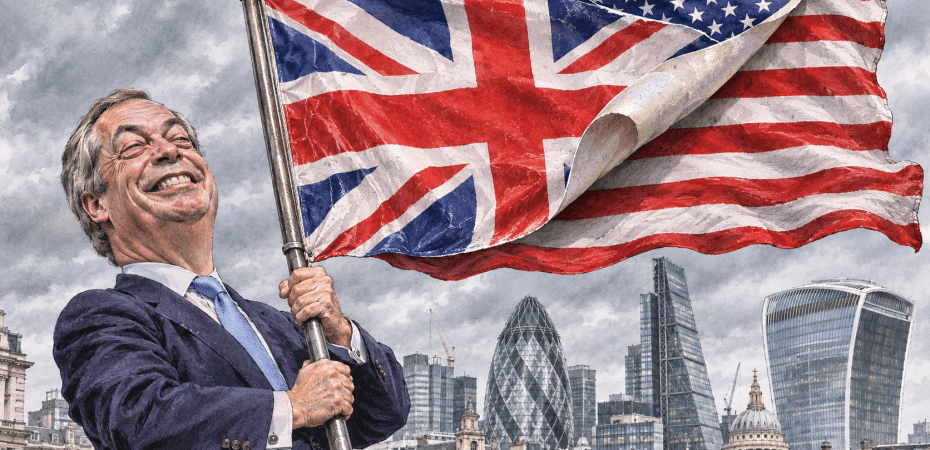
A few weeks ago, I received an e-mail from Nigel Farage. I do not mean that he wrote to me personally. It was the sort of message that arrives unasked from every party that has ever had your address, and it set out what Reform UK proposes to do about national security. “The threats to Britain are no longer abstract,” it began. Terrorists and agents of the Islamic Republic are “entering our homeland through porous borders”. Our adversaries “pray that the same political class stays in power”. Reform will spend more on defence, ban the Muslim Brotherhood, leave the European Convention on Human Rights, be “far more wary of Communist China”, and put Britain “back in the driving seat at home, in our region and around the world”. It ends by assuring me that “the world is a better place when Britain is a better place”. I read it twice, the second time with growing recognition, because I have been reading it all my life.
It is the pompous, lecturing harangue that Conservative politicians have been spraying at us since the 1950s. Since Suez, every one of them has told us that decline is a choice, that Britain can still punch above its weight, and that what is needed is a firmer resolve and a larger defence budget. Dean Acheson told an audience at West Point in 1962 that Great Britain had lost an empire and had not yet found a role. Our rulers took offence, and have spent the sixty years since proving him right. The decline was real enough, but it was not an accident of history or a failure of willpower among voters. Britain declined as a great power because the people who rule it decided that it should have no role other than as a trading platform, with shops for the many and grouse moors for the few. A great power needs coal, steel, shipyards and engineers, and the men who work in them. Our ruling class found it more agreeable and more profitable to live on rents, fees and the commissions of the City of London. Mr Farage, who spent his own working life before politics as a metals trader in the City, is hardly the man to reverse that choice. Nor does his e-mail suggest that he wants to.
The era-defining shift
Look at what he actually proposes. Reform will spend 3 per cent of national income on defence by 2030 and 3.5 per cent by 2035, and calls this “an era-defining shift in our priorities”. In June 2025, the Starmer Government committed Britain at the NATO summit to spending 3.5 per cent of national income on core defence by 2035. The era-defining shift is therefore the official policy of the Labour Party, with a smaller aid budget attached. I would be glad to see foreign aid cut to £1 billion, or to nothing. But the saving will not go far once the armed forces have been asked to make Britain the policeman of the “Euro-Atlantic region”, and Mr Farage admits that the money will be poured into the same Ministry of Defence that has spent decades turning large budgets into small and late results.
The first enemy
Mr Farage names three enemies. The first is the Moslem Brotherhood, which he wants banned. Islam is no threat whatever to this country. What we do have is a problem with immigration at levels that amount to replacement, much of it from Moslem countries. That is a domestic problem. It calls for a firm but humane domestic response, which means control of the borders, an end to the subsidy of mass settlement, and the equal enforcement of the law against everyone who breaks it. It also involves a discussion of and with those already here about what else needs to be done. It does not call for the banning of an organisation whose main interests lie in Egypt and the rest of the Arab world. David Cameron’s government spent the best part of two years looking at the Brotherhood, and in 2015 decided against proscription. I see no reason to think the facts have changed, and I notice that Mr Farage’s e-mail does not even keep its enemies apart. It opens with agents of the Islamic Republic in Tehran, which is a Shiite revolutionary state, and moves on without pause to a Sunni movement that the Iranians have never controlled. Banning the one will do nothing about the other.
There is a further point that a libertarian ought to make. The power to proscribe is a weapon that never stays pointed at its first target. When Palestine Action was banned in 2025, the police went on to arrest hundreds of people, many of them elderly, for holding up cardboard signs. Every new proscription makes the next one easier, and a party that claims to care about free speech should think about who will be holding that weapon after it.
The second enemy
The second enemy is Russia. “Vladimir Putin sees our weaknesses and exploits them.” No doubt it is no fun to live next door to Russia. But we do not live next door to Russia. Consider what the Russians would have to do before they could come here to rape our women and steal our taxes. They would first have to defeat and occupy the whole of Ukraine, which has had the backing of NATO for nearly five years and which they have not managed to conquer in that time. They would then have to defeat and occupy Poland. To secure their northern flank, they would have to defeat and occupy Finland, Sweden and Norway, all now members of NATO. After that would come Germany, then Belgium and Holland, and then they would have to impose order on France and occupy at least its northern half before they could look across the Channel from Calais.
They would do this with a population of about 146 million, of whom only about 105 million described themselves as Russians at the last census. Half of them are women. A great many are elderly, and some are children. Millions of the men of military age are needed in the factories, mines, railways and offices without which Russia could not wage a war at all. Against them would stand the European members of NATO, with more than half a billion people and an economy many times the size of Russia’s. The idea of a Russian threat to these islands is absurd.
I will admit the obvious objection. Mr Farage is not really talking about tanks in Kent. He talks about attacks on “our airports, hospitals, energy, food security and wider infrastructure”, and there may be something in that. But sabotage and hacking are dealt with by competent police and security services and by engineers who build systems that cannot easily be broken. They are not dealt with by spending tens of billions more on the armed forces. Nor is it irrelevant that Britain has spent years supplying the weapons that Ukraine fires into Russia. A country that chooses to take part in someone else’s war should not be astonished when the other side takes an interest in it.
The third enemy
The third enemy is China, whose “lust for Taiwan could crash the entire global economy”, so that Britain “has to be at the forefront of ensuring that never happens”. I wonder whether anyone at Reform has read the joint communiqué of 1972, in which the British Government recognised Beijing as the sole legal government of China, acknowledged the Chinese position that Taiwan is a province of the People’s Republic, and withdrew its consulate from the island. That has been our official position for more than half a century. If Taiwan is part of China, I fail to see why the internal affairs of China are any business of ours.
There is a more relevant point. China is a serious country, with a real economy and real armed forces. It builds more ships in a year than we have built in a generation. We are not a serious country in that sense. We have a navy that struggles to keep its few escorts at sea, an army smaller than at any time since the Napoleonic Wars, and no presence anywhere near China except a battalion of Gurkhas in Brunei. We have nowhere from which to project force, even if we had the force to project. If we must take any view of what China may do about Taiwan, it should go no further than politely asking the Chinese not to make as much trouble for the rest of us as the Americans routinely do. I suspect they would oblige with one of their less inscrutable smiles.
The friend he does not name
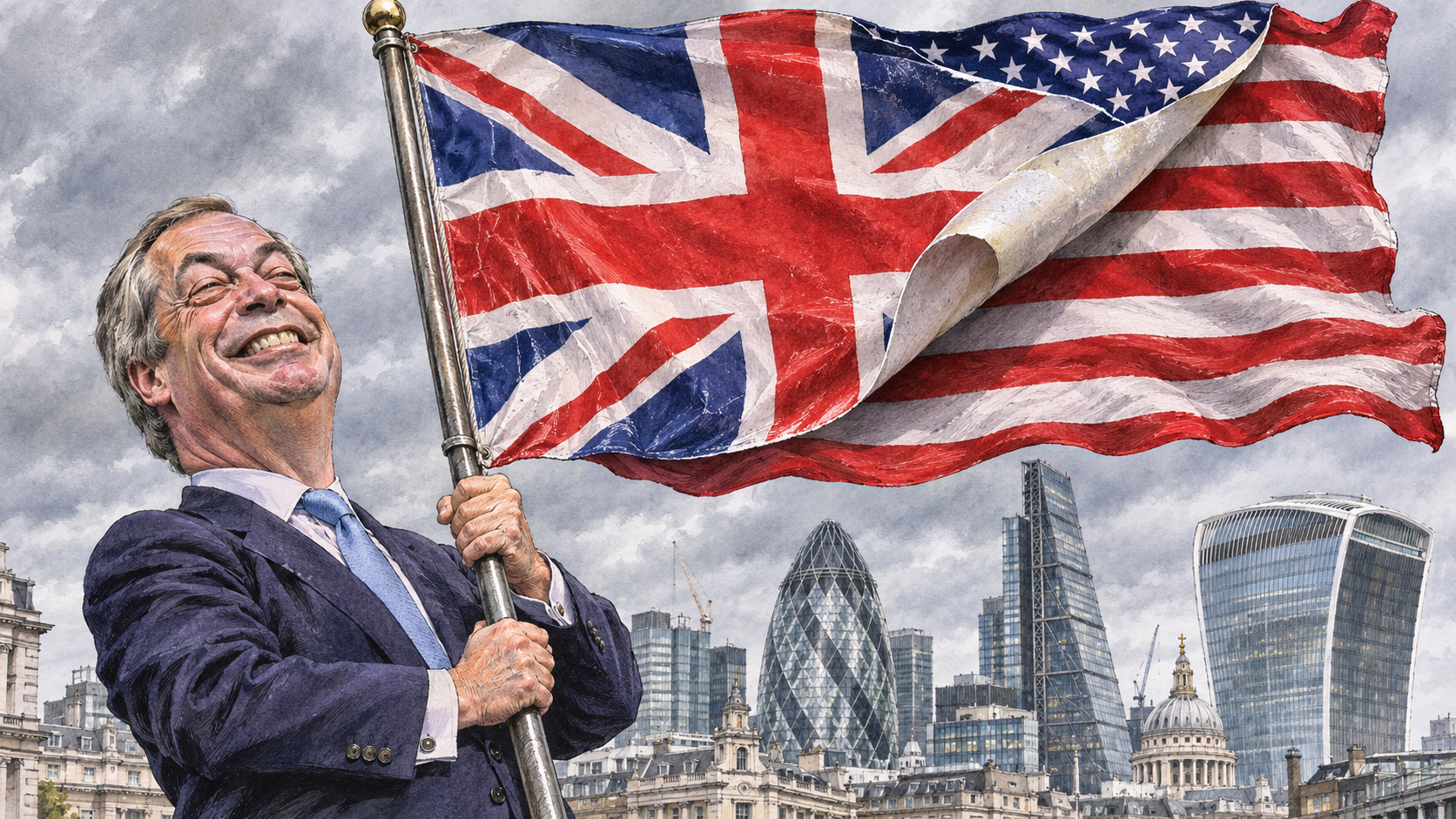
That brings me to the subject the e-mail never mentions by name. All its talk of “the Euro-Atlantic region”, of alliances “strengthened by intelligence sharing and secure common supply chains”, and of renewing the nuclear deterrent, means one thing. Mr Farage wants a closer commitment to the American alliance. In August, Reform’s people were assuring JD Vance that a Farage government would fund the British military in full. Even his patriotic line about the Chagos Islands has an American base at the heart of it, since the only reason anyone cares who owns Diego Garcia is that the United States uses it.
I regard this policy as insanity bordering on treason. The American Government has been our principal enemy since 1917, or at least our principal enemy after our own ruling class. It entered the Great War when we were already dependent on American credit, and spent the following years collecting its debts. In 1922 it used the Washington Naval Treaty to end our naval supremacy, having already pressed us into abandoning the alliance with Japan. It lent us the means to fight Hitler on terms that stripped us of our overseas assets, ended Lend-Lease without warning a few days after the war with Japan ended, and attached conditions to the loan of 1946 that brought on the sterling crisis of 1947. In 1956 it broke the Suez operation by threatening the pound. Since then it has dragged us into its wars and sold us an extradition treaty under which British subjects can be sent to America on terms that no American could be sent here. Our nuclear deterrent depends on missiles drawn from an American pool. These are not the dealings of a friend. They are the dealings of a creditor that has slowly taken possession of a bankrupt estate, and that has found the estate’s own managers willing to help.
It will be said that the Americans helped save us from Germany. They did, once we had gone to war with Germany for reasons that still cannot be openly discussed, and they charged us an empire and a currency for the service. You may be grateful to a moneylender who keeps you out of the workhouse, but you would be foolish to call him your friend, and mad to give him the keys to your house. A patriotic British Government would immediately expel all American forces from British territory, from Lakenheath and Mildenhall to Menwith Hill, and end all security and other cooperation. It would withdraw from every treaty that can reasonably be seen as unequal, beginning with the extradition treaty. It would mend our relations with Russia, and seek peaceful trade with China and Iran. As a libertarian, I can do no better than quote an American. In his first inaugural address, Thomas Jefferson called for “peace, commerce, and honest friendship with all nations, entangling alliances with none”. That was good advice for a young republic, and it is good advice for an old kingdom that has run out of the money to be anyone’s auxiliary.
The facts have changed
I have argued in the past that we should support Reform if we wanted to finish off the Conservative Party. I still want the Conservative Party finished off. But this e-mail could have been written by any Conservative defence spokesman of the past forty years. It has the same reverence for the American alliance, the same enemies chosen in Washington, the same promise of greatness funded by a larger budget, and the same silence about the industrial ruin that made us weak in the first place. On everything that matters, Reform is now indistinguishable from the party it claims to be replacing. The facts have changed, and I must change my mind. I shall therefore look about for another party that may deserve my vote. There is no hurry. In September, Mr Burnham said of 2029, “That’s when the next election will be,” which shows that my forecast of an early election was premature and gives me plenty of time to look. I shall vote just as soon as Mr Burnham decides to let me. Until then, I shall go on noticing that every party offering to restore Britain’s place in the world keeps the shops, the grouse moors and the American bases exactly where they are.
Sources:
- UK: UK to deliver on 5% NATO pledge (23 June 2025)
- ITV: Prime Minister commits to 2029 general election
- Breitbart: Reform tells JD Vance a Farage government will fund the military fully
- ITV: Senior RAF figure to be Reform’s armed forces spokesman
Discover more from The Libertarian Alliance
Subscribe to get the latest posts sent to your email.



„…the same enemies chosen in Washington, the same promise of greatness funded by a larger budget, and the same silence about the industrial ruin that made us weak in the first place.“
Amen. I could translate this word for word into German and it would apply just as well.
A “libertarian” complaining that Reform is not socialist enough?
Whatever!
It is straightforwardly applicable to all EU countries without distinction.