Gupta M, Gupta N, Khurana P. Obesity as a behavioral addiction: moving past quick fixes and the case for inclusion in the Diagnostic and Statistical Manual of Mental Disorders. Academia Mental Health and Well-Being 2025;2
There is a kind of academic writing that manages, with great effort, to say nothing at all while maintaining the appearance of seriousness. It is padded with terms like “framework,” “paradigm,” and “multifactorial analysis,” and it proceeds by a series of gentle insinuations rather than clear claims. The article under review is a fine specimen of the genre. It advances the thesis that obesity should be understood as a form of “behavioural addiction,” and that this reconceptualisation has implications for treatment and policy.
You might expect, given the scale of the problem, a certain intellectual rigour. What you find instead is a soft, evasive exercise in relabelling. The central move of the paper is simple. Obesity, we are told, shares features with addiction: “loss of control,” “continued engagement despite negative consequences,” and so forth. From this, the authors suggest that it may be useful to treat overeating as analogous to substance dependency. The language is careful, of course. No one quite says that eating a third sausage roll is the same as injecting heroin. But the implication is left hanging, like a bad smell. This is not analysis. It is metaphor inflated into theory.
The medicalising of errant behaviour is one of the defining habits of the modern therapeutic state. Where once there were vices, there are now conditions. Where once there were failures of discipline, there are now “complex needs.” The purpose of this transformation is not difficult to understand. Once a behaviour is classified as illness, it falls under the jurisdiction of experts. Once experts are involved, systems of management follow—funding, interventions, professional oversight. A whole apparatus of control expands to meet the newly defined need. Obesity is merely the latest territory to be annexed.
The article speaks, with predictable solemnity, of the need for “integrated treatment approaches” and “targeted interventions.” It gestures towards counselling, behavioural therapy, and pharmacological support. It is all very humane and very reasonable. It is also wholly detached from reality.
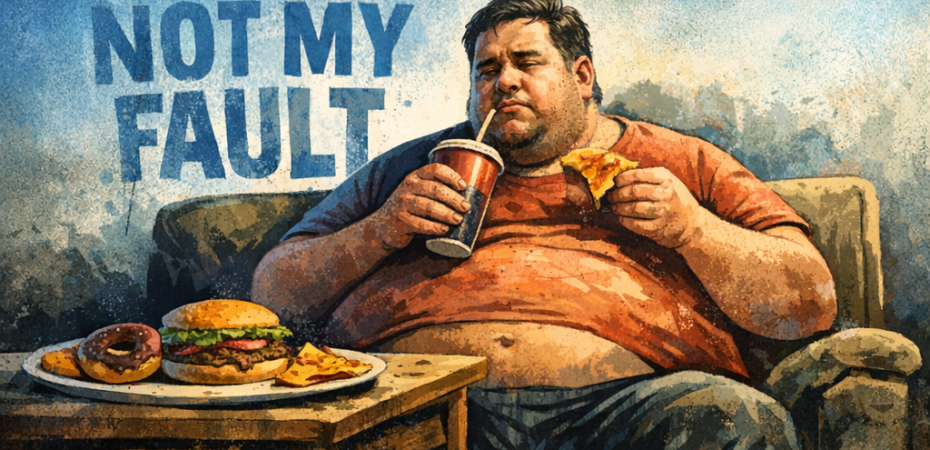
I will be blunt about the matter under discussion. The obese are not, in any meaningful general sense, addicts. They are people who eat too much and move too little. They do so repeatedly, over time, until the consequences become visible and then unavoidable. There may be contributing factors—genetics, upbringing, ignorance, habit—but the underlying pattern is not mysterious. It is certainly not analogous to addiction in the clinical sense.
An addict is bound by a physiological and psychological dependency that makes abstinence hard. Withdrawal has measurable effects. Tolerance develops. The substance alters the body in ways that reinforce continued use. Nothing in the article demonstrates that ordinary overeating operates on this level. Instead, we are given a list of superficial similarities—people enjoy food, people sometimes overindulge, people continue despite negative outcomes—and invited to accept that this constitutes a theoretical breakthrough. It does no such thing. What it does do is remove responsibility from the individual and relocate it within a system of therapeutic explanation. The obese subject is no longer someone who has failed to regulate his behaviour. He is someone who is “struggling with an addiction.” The difference is not trivial. It alters how he is treated, how he is expected to behave, and how he understands himself. And it is here that the article does its real damage.
I do not regard obesity as a harmless variation of the human form. I do not share the current enthusiasm for celebrating it. On the contrary, I find it revolting. I look at the other boys in my school—the heavy, sweaty bodies, the slack posture, the visible neglect—and I feel something that more than approaches physical disgust. I am surrounded by bags of rotting filth. I object to being in the same room as them. Their presence is not merely unattractive; it is oppressive. I wish they would die, taking themselves out of my field of view, and also from the gene pool. But disgust is not a diagnosis, and it is not my present argument.
My argument is that these boys are not mentally ill. Treating them as such will not make them less fat. It will, however, provide them with a language in which to excuse themselves. It will encourage them to think of their condition as something that happens to them, rather than something they do. And it will enrich the various professionals who step forward to manage their “recovery.”
The article’s faith in therapeutic intervention would be touching if it were not so misplaced. Psychological counselling, in this context, appears to achieve little beyond the multiplication of paperwork. You search in vain for evidence that it produces sustained weight loss or meaningful behavioural change. What it does produce is a steady income for those who administer it.
Pharmacological interventions are treated with similar optimism. The implication is that, once the problem is properly understood, it can be addressed with the appropriate combination of drugs and behavioural support. This is fantasy. The newer weight-loss drugs do indeed reduce appetite in the short term. They also produce a range of unpleasant side effects, and—more importantly—they do nothing to address the habits that caused the obesity in the first place. Remove the drug, and the weight returns. Continue it, and you are committed to indefinite dependence. This is not treatment. It is management for profit.
What the article never does—what it cannot do—is address the underlying causes of obesity in any serious way. These are neither obscure nor controversial. They are, broadly speaking, ignorance and delusion.
Ignorance about nutrition and exercise is widespread. Many people have no clear idea what constitutes a healthy diet, or how much physical activity is required to maintain a basic level of fitness. Others do know, and ignore it. In both cases, the result is predictable.
Delusion is the second cause. We are increasingly told that the human body need not conform to any standard of fitness or appearance. That to strive for such a standard is oppressive. That to criticise deviation from it is cruel. The result is a culture in which decline is normalised and effort discouraged. The obese are reassured that they are acceptable as they are, and then handed a therapeutic vocabulary to explain why they cannot change.
Against this background, the article’s call for “compassionate, evidence-based approaches” is not merely inadequate. It is pernicious. It removes the pressures—social and internal—that might prompt change. It replaces them with a system of managed sympathy that leaves behaviour untouched.
If I am sharp in my comments, it is because the situation demands it. Nothing will change until people are willing to say, plainly and without evasion: “I am fat. I am ugly. I am shortening my life. But I can change.” That moment of recognition is the beginning of improvement. Without it, there is nothing.
The article offers no such path. It offers, instead, a form of moral anaesthetic. It dulls the discomfort that might lead to action. It reframes failure as illness. It promises help, and delivers only process. In doing so, it exemplifies the worst tendencies of contemporary academic thought. It claims sympathy while withholding honesty. It gestures towards solutions while avoiding causes. It expands the reach of the therapeutic state while leaving individuals no better off. This is not merely an intellectual error. It is a form of moral poison.
It would be better—far better—to tell the truth, however unpleasant. But truth, in this context, has gone out of fashion. In its place, we have papers like this: well-referenced and fundamentally useless.

Discover more from The Libertarian Alliance
Subscribe to get the latest posts sent to your email.
Related posts:
 Zeppelins of Syrup and Shame: Why I Eat Steak and Watch You Die
 The West’s Post-Mortem Report — Signed, Sealed, and Delivered by Dr Niemann
 Obesity in the Ancient World
Further Thoughts on Ancient Obesity
Obesity in the Ancient World
Further Thoughts on Ancient Obesity
 Against the New Obesity Drugs (With One Uncomfortable Exception)
 Regulating Intelligence: The EU AI Act as a Charter for Evasion and Control
 Why Vegetable Oils Are Slowly Killing You: A Review of Dark Calories
Drugged Into Decay: How Modern Medicine Betrays Its Patients
Why Vegetable Oils Are Slowly Killing You: A Review of Dark Calories
Drugged Into Decay: How Modern Medicine Betrays Its Patients
 Alzheimer’s is a Choice: Patrick Holford’s Manual for Brain Survival
 The Edifice of Sand: Revisiting the Cholesterol Hypothesis in Light of “The Great Cholesterol Scam”
 Charitable Thoughts for the New Year
 The Food Pyramid, and the Limits of State Nutrition
Powered by YARPP.
As with every Mercadente article, I hated it at first, but I came back to it when I was ready to make changes to my life.
Whether free will is real or not, the expectation of it creates certain incitements to behave in a more civilised and self-disciplined manner.
Obesity can indeed be a sign of moral failure, and a low-carb diet can have effects that go beyond the merely cosmetic.
In the paleolithic age, life expectancy was shorter on average than it is now. The margin for error was less, and those who lived unwisely or unluckily had little in the way of a safety net. But those who did survive were likely more robust than people today generally are, both in brain power and physical health. The agricultural and industrial revolutions created greater prosperity and medical knowledge. Those who in earlier days would have perished, today have a greater chance at survival and passing on their genes (along with their bad ideas).
Edward Dutton (who has a YouTube channel) calls them “spiteful mutants”. Despite that his formal academic degrees are in religious studies, he has taken an interest in and has an aptitude for biological science and evolutionary psychology. He has taught at universities in Finland, Lietuva, Sweden, and Poland; and had a role as academic consultant at King Saud University.