A few years ago, people began to ask if artificial intelligence would replace writers. The answer is that it largely has. Most of the boys in my class border on illiteracy. A few of them stand rather far across that border. As for the teachers, these are generally the sweepings of a profession not noted at best for a command of English style. Even so, their writings nearly all possess a smooth fluency that would, until recently, have astonished. I seldom look at newspapers. When I do, what I see in them is almost universally AI slop. So the answer to that question is a clear affirmative. A more interesting question is to what extent artificial intelligence has replaced readers.
Let me return, though, to the first question. The internet carries a daily flood of machine-generated text that is beyond the crudest measurement, let alone any precise counting of words. It is a daily flood of articles explaining politics, reviewing products, discussing current events, or offering life advice. Most of it is written by nobody, but is generated by language models. Some of it may be lightly edited by content-farm operators. Edited or not, it is all uploaded into the endless expanse of the Web, its purpose not so much to inform, nor even to persuade. The purpose is to exist.
The danger is not in itself that the text exists. Some of it, as said, is a relief from the illiterate ramblings it has replaced. The real danger has been summarised in this paper from February 2026: Retrieval Collapses When AI Pollutes the Web. The argument here is that search engines and AI systems increasingly obtain information from content that was itself generated by AI. The more this process continues, the more the Internet becomes a self-referential loop in which machines are trained on machine-generated material to generate more of the same, which is then used for generating yet more of the same. The authors of the paper call this process “Retrieval Collapse.”
They identify two stages in this collapse. The first is what they call “Dominance and Homogenization.” Rather decent AI-generated articles, carefully optimised for search engines, begin to crowd out human-written material. Because they are often coherent and technically accurate, nothing looks wrong with these articles. Search results still look sensible. Questions still receive answers. Accuracy metrics remain stable. Underneath this appearance of health, however, source diversity begins to disappear. The internet becomes an echo chamber of synthetic content.
This historical example may help explain the problem. Ten years ago, a search for the causes of the Civil War might have returned a traditional Whig interpretation, a Marxist interpretation, a revisionist interpretation, a royalist defence of Charles I, and perhaps a scholarly article criticising all four. You would have encountered disagreement. Different assumptions and different intellectual traditions would have been visible. Now imagine thousands of AI-generated articles trained on the same body of source material and optimised for the same search algorithms. They quickly converge on a safe consensus. The answer may remain broadly correct, but the variety of perspectives begins to disappear. Search results become filled with hundreds of near-identical articles saying essentially the same thing in slightly different words.
The second stage is more dangerous. Once synthetic content dominates search results, malicious or low-quality material can enter the system more easily. Search engines that rely on traditional ranking methods become vulnerable to manipulation. False content begins appearing in search results, and automated systems become increasingly likely to treat it as authoritative.
Here again, scale is the key problem. Human writers can produce errors and falsehoods. They always have. The difference is that a human crank may write one misleading article in an afternoon, whereas a machine can generate ten thousand before lunch. Imagine someone producing vast quantities of plausible-looking articles claiming that Oliver Cromwell abolished Parliament in 1642. The statement is false. A competent historian would recognise this at once. A retrieval system, however, sees only thousands of apparently relevant documents agreeing with one another. If enough synthetic material enters the web, the distinction between authority and volume begins to blur. History teachers, I can tell you for sure, seldom read the notes they download from the Web. You would soon have an entire generation taught not just iffy interpretations of the Civil War, but a false chronology of its main events.
Move from history to current events, and the danger becomes more obvious. We can be reasonably sure – though opposite opinions must always be taken into account – that the Israelis have murdered at least tens of thousands of civilians in Gaza, and they have tortured and raped many of their prisoners, along with stealing their land. Suppose some well-funded defence of Israel were to put out ten thousand long reports, carefully referencing each other, that these claims had all been made up by the Chinese Government – why, you can imagine the shifting of the narrative once memory of the news reports and debates over them began to fade. Who controls the present controls the past. Who controls the past controls the future.
The researchers tested these possibilities using a controlled simulation. Their results are worrying. When about two-thirds of the available document pool was replaced with AI-generated material, over eighty per cent of the content appearing in search results became synthetic. Answer quality appeared largely unchanged. Users would not necessarily notice anything wrong. Yet the retrieval system had already become overwhelmingly dependent on machine-generated sources. Systematic bias, or at least, fading of complexity, became baked into the results.
This is perhaps the most interesting finding in the paper. The internet can become intellectually hollow long before it becomes visibly stupid. Like a field planted with a single strain of wheat, it may appear healthy for years. The danger only becomes obvious when disease arrives and every natural defence has already been stripped away.
You may ask why any of this matters. Surely educated people can tell the difference between human writing and AI slop? The answer is yes – or yes for the most part. And here is my own contribution to the debate. The authors of the paper I am discussing seem to underestimate how good human beings are at recognising patterns. I can usually identify machine-generated material within a few sentences. The clues are everywhere. You have those verbless sentences, the compulsive use of bullet points, the identical transitions and stock phrases. You have the profusion of empty adverbs like “precisely,” “fundamentally,” “critically,” “notably,” “increasingly,” “significantly.” You have ideas presented in block after block of three – ascending tricolons is what the rhetorical handbooks call them: useful, as at least the Indo-European mind is programmed to think in threes, but tiresome if done too often. Oh, and there is the omnipresent if unmemorable literacy. Artificial intelligence does not make spelling or grammatical mistakes – of does not unless told to.
Most of all, there is the absence of personality. Human beings write differently because human beings are different. Some writers are pompous. Some are witty. Some are insane. Some are brilliant. Some are all four simultaneously. Machine-generated prose tends towards a universal mediocrity. It can imitate style. It struggles to possess one. You see this in much financial commentary, though most writing here has always looked like AI slop for the good reason that the writers already have minds that work like AI engines. But you also see it increasingly in political commentary. How many articles have you seen that begin with a statement of the obvious, proceeding through a sequence of bullet-pointed observations, to end with something windy about how “History shows X”? Reading enough of this is like eating food from Greggs: it corrupts the consumer even as it pretends to nourish.
The real danger, however, is not direct corruption. As said, anyone of more than average intelligence can recognise synthetic content and disregard it. Search engines cannot. Retrieval systems do not possess taste. They do not become bored. They do not notice when every article says the same thing in slightly different words. They reward fluency and relevance. AI systems are becoming good at manufacturing both. That is the problem.
The internet was originally valuable because it lowered the cost of publication. This allowed talented outsiders to compete with established institutions. A teenager with an interesting idea could publish alongside a newspaper columnist. A specialist with obscure expertise could reach a worldwide audience. The AI revolution threatens to reverse this. The cost of publication is now approaching zero. The result is not an explosion of knowledge. It is an explosion of noise. A search query that once returned ten thoughtful articles may soon return ten thousand synthetic approximations of those articles. The information remains somewhere inside the system. Finding it becomes increasingly difficult.
I come back to my second question. One of my old film reviews got fifteen thousand hits last month. Does this mean that fifteen thousand people wanted to know what I thought of some entertaining slasher film from Korea? Probably not. More likely, whatever I said about it was being harvested for future regurgitation by one set of machines to another set. I suspect that most reading on the Internet is now done by computers. Possibly worse than this, a lot of reading that should be done by individuals is now mediated by AI engines. I am more guilty of this than many. My A-Level Economics text book is a vast and rebarbative production. I have read very little of it directly. Instead, I feed it, chapter by chapter, into my preferred AI engine. The result is more digestible. This works for me. I will regard myself as a special case, as I already know the subject, and mainly need to know what I am expected to know. I may occasionally move from the summary to the main text if something looks interesting or unclear. When I review a book, and am not greatly interested in the content, I skim the generality of its content, then generate a summary and work from that. This also can be justified. The content of many books, however, is irreducibly complex, and reading summaries is a poor substitute for learning from the original.
The obvious problem is that summaries leave things out. The deeper problem is that they leave out the things that matter most. A summary can usually give you conclusions. It struggles to give reasoning. It can tell you what an author thinks. It can fail to show us why he thinks it. Consider an older or a good modern work of history. I think here of the book I am reading a present – A.R. Burns, The Lyric Age of Greece. The value of this book lies only in its conclusions, interesting as they are. It lies also in the evidence selected, the arguments advanced, the objections considered, the uncertainties acknowledged, and the judgements exercised along the way. Above all, it lies in engaging with the considered thoughts of a man who has spent a lifetime making sense of some very fragmentary evidence. Reading a summary is rather like examining a building by looking at a photograph of the finished exterior. You see the shape, but not the foundations. You never see the supporting structure, the thousands of decisions that allowed it to stand.
The danger here is intellectual passivity. A summary presents knowledge in its most digestible form. The hard work of interpretation has already been done. Contradictions have been smoothed away. Digressions have been removed. Qualifications have been compressed into a few sentences. You receive conclusions without having participated in the process that generated them. This matters because understanding is not the same thing as information transfer. You often learn by wrestling with a difficult text. You notice tensions. You become irritated by weak arguments. You discover unexpected connections. You pause over a striking sentence. You disagree with the author. None of these experiences survives compression.
The result is that a man who has read a hundred summaries may possess more information than a person who has read ten books. He will often possess less understanding. His knowledge resembles a collection of map references rather than a journey through the territory itself.
There is a more subtle danger. As I have said, AI systems tend towards consensus. They are designed to identify the central themes, the main arguments, and the generally accepted interpretation. Yet many important books are valuable so far they resist simplification. A summary of Nietzsche, Marx, Hayek, Hume, or de Tocqueville inevitably pushes you towards a standardised interpretation. The eccentricities, ambiguities and provocations that made these writers influential are often the first things to disappear.
For routine purposes, summaries are useful. I have said I use them myself. If I need a reminder of a chapter in an economics textbook, a summary saves time. If I want to know whether a book is worth reading, a summary may help me decide. The problems come when summaries cease to be gateways and become destinations. At that point, you are no longer using them to assist reading. You are using them to avoid reading.
A civilisation in which most books are written by machines, summarised by machines, searched by machines, and consumed through machine-generated digests would still contain information. What it would increasingly lack is understanding.
But I come back to the paper I am sort of reviewing. The authors suggest several defences against AI capture. They involve provenance tracking, ranking systems that reward source diversity, and filtering mechanisms that identify suspiciously fluent but poorly sourced content. They also argue that future retrieval systems must consider more than simple relevance. They must evaluate the origins and reliability of information as well. Whether this will be enough remains uncertain.
My own suspicion is that the internet will divide into two worlds. One will consist of endless machine-generated sludge consumed by other machines. The other will consist of human-created communities where reputation still matters and where readers still care who is speaking. The first world will be larger. It will also be worthless. The second world will be smaller. It will contain most of what is worth reading.

Discover more from The Libertarian Alliance
Subscribe to get the latest posts sent to your email.
Related posts:
 Planet Aqua: A Deluge of Nonsense
 The Corpse of the University: A Review of Peter Fleming’s Dark Academia
 The AI Recession We Have Been Waiting For
 Tarnished Towers and the University Extinction Event
 AI: The Financial Adviser Is Next
 Why the Libertarian Alliance Must Now Read Itself Before the Police Do
 Antinous Drowned Twice: Once in the Nile, Again in Hausrath’s Novel
Powered by YARPP.
The phenomenon these researchers describe happens in humans, too. It is known as “groupthink.” I skim-read the referenced paper, and its ideas seem plausible, even if the author list does sound suspiciously like Peep-Bo, Pitti-Sing and Yum-Yum.
I have already worked out how to identify AI-generated videos. They virtually all mis-pronounce difficult words, particularly foreign ones. Imagine, for example, how the pronunciation of “Notre Dame” shows the provenance of the AI’s culture, whether Indiana, Paris or somewhere in between.
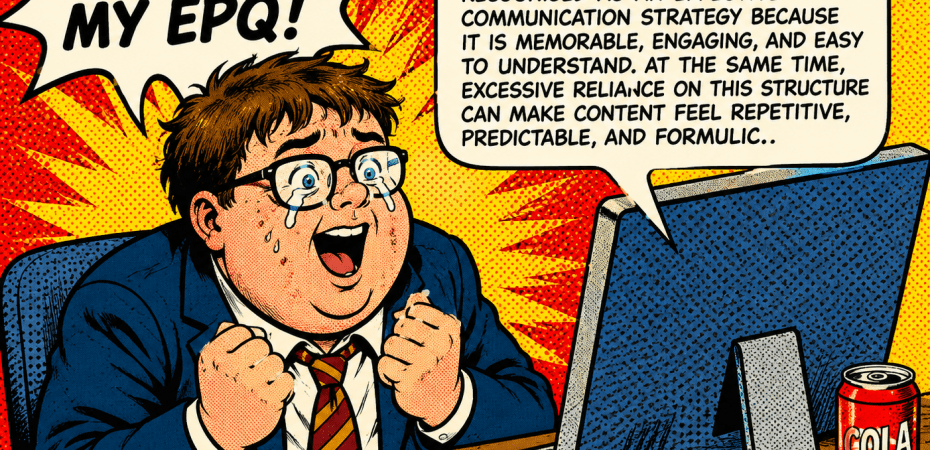
AI-generated images are a little harder, though occasionally an egregious error stands out (as in the mis-spelling of “formulaic” in the featured image of this post). Though I cannot be certain that this error was not deliberately inserted by being “lightly edited by the content-farm operator,” since I know Mr Bickley well enough to understand his sense of humour.
AI-generated text is the hardest of the three. I was piqued enough to try the “causes of the English civil war” test. The first time, I got: “The English Civil War (1642–1651) was triggered by a combination of King Charles I’s staunch belief in the Divine Right of Kings, deep constitutional disputes over the balance of power with Parliament, unpopular financial policies, and explosive religious conflicts across his kingdoms. [1, 2, 3]”. Four causes, each of which required four explanations. When I tried the same 20 or so minutes later, I got “The English Civil War (1642–1651) was primarily caused by the clash between King Charles I and Parliament over the balance of power, compounded by deep religious divisions, and the King’s controversial methods of taxation.” Three causes, each of which had two explanations.
Myself, I’ll just steer as far clear of AI as I possibly can. To correct its mistakes (and its style) would take far more effort than just doing the work yourself in the first place. Image sites like Freepik already provide a “no AI-generated content” option. I suspect it won’t be long before the better browsers start to offer a similar option, and that may contribute to a solution to the problem identified here.
Some more tips for identifying AI slop. Here’s a really good example: https://www.youtube.com/watch?v=63WlSJ1LyCk.
(1) Pronouncing words differently to the accent of the narration as a whole. The narration is closer to British than American, yet at 3:15 the word “routed” is pronounced as “rowted” rather than “rooted.” For a reason obvious to those who have lived in both countries. (In the 1980s tech world, Americans even spelled our word “routing” as “routeing!”)
(2) There’s a beaut of a mispronunciation of an Italian name at 3:38. Archbishop Battaglini is pronounced as “Batter Gleanie” instead of the subtle -ly- sound that -gl- represents in Italian.
(3) Mis-spelt subtitles are another symptom. This film shows words ending in ‘s with the ‘ at the end of one line and the s at the beginning of the next.
(4) An unnaturally low “deep throat” voice is very common in slop, as in this example.
As to the content, as an agnostic who calls the pope “the pipsqueak,” I will leave it to Mr Wang to respond.
There is a lot of really bad AI stuff out there – but a lot of good stuff that usually can’t be told apart from the real thing
Yes, there are people who are using AI simply as a way to generate videos faster than they could without it. If you look at the content of these rather than the style, they are just as good as they would have been produced “by hand.” Here is an example: https://www.youtube.com/watch?v=acyyts_cQWg.