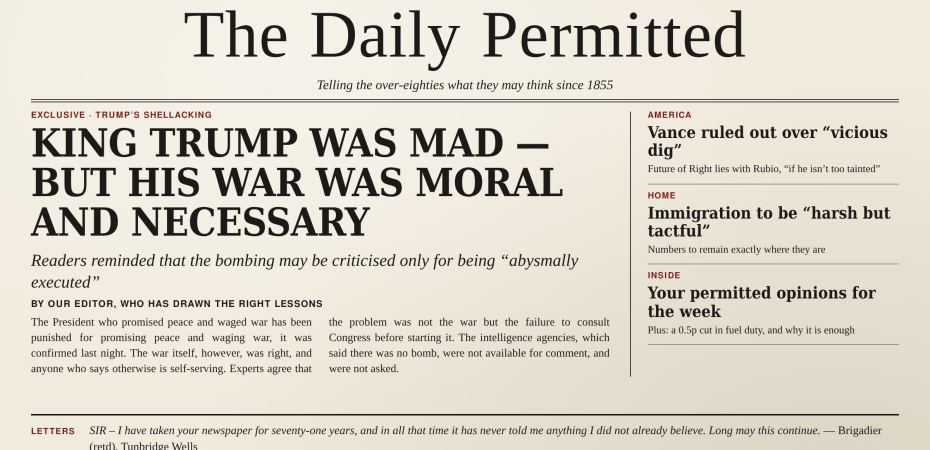
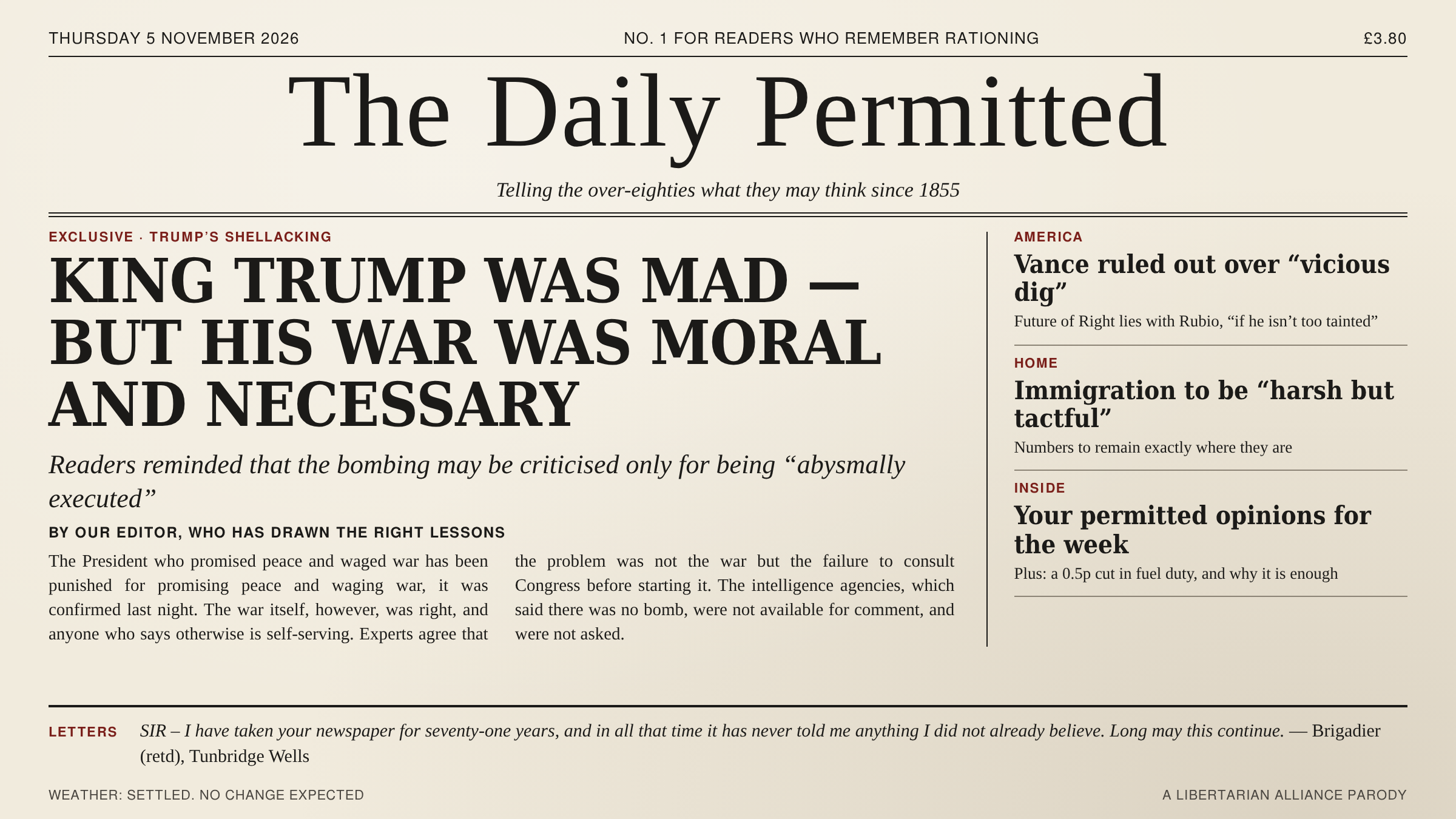
I stopped buying newspapers at about the time of the Iraq War, and I have never regretted the saving. I do still read them, though only when a friend sends me something he thinks will annoy me. A friend has just sent me this article by Allister Heath, published in The Daily Telegraph on the 4th November, under the title “King Trump has descended into madness and betrayed the Right.” He was right. It did annoy me. But it also illustrated, better than most things I have read this year, how that newspaper does its work.
The function of The Daily Telegraph is to claim to be a newspaper of conservative opinion, while telling its dwindling audience of the very old what they are and are not allowed to think. According to the Telegraph, the whole job of a conservative is to hope for marginal tax cuts, and for some of the more scandalously wasteful or destructive spending by the British State to be reduced. To this can be added a tepid, and therefore ineffectual, resistance to the culture war waged by the British State against the traditional population since at least the 1960s. Serious analysis of who rules us, how we are ruled and to what end is forbidden. Anything approaching advocacy of a counter-revolutionary capture of the State is extremism. Replacement levels of immigration can be mentioned, though never as a main issue, and never with any discussion of what might be done about it. Complaint is only allowed to become specific when the immigrants begin to ask for things the ruling class does not want to give, and then we are encouraged into a sweat about “Islamism.” Disapproval of the massacres committed by the Israeli Government is anti-semitism. Outrage at the close support given to these massacres by the British State is anti-semitism. Supporting the endless wars waged for the advantage of the ruling class is a patriotic duty.
Mr Heath’s article sets out to explain how a reader of the Telegraph should regard the promises made by Donald Trump in 2024, around which he gathered a winning coalition, and how he should regard the humbling of Mr Trump in this week’s elections. The method is simple. You take those parts of the Trump agenda that are broadly congruent with what the Telegraph is willing to let us discuss, and you explain how they were wrecked. Everything else is either left out or reclassified as a success.
So we have this:
“Two years ago, he assembled a pro-prosperity, pro-growth, anti-woke cross-racial coalition of suburbanites, hispanic and white, younger and older, working-class and middle-class voters, proving demographics needn’t be destiny, that it was possible to defeat progressivism.”
And we have the bill of indictment:
“He passed almost no legislation. He governs like a Middle Eastern potentate, with whom he shares garish tastes, hiring on the basis of looks, loyalty and family ties; he rewards those who genuflect to his every whim. He accepts gifts from despots, and has merged his and his associates’ private business interests with government business…. His protectionism, economically illiterate and imbecilic, was implemented in the dumbest possible way, targeting friendly countries, ruining farmers, tariffing goods that the US didn’t produce, upping the cost of inputs for US manufacturers and impoverishing Maga voters.”
I have no quarrel with any of this. The criticisms are wholly just. I said much the same about the tariffs when they were announced, and I did not need to wait for an election result to say it. If Mr Heath had confined himself to this, I would have nothing to write about.
But he does not confine himself to it, because the main reason for the collapse of the Trump coalition is one that cannot be properly discussed in the Telegraph. Look at the list of successes. Among them is “the capture of Nicolas Maduro.” Capture is a polite word for what happened. The United States sent its forces into another country and kidnapped its head of state. You may think Mr Maduro a bad ruler. I do not much care for him myself. But I cannot see by what principle the government of Venezuela is the business of any American President, and I can see that this was the moment when a coalition elected on a promise of no more foreign adventures first began to wobble. Mr Heath files it with “energy security” and “women’s rights,” as if it were a minor administrative triumph.
Then there is the real catastrophe, which is the war on Iran. This also goes down, in principle, as a success. “Even when Trump was right,” we are told, “– the war on Iran was to prevent an evil regime from obtaining nuclear weapons – he failed to explain himself, didn’t involve Congress and eventually botched everything.” And again: “the Iran war was moral and necessary, but abysmally executed.” The only objection permitted is that it was done badly.
Let us consider what was done. In March 2025, Tulsi Gabbard, the Director of National Intelligence, told Congress that the American intelligence agencies did not believe Iran was building a nuclear weapon. Mr Trump said she was wrong, and bombed Iran in June of that year. On the 28th February this year, while negotiations were still going on, the Americans and Israelis struck again, and timed the opening blow, according to sources quoted by Reuters, for a moment when the Supreme Leader was meeting his inner circle. They killed him and a large part of the Iranian leadership. I leave readers to decide how much honest diplomacy was being carried on in the weeks before. On the 18th March, Miss Gabbard told the Senate Intelligence Committee, in her written testimony, that there had been “no efforts” since the previous summer to rebuild Iran’s enrichment capability. She did not repeat this out loud, and when asked why, she said she had not had time to read her full testimony at the hearing. The intelligence, in other words, was the same before the war as during it. It was simply not wanted.
On the first morning of that war, a girls’ elementary school in Minab was destroyed. A hundred and fifty-six people were killed, a hundred and twenty of them children. The independent investigations, including those of Amnesty International, the Associated Press and the New York Times, attribute the strike to an American Tomahawk missile. Mr Trump blamed the Iranians. Medics and a parent say that a second strike followed the first and killed those who had taken shelter, and a nearby clinic treating the wounded was also hit. A United Nations fact-finding mission has said there are reasonable grounds to believe that American war crimes were committed. None of this appears in Mr Heath’s article. A war that begins with the murder of a government under cover of negotiation, and is waged in part by blowing up schoolgirls, is “moral and necessary.” The complaint is that Congress was not consulted.
I notice also that Mr Heath cannot keep his own story straight. Early in the article, among the things Mr Trump did instead of what he promised, we find: “He promised peace and waged war.” Two paragraphs later, the war is moral and necessary. Which is it? Either the war was a betrayal of the voters, in which case Mr Heath should say so and explain why he supported it, or it was a duty, in which case it cannot also be listed among the betrayals. He wants the voters’ anger at the war without admitting that the voters were right to be angry.
We are told that an “evil regime” must not have nuclear weapons. Perhaps not. But America’s best friend in the world, Israel, is wholly welcome to have them, and has had them for about sixty years without once admitting it or allowing an inspector near them. Israel is governed by one gang of psychopathic thugs, and the likely alternatives are no better. Between them, they have the full support of their electorate. If the test is the character of the regime, I do not see how Israel passes it. If the test is something else, I should like Mr Heath to tell us what it is.
There is one further thing that Mr Heath does mention, though only in passing and only as a further example of incompetence: “He couldn’t even release the Epstein files properly.” I wonder why not. I wonder why a President who promised to release them, and whose own name was known to be in them, found the process so difficult. I wonder whether the timing of a war that began while that argument was still embarrassing him was entirely a coincidence. I do not say that this is proven. I do say that it is a hypothesis, and that it deserves more serious attention than a nuclear threat that the President’s own intelligence chief had twice disowned. It will not receive that attention in the Telegraph, because questions about who has leverage over our rulers belong to the category of things that may not be asked.
So to the lesson we are to draw. America, says Mr Heath, needs a “competent, radical but mainstream Republican.” I am not sure what radical but mainstream means. I suspect it means another interchangeable bribemaster who will do the bidding of the military-industrial complex, the pharmaceutical companies and the financial sector, and will do nothing about the growing impoverishment and dispossession of the American people. He is to be found in “Marco Rubio, if he isn’t too tainted, or Ron DeSantis.” It is worth asking what Mr Rubio might be tainted by. He has been Secretary of State throughout. The only thing he could be tainted by is the foreign policy that Mr Heath has just called moral and necessary.
J.D. Vance, on the other hand, is ruled out. His analysis of the defeat is “simplistic, self-serving” and “contains a vicious dig at Israel.” That last phrase is evidently the real objection. Mr Vance is no hero of mine. He spent the autumn telling voters that the war on Iran was not really a war at all, and he has every reason to blame a policy that was not his own. But he has made a coded and public admission of what went wrong, and for that he must be cast out. “The Right must ignore Vance,” we are told, “and draw the right lessons from Trump’s shellacking.” The right lessons are the ones the Telegraph has approved in advance.
The same discipline is applied at home. In Britain, says Mr Heath, Trump’s fate is a warning: “don’t assume mass deportations would be popular (immigration policy must be harsh but tactful).” Here, in one bracket, is the whole Telegraph position on immigration. It may be mentioned. It may be called a problem. But nothing must be done that would actually reverse it, and anyone who suggests otherwise is to be warned off with the example of Mr Trump’s masked snatch squads, as if the only alternative to doing nothing were doing something stupid.
I turn now to the style of the article. I met Mr Heath in 2010. I was not impressed by him. He was a young man who seemed much given to scratching, and nothing he said that evening has stayed with me. He also spoke with a distinctly foreign accent. I have not seen much of his written work. What I have seen has always struck me as somewhere between the risible and the mediocre. His recent work, though, has more than a passing scent of artificial intelligence. I spend some of my time nagging students about this, and I can smell it.
I cannot prove that a machine wrote this article, and I will not pretend that I can. But I can show why it reads as if one had. Look at the opening: the President is accused of “narcissism, megalomania, delusion, impetuousness and mood swings,” and then, a sentence later, of “incompetence, erraticism, impulsiveness, irrationality and capriciousness.” Impetuousness, impulsiveness, erraticism and capriciousness are four ways of saying one thing. Nothing is added by the second, third or fourth. This is how a language model fills space when it has been asked to sound outraged.
Or look at this: “He promised manufacturing jobs; instead, he threatened to invade Greenland and Canada.” The two previous sentences in the series make sense. Higher inflation is the opposite of lower prices. This one does not. Threatening Greenland is not the opposite of creating manufacturing jobs, nor even a failure to create them. It is there because the pattern required another betrayal, and something of the right shape was dropped in without anyone checking whether it meant anything. Then there is the single judgement that does duty throughout. The Iran war was “moral and necessary, but abysmally executed.” Doge was “a good idea absurdly implemented.” The tariffs were “implemented in the dumbest possible way.” The migration crackdown was “mishandled.” And there is the stock reversal that every machine reaches for: Trump’s defeat is “a short-term calamity,” but “it is also a longer-term opportunity.” Add to this a list of eight things Mr Trump was “meant” to do, balanced against a list of things he did “instead,” and a closing paragraph of six instructions to British Right-wingers that could be pasted unaltered onto a slide, and you have something that looks very much like an argument assembled from parts.
To be fair, there are some human fingerprints. No machine would have written “Left-wing nostra,” which is a schoolboy attempt at a Latin plural for a word that in English has always been nostrums. Nor would a machine have written that Mr Trump had “fallen foul to” his vices. Someone has been at the text with his own indifferent hand. But whoever wrote it, whether Mr Heath, a machine, or Mr Heath correcting a machine, it reads like the work of somebody who has stopped thinking about what he is saying and is only concerned with how it sounds. That is a bad sign in any writer. It is a worse one in a man who presumes to tell the Republican Party whom it should nominate in 2028.
What, then, should be done? My advice is to follow my lead. Do not buy The Daily Telegraph. If you want to know what is in it, have your friends who still read it send you the pieces worth reading, or worth laughing at. I might even suggest writing to its advertisers, and telling them that you are less inclined to buy their products because of where they choose to advertise them. I certainly do not regard the newspaper as in any sense an intellectual forum for the British right. It is a fence around the British right, put up to keep its readers from wandering into thoughts that might be useful to them.
Discover more from The Libertarian Alliance
Subscribe to get the latest posts sent to your email.