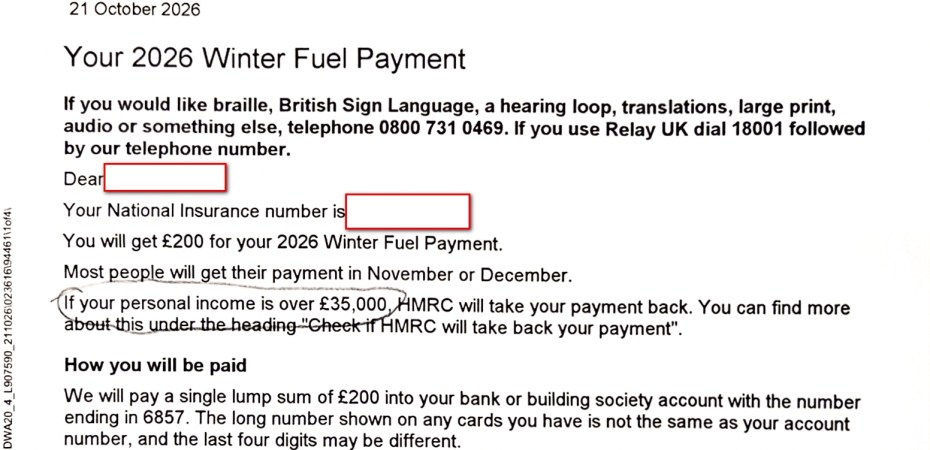
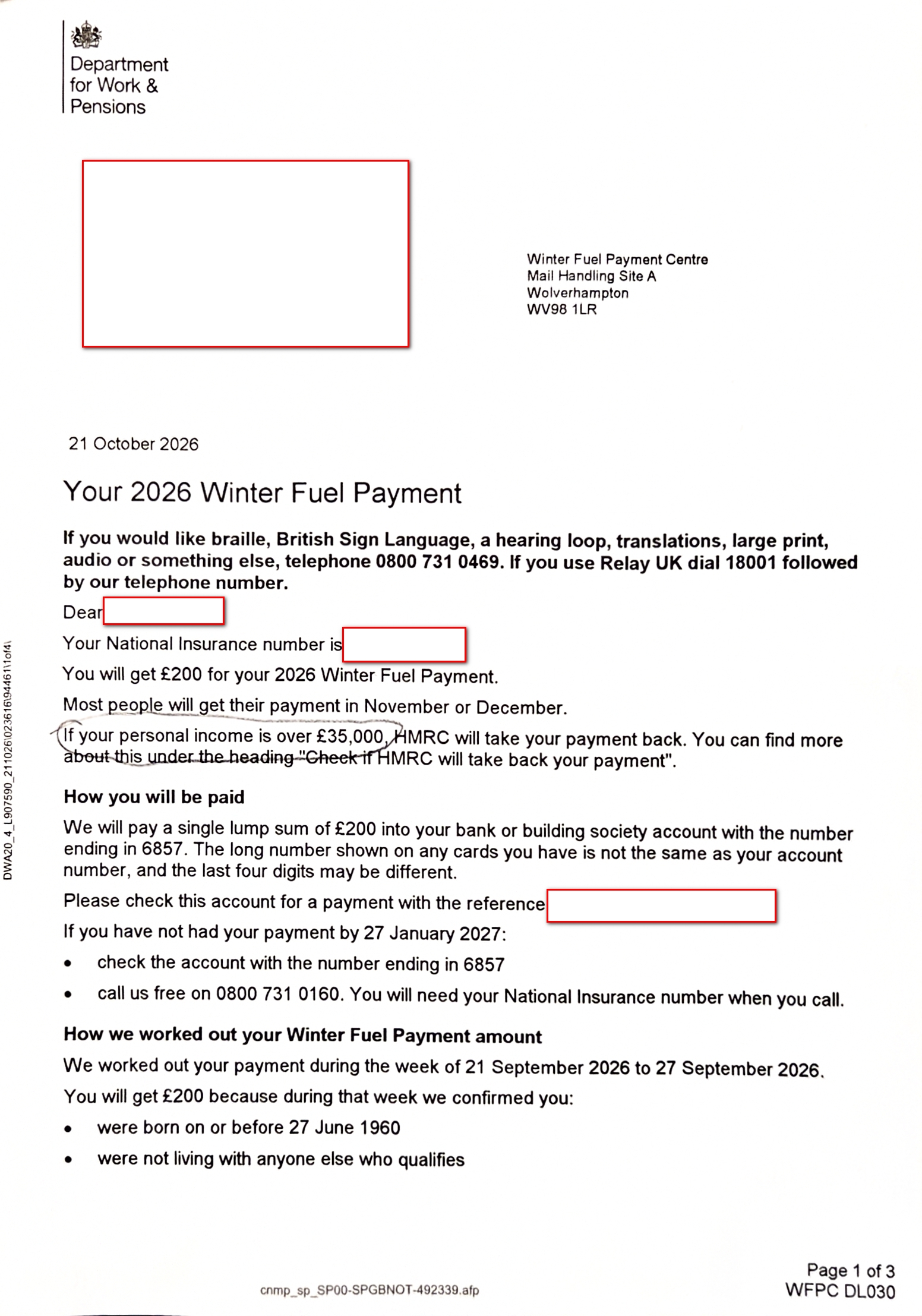
Last week I had a letter from the Winter Fuel Payment Centre, which the Department for Work and Pensions keeps at Mail Handling Site A in Wolverhampton. It is dated 21 October and tells me that I shall receive £200 as my 2026 Winter Fuel Payment, because during the week of 21 to 27 September the Department confirmed that I was born on or before 27 June 1960 and was not living with anyone else who qualifies. I could have told them the second of these facts without the research. Before it reaches any of this, the letter offers to communicate with me in braille, British Sign Language, large print, audio or translation, or through a hearing loop, “or something else”. The Department is plainly anxious that I should understand what it has to say, and in its third paragraph it says it: “If your personal income is over £35,000, HMRC will take your payment back.” I have drawn a circle round that sentence in pencil, since it is the only part of the letter that matters.
As most of our readers are American, I must explain what this payment is. The Winter Fuel Payment was introduced by Gordon Brown in 1997, when it was worth £20, and for most of this century it has stood at £200 for households in which nobody is over eighty. It has never been uprated for inflation, and it now buys about half of what it bought when Mr Brown fixed it at that figure. For a quarter of a century it went to everyone over pension age, rich or poor, as a token that the State recognised a duty to those who had paid for it during their working lives. In July 2024, within weeks of taking office, Rachel Reeves restricted it to those receiving Pension Credit or certain other means-tested benefits, which reduced the number entitled to about one pensioner in eight. The outcry was loud, and the electoral cost was louder. After the local elections of May 2025, the Government announced that the payment would again go to everyone over pension age, but that anyone whose taxable income exceeded £35,000 would have it taken back through the tax system. That is the arrangement under which my letter was sent.
The machinery deserves a moment’s notice, because it is a perfect specimen of modern administration. The Department for Work and Pensions pays me £200 in November or December. His Majesty’s Revenue and Customs then alters my tax code, or adds a “Winter Fuel Payment charge” to my self-assessment return, and takes the £200 back. Two departments and their computers are thus employed to produce a net transfer of nothing. The threshold is applied to each person separately, and it is a cliff rather than a slope. A pensioner with an income of £34,999 keeps the whole payment, while one with £35,001 loses all of it, so that the last two pounds of his income are taxed at ten thousand per cent. Nor is the threshold to rise with prices. The Government says that £35,000 is broadly in line with average earnings, which was true when the figure was announced and will become less true every year, until it catches pensioners whose only other income is a modest occupational pension. About 2.2 million people were expected to lose the payment in this way, and the Government estimated a saving of about £450 million a year. The House of Commons Library observes that much of this may be swallowed by the increase in claims for Pension Credit that the original cut provoked.
I must be honest about my own case. I do not need the money. As readers of these pages know, I live in a house in the West Country that is larger than I need and dearer to heat than I can justify, and I have taken to closing the doors on the rooms I do not use. Two hundred pounds would not keep my boiler going for long in January, and losing it will not change what I eat or drink. My income is over the threshold because I still have work on my desk and some savings from a long professional life, and I do not ask to be pitied. My need, however, has nothing to do with the matter. What is in question is whether the State may make a promise, collect the price of it for half a century, and then withdraw it from those who were prudent enough not to need it.
Lawyers have a name for what I have lost. In public law, a legitimate expectation arises when a public authority, by a promise or a settled practice, leads a person to believe that he will be treated in a certain way. In R v North and East Devon Health Authority, ex parte Coughlan, decided by the Court of Appeal in 1999, a severely disabled woman had been moved into a new care home on the assurance that it would be her home for life. When the authority decided to close it, the court held that to frustrate her expectation without an overriding public interest would be an abuse of power. I do not pretend that my own case would succeed. The doctrine restrains the way in which ministers use their discretions, but it does not bind Parliament, and it was never meant to protect a whole class of people against a change of general policy. No judge would listen to me for long. Yet the doctrine rests on a moral intuition far older than any reported case, which is that a State that has induced people to arrange their lives on the faith of its word ought not to break that word merely because breaking it has become convenient.
My own expectation was formed over a working life. I began paying income tax in the 1970s, when the basic rate stood above thirty per cent and the top rate on earned income was eighty-three. Since then I have paid National Insurance, VAT, stamp duty, capital gains tax, the duties on drink and tobacco, which in my case have been considerable, and a long list of lesser charges that I have mercifully forgotten. In return, the State assured my generation that it would see to our security in old age. I never thought much of that bargain, and libertarians opposed it from the beginning, as I explained in these pages in the summer. But I was given no choice about entering it, since the State took its price first. Having received full performance, it now proposes to reduce its own, and the law of contract has a plainer word than disappointment for conduct of that kind.
Here I must concede what any consistent libertarian would concede. If the State announced that it would stop paying the Winter Fuel Payment to anyone at all, and would reduce taxes by the same amount, I should have no complaint. The money would remain with those who earned it, and that would be more legitimate even than paying it to me. Nobody has proposed anything of the kind. The £200 taken back from me will not be returned to anyone who pays taxes. It will go into the Consolidated Fund, from which the State pays for everything else, and it is fair to ask what else that fund is being used for.
The answer is the same as when I wrote about the triple lock earlier this month. Health and disability benefits cost £83.4 billion in 2025-26, and the Office for Budget Responsibility expects them to reach almost £100 billion by 2028-29. The asylum system cost about £4.9 billion in 2024-25, and the contracts for housing asylum seekers, which were expected in 2019 to cost £4.5 billion over ten years, are now expected to cost £15.3 billion. Universal Credit paid in 2025 to households containing at least one foreign national was reported in September at £11.9 billion. Against these sums, the £450 million that the State hopes to recover from me and two million others is about one part in two hundred of the disability bill alone. I do not claim that every claimant is idle, and many are no doubt as ill as they say. My point is that a State which cannot bring itself to examine the growth of these payments has no business telling a pensioner who has paid his way that his £200 cannot be afforded.
Then there is the war. On Sunday, the Defence Secretary, Wes Streeting, wrote in the Telegraph that the country has “a little over 1,000 days to complete our mission: to be ready with our allies to fight and win.” The enemy he named was Russia. Three days earlier, the Cabinet Office had advised every household to keep at least three days’ food and nine litres of bottled water. Mr Streeting is “100 per cent confident” that defence spending will reach 3.5 per cent of national income by 2035, and the Office for Budget Responsibility reckons that this will cost an additional £40 billion a year. I argued recently that a long war with Russia cannot be fought by a country in our condition, and I have not changed my mind. A war that cannot be fought can nevertheless be prepared for, and preparation is where the money goes. Contractors will be paid and factories subsidised, consultants will be engaged to write plans for civil resilience, and every frightened household in the kingdom will buy its nine litres of water.
Why should our rulers want this? I can offer only an inference, and I mark it as one. For about a century, first in London and then in New York, the Anglo-American financial order has lived on the rest of the world. It has issued the currencies in which the world trades and saves, and it has financed itself by selling its debt to foreigners who had little choice but to buy it. That order is now questioned more openly than at any time since 1945. Central banks have been buying gold at a rate not seen for half a century, and the keenest buyers have been those that watched the Western powers freeze Russia’s reserves in 2022 and drew the obvious conclusion. A ruling class whose wealth and position depend on the old order has every reason to be frightened, and frightened ruling classes have a long habit of looking for an external enemy. Russia, which has shown more plainly than any other country that sanctions imposed from London and Washington can be survived, is the obvious candidate. The permanent expectation of war justifies the taxes and makes dissent look like disloyalty, and it is useful whether or not the war ever comes. Pensioners are among those who will pay for it.
The history of the payment since 2024 illustrates what I said earlier this month about the nature of democracy. The cut of 2024 was not in Labour’s manifesto. It was imposed at once, defended for ten months with every argument from necessity, and abandoned only after the local elections had shown what it was costing. The voters were allowed something of what they wanted, but observe how much. They were not given back the universal payment. They were given a means test of a different shape, administered through the tax code instead of the benefits system, at a threshold that inflation will lower every year without anyone having to vote for it. That is what I meant when I said that elections are sometimes treated as a consultative opinion poll. The people are heard, but the direction of travel remains the one fixed elsewhere.
Mr Healey’s first Budget is due as I write, and I expect nothing from it that will make the letter from Wolverhampton look any better. The £200 will reach my bank in November or December, and in due course the Revenue will retrieve it through my tax code, after which, for all I know, the two departments will write to each other to confirm that the transaction is complete. I have put the letter with my other papers. I keep most documents that record a promise, because a lawyer learns early that the time to collect evidence of a broken undertaking is before the other side begins to deny that it was ever given. The Department will explain itself in braille or in sign language if I ask. What it cannot do in any language is explain why a man who has paid tax for fifty years must treat his winter fuel as a privilege of poverty, while the money he gives back is spent on a war that cannot be fought and on an army of dependants whose claims nobody in office dares to examine.
Sources
Department for Work and Pensions, letter from the Winter Fuel Payment Centre, 21 October 2026.
House of Commons Library, “Winter Fuel Payment from 2025/26”, CBP-10973: https://commonslibrary.parliament.uk/research-briefings/cbp-10973/
MoneyWeek, “HMRC to start clawing back Winter Fuel Payments from certain pensioners”: https://moneyweek.com/personal-finance/tax/how-hmrc-recovers-winter-fuel-payment
R v North and East Devon Health Authority, ex parte Coughlan [2001] QB 213 (Court of Appeal, 1999).
Wes Streeting in The Sunday Telegraph, 25 October 2026, as reported by the World Socialist Web Site, 26 October 2026: https://www.wsws.org/en/articles/2026/10/26/wcww-o26.html
Full Fact on health and disability benefits (Office for Budget Responsibility figures): https://fullfact.org/economy/tony-blair-disability-benefits-defence-spending/
National Audit Office, “An analysis of the asylum system”, 10 December 2025, and “Home Office’s asylum accommodation contracts”, 7 May 2025: https://www.nao.org.uk/
House of Commons Library, “UK defence spending”, CBP-8175, 22 July 2026: https://researchbriefings.files.parliament.uk/documents/CBP-8175/CBP-8175.pdf
Discover more from The Libertarian Alliance
Subscribe to get the latest posts sent to your email.
Related posts:
 The Pension as Pretext: How the Blairite Clerisy Proposes to Loot the Old and Call It Reform
 The End of the Bargain: Why They Are Coming for the State Pension
 Mr Burnham Picks the Lock: The State Pension and the Limits of Democracy
 Nick Griffin and the Demographic Winter That Need Not Come
 Mr Healey’s Budget and the Arithmetic of Ruin
 The Drumbeat for Conscription: Why War with Russia is the Regime’s Last Throw
 Too Soon, Not Too Wrong: Gold and the Meaning of a Fall
 Hyperinflation: Engineered Crisis or Convenient Catastrophe?
 Tax the Rich, Free the Middle Class
 Gold Is Down. So What? Why I’m Still Buying Gold and Silver
 The Great Intellectual Property Bubble and the Coming Reckoning for Western Economies
 Your War Is Not My War
Powered by YARPP.