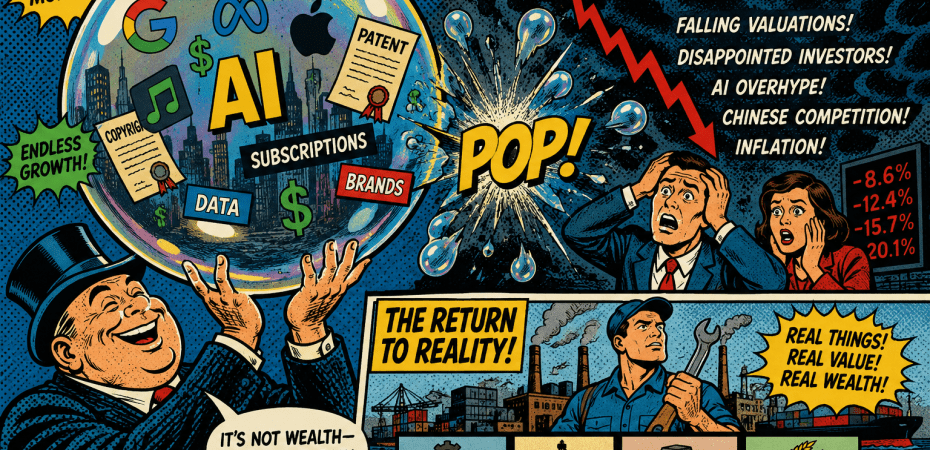
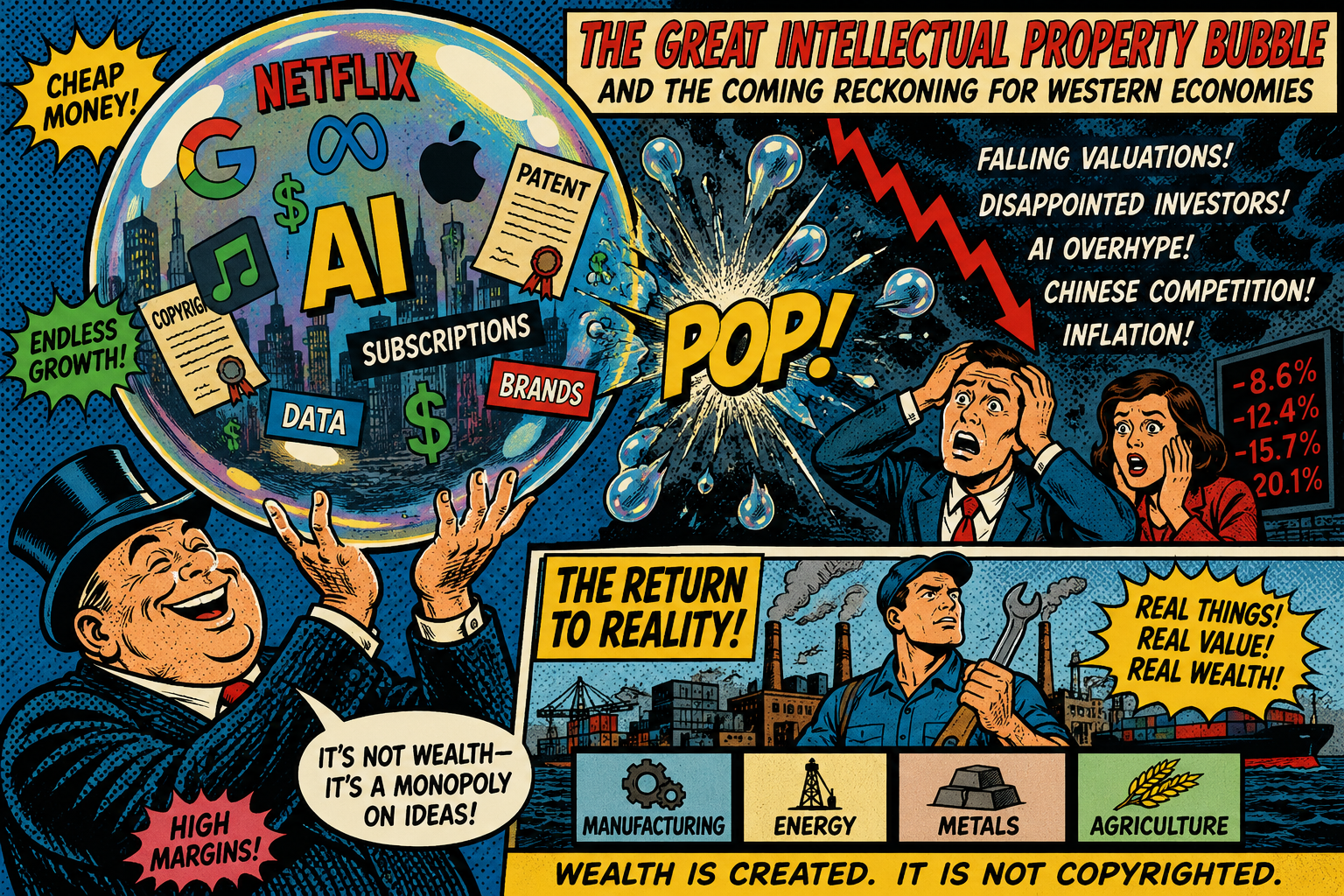
Since the early 1990s, Western economies have undergone a complete and perilous transformation. They have shifted from systems centered on the production of tangible goods to ones dominated by the extraction of rents through finance and intellectual property. Factories and machine tools gave way to platforms and algorithms, both resting on legal monopolies. Wealth came to be measured less by what nations manufactured than by the soaring market capitalizations of technology companies whose primary assets consisted of patents, copyrights, trademarks, and proprietary data. This was presented as the inevitable triumph of the “knowledge economy.” In reality, it represented a dangerous wager: that legal privileges and financial engineering could indefinitely substitute for genuine productive capacity.
That wager is now visibly unraveling. The recent weakness in technology stocks, the mounting difficulties of streaming giants like Netflix, and the sharp sell-offs triggered by Chinese open-source AI breakthroughs are not isolated corrections. They are the first cracks in a thirty-year experiment that substituted paper claims and monopoly rents for the hard work of making things. The intellectual property bubble—sustained by intrusive laws, currency debasement, and speculative capital—is beginning to deflate. Its collapse will force a painful reckoning.
The distinction between productive assets and intellectual property is routinely blurred in modern economic discourse. A steel mill produces steel regardless of whether legislatures amend patent statutes. An oilfield yields crude because of geology and engineering. A farm generates wheat through soil, labor, and machinery. These assets possess intrinsic value because they transform physical reality into goods that satisfy human needs. Their worth does not depend on continuous political enforcement. Intellectual property operates differently. A patent derives its commercial power from the state’s willingness to prohibit others from using the same invention. A copyright exists only because courts punish unauthorized copying. A trademark retains value through laws that protect it from imitation. Remove or weaken these legal privileges—through circumvention, open-source alternatives, jurisdictional arbitrage, or simple non-enforcement—and much of this “property” becomes worthless worth. It is not property in the classical sense. It is a state-granted monopoly, a privilege sustained by law and litigation.
Rewarding invention may be essential to progress. The problem arises when legal protections cease to incentivize discovery and instead become instruments for extracting perpetual monopoly rents. Western capitalism has tilted decisively in this direction. The result is an economy that increasingly rewards ownership of legal claims rather than the creation of tangible wealth.
This shift was supercharged by extraordinary monetary expansion. Following the 2008 financial crisis and especially after 2020, central banks—led by the Federal Reserve—created trillions in new money. Interest rates were driven to near zero. Investors, starved of yield in traditional assets, poured capital into sectors promising scalable rents with minimal physical infrastructure. Technology platforms, streaming services, SaaS companies, and AI ventures became magnets for this liquidity.
Netflix provides a textbook case. The company initially built its audience with low prices and a vast library of content. Once it had captured tens of millions of subscribers, it pivoted to aggressive price increases, the reintroduction of advertising, both attended by more selective content investment. The goal shifted from delighting customers to maximizing extraction from a captive base. For years the strategy appeared to work. Subscriber growth masked underlying fragility.
Reality has now intruded. Recent quarterly results disappointed Wall Street. Revenue and earnings projections for the third quarter fell short of expectations. The company has grown reluctant to release detailed viewership data, postponing comprehensive reports until 2027. Even its biggest new series have struggled to retain audiences, and subscriber churn is rising as users complain of declining value and repeated price hikes. Shares have lost roughly a fifth of their value this year, with sharp drops following earnings releases. Similar pressures afflict Spotify, Disney, and other platforms pursuing parallel “audience capture” strategies—raising prices while reducing investment in genuine innovation or quality.
This is not only corporate mismanagement. It is the logical endpoint of a broader model that has spread across the digital economy. Search engines prioritize advertising over information. Software once sold outright is now rented indefinitely. Smartphone ecosystems are engineered for lock-in. Printer manufacturers tie customers to proprietary consumables. Loyalty programs and subscription models proliferate. The common thread is the replacement of competition through superior products with competition through inconvenience of departure.
Artificial intelligence has supercharged the bubble rather than resolving it. Enormous capital expenditures—up nearly 876% since 2019 among major tech firms—have driven valuations to extremes based on assumptions of durable monopolies over future technology. Investors bet that proprietary systems from a handful of American giants would generate immense licensing revenues for decades. Developments in China are challenging that premise. Moonshot AI’s recent release of Kimi K3, a powerful open-source model closing much of the gap with leading Western systems, triggered sharp sell-offs. The Nasdaq fell over 1%, semiconductor indices entered bear market territory, and Asian markets (Taiwan, Japan) plunged. Similar shocks followed earlier Chinese breakthroughs. Open-source models threaten the high-margin, closed-source subscription model by commoditizing capabilities that investors assumed would remain scarce and expensive.
The broader market reaction—declines in Nvidia, Alphabet, and related names—reflects growing recognition that the AI spending spree may face limits. Concentration risk is extreme: technology, media, and telecom now comprise nearly half the S&P 500, exceeding dot-com bubble peaks. A reversal in AI leaders ripples across the entire index.
While the West specialized in legal privileges, competitors—notably China—continued building real productive capacity. Steel production, shipyards, semiconductor fabrication, machine tools, and engineering talent were prioritized. Western universities churned out administrators and consultants; others trained engineers. Financial assets and intellectual property represent claims on production. They cannot substitute for it indefinitely. A society cannot consume software or heat homes with patents. Every prosperous civilization rests on its ability to transform raw materials into useful goods.
For years, rising asset prices disguised industrial decline. GDP statistics flattered policymakers even as manufacturing employment shrank and supply chains migrated overseas. Much of the apparent prosperity was asset inflation rather than increased real output. That illusion is dissolving.
Investors should draw the obvious lesson: exit markets where valuations rest primarily on intangibles sustained by law and narrative. High-multiple software platforms, streaming empires, and speculative AI ventures dependent on perpetual audience captivity and monopoly enforcement carry growing risk. Instead, favor commodities with intrinsic scarcity and shares in companies engaged in genuine manufacturing and production. These assets retain value rooted in physical reality. They stand to benefit from re-shoring trends and the general reassertion of production-based economics.
The political implications are equally significant. Western governments altered capitalism’s incentives: making speculation easier than manufacturing, encouraging investment in legal monopolies over productive enterprise, and using cheap money to inflate paper wealth. The resulting detachment from physical processes has left economies vulnerable. Reviving manufacturing, reforming monetary policy to restrain debasement, and reconsidering the endless expansion of IP protections are not optional. They are essential to avoid a more disorderly adjustment.
The Netflix saga, the AI valuation wobbles, and the broader tech rotation are early warnings. Audience capture worked while capital was abundant and alternatives scarce. That era is ending. Chinese competition and macroeconomic pressures are exposing the model’s limits. Companies will either return to genuinely serving customers or face accelerating decline.
A civilization cannot indefinitely license ideas while others manufacture reality. The age of abstractions is yielding to the age of things. Those who recognize this shift—positioning in tangible assets and productive enterprise—will be far better placed when the intellectual property bubble fully deflates. The reckoning is uncomfortable but necessary. Real wealth was never found in legal privileges alone. It was always found in what can be seen, touched, and built.
Discover more from The Libertarian Alliance
Subscribe to get the latest posts sent to your email.
Related posts:
 Gold, Silver, and the Managed Demolition of Western Money
 Britain’s Debt is a National Scam: A Case for Repudiation
 Repudiating Britain’s National Debt: An Inevitable Reality Already Unfolding
 Going for Gold
 Going for Gold: A Note of Caution to Bryan
Too Soon, Not Too Wrong: Gold and the Meaning of a Fall
Going for Gold: A Note of Caution to Bryan
Too Soon, Not Too Wrong: Gold and the Meaning of a Fall
 Hyperinflation: Engineered Crisis or Convenient Catastrophe?
 Bullion Falls, Fiat Rots
 A Case for Investing in Uranium and Other Commodities
 The Lure of Gold
 The End of Fiat and the Return of Gold
 Gold Is Down. So What? Why I’m Still Buying Gold and Silver
Powered by YARPP.
Pozeram, “The Great Intellectual Property Bubble and the Coming Reckoning for Western Economies” https://c4sif.org/2026/07/pozeram-the-great-intellectual-property-bubble-and-the-coming-reckoning-for-western-economies/