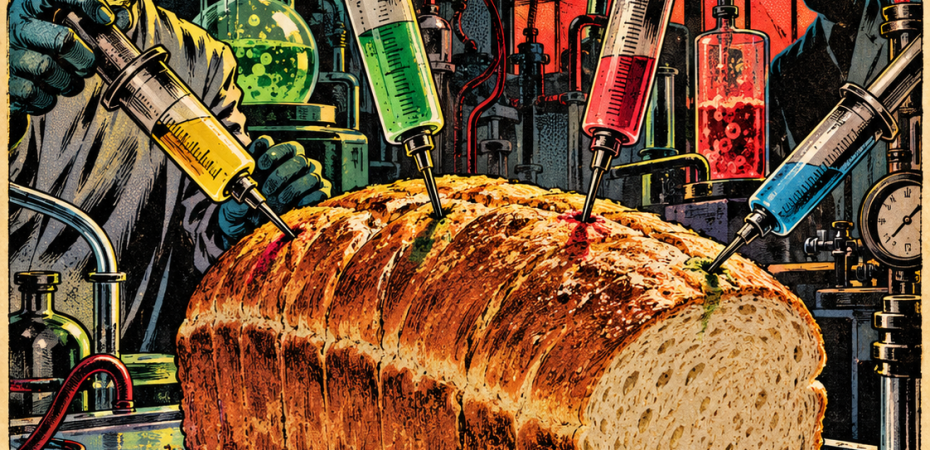
A few weeks ago, in an essay called “Medicine in the Loaf”, I wrote about the Government’s decision to add folic acid to all white and brown wheat flour sold in the United Kingdom. The law takes full effect on the 13th December, which is now about a month away. I said then that I had read the evidence on both sides, that I found it inconclusive, and that I did not think the answer mattered very much. Even if folic acid did everything the Government claimed and nothing its critics feared, I should still object to its being put into the daily food of sixty-nine million people who had not been asked.
Since then the argument has grown louder. A parliamentary petition calling for the law to be repealed has, according to its supporters, passed the hundred thousand signatures needed for it to be considered for debate. And on the 21st October, Dr Liz Evans, the chief executive of the UK Medical Freedom Alliance, appeared on UK Column News to give a fifteen-minute presentation on the subject. The Alliance has since published a summary of it under the title “Who’s Behind the Global Folic Acid Fortification Agenda?” I have watched the presentation twice and read the summary, and I want to review both. Dr Evans makes some excellent points and some poor ones, and the difference between them is worth examining. But my conclusion is the one I reached before, and it has grown firmer. This law is one more step by the British state towards the claim that nothing we do, or eat, or drink, lies outside its jurisdiction.
I should say a word about the setting. UK Column is not a programme I normally watch, and I share few of its wider opinions. The edition in which Dr Evans appeared also dealt with British aircraft in the Yemen war, with the inquiry into care homes during the Covid lockdowns, and with the possibility of conscription, and much of it was delivered in a tone I find unhelpful. But a case is not refuted by the company it keeps. It is a reproach to the newspapers and the BBC that people who object to compulsory medication in their bread must go to outlets like this to be heard at length. I shall judge Dr Evans on what she said. In quoting her, I have removed the hesitations of live speech.
What she gets right
Dr Evans begins with the procedure, and here she is entirely correct. In November 2024, she says, “an amendment to the 1998 Bread and Flour Regulations was quietly introduced by statutory instrument, placing a legal requirement on millers and flour producers to add folic acid to non-wholemeal wheat flour.” It was signed by Daniel Zeichner, then a Minister of State at the Department for Environment, Food and Rural Affairs. There was, she says, “no parliamentary debate and no full scientific impact assessment.” I found the same when I looked. The House of Lords discussed the subject in the spring of 2024, before the instrument was made, and Baroness Merron, for the Government, reassured peers who raised questions about safety that “safety is paramount”. So far as Dr Evans could find, the Commons has not debated the subject since 2018.
She adds some details I did not know. The Government held a public consultation in 2019, which ran for twelve weeks. “Only around 1,400 responses were received,” she says, “of which only 53% supported fortification. So, not exactly a ringing public endorsement.” I have not checked these figures against the Government’s published response, but they sound plausible, and they make the point rather well. In a country of nearly seventy million people, a policy that will change what every one of them eats was approved by just over seven hundred self-selected respondents, and opposed by nearly as many.
She is also right on the practical consequences. The only exemptions in the regulations are for wholemeal flour, for flour from very small mills, and for flour used to make “communion wafers, matzos, gluten, starch” and the concentrated preparations of the additives themselves. As she says, “Even if you make your own bread using unfortified wholemeal flour, when eating out or buying food to go you will be hard pressed to avoid ingesting folic acid.” Anyone who eats in a café, a canteen, a hospital, a care home or a school will take it whether he wishes to or not.
Her best point is about the dose. The Government’s justification is that about half of all pregnancies are unplanned, and that women who do not know they are pregnant do not take the supplements they are advised to take. “But surely,” she asks, “the answer can’t be to medicate the whole population to target this tiny cohort.” And she goes on:
Mass medication through fortification gives no control over the dose an individual receives. And it’s self-evident that individual doses will vary widely depending on the amount of fortified flour consumed. Worryingly, children may ingest the most folic acid, as they are high consumers of other fortified foods such as breakfast cereals.
The official advice is that long-term intake of folic acid from fortified foods and supplements should stay below one milligram a day for adults, and lower for children. “But how on earth,” she asks, “can that be measured or adhered to in practice?” It cannot. That is the difference between a medicine and an additive. A doctor who prescribes a tablet knows the dose, the patient and the reason. A minister who orders an additive knows none of these. He knows only the average, and nobody is average. The young man who eats a loaf a day, the child who lives on toast and cereal, the old woman with pernicious anaemia who eats mostly bread and soup, will all receive amounts that nobody has calculated and nobody will measure.
Finally, she states the ethical case in terms I cannot improve on:
Fortification is using a sledgehammer to crack a nut. The only people who can benefit from additional folic acid are women in early pregnancy, who make up less than 2% of the population. Yet the whole population of 70 million men, women, and children are being treated. 70 million people forced to ingest a synthetic drug through a staple food that none of the men, post-menopausal women, children, or babies can benefit from at all.
The written summary puts the target group at less than one per cent rather than two, and I suspect that at any given moment it is smaller than either. It hardly matters. The whole nation is to be dosed for the sake of a small fraction of it.
A Catholic aside
Dr Evans also quotes a figure that deserves more attention than it usually gets. The Government’s estimate of two hundred neural tube defects prevented each year translates, she says, “into around 28 fewer live births with spina bifida or anencephaly.” The rest of those two hundred pregnancies would, for the most part, have ended in miscarriage or in abortion.
The critics of fortification usually mention this to make the benefit seem smaller. As a Catholic, I see it differently. If the policy works as the Government says, then one of its effects will be that well over a hundred pregnancies a year that would have ended in abortion will not be conceived with the defect in the first place. I do not think that is a trivial good, and I should be dishonest if I pretended otherwise. It is one reason why I have tried throughout this argument not to pretend that the Government’s case is worthless.
But it does not change my conclusion. Good ends do not license any means that may serve them. It would no doubt reduce the number of abortions if the state monitored the menstrual cycles of every woman of childbearing age, and I hope nobody would propose it. The question is not whether compulsion might do some good. Compulsion often does some good. The question is whether the state has any business doing it.
What she gets wrong
I turn now to the weaker parts of the presentation, because a case is not helped by claims that will not bear examination, and the defenders of the policy will seize on these to dismiss the rest.
The first concerns an advertisement. Dr Evans shows an infographic from one of the large manufacturers of folic acid, promoting a “premium alternative” based on methylfolate, the form in which the body actually uses the vitamin. The advertisement says that up to 75 per cent of people in the world may not be able to convert folic acid properly, which she calls “quite an astonishing admission from a folic acid manufacturer.” I do not find it astonishing at all. It is a claim made by a company in order to sell a more expensive product, and it should be treated with exactly the scepticism one would bring to a claim by the same company that its folic acid was perfectly safe. A sales brochure is not a scientific paper merely because it says something one wishes to hear.
The second is more substantial. Dr Evans cites an American study, published in 2014, that found unmetabolised folic acid in the blood of more than 95 per cent of Americans. That study is real, and the finding is not in dispute. But she then says that this unmetabolised folic acid “can cause widespread harm”, and that it “blocks key brain receptors, preventing essential folate uptake to the central nervous system.” I know of no good evidence for this. Our own Scientific Advisory Committee on Nutrition said in 2017 that the evidence was insufficient to show whether unmetabolised folic acid did any harm at all. That is a long way from showing that it does none. But it is also a long way from what Dr Evans says.
The third concerns the Hungarian trial of 1992, in which, she says, there were “nine fetal deaths for every one NTD birth prevented.” I discussed this in my earlier essay. The excess of fetal deaths in that trial is real, and it has never been conclusively explained. But the women in it took a multivitamin containing a dozen other vitamins and minerals, not folic acid alone, and a much larger Chinese study of women who took folic acid alone found no increase in miscarriage. The terathanasia hypothesis is a fair question. It is not an established fact.
She also says that the Scientific Advisory Committee “inexplicably” reversed its position, advising against fortification in 2002 and in favour of it a few years later. It is not inexplicable. American evidence on the masking of vitamin B12 deficiency, which had been the main reason for the earlier caution, came in during those years and was more reassuring than had been feared. One may think the committee was wrong to be reassured. But changing one’s mind in the light of new evidence is what a scientific committee is supposed to do.
The map and the money
The last part of the presentation asks who is “behind the global push to adulterate flour with synthetic and toxic chemicals masquerading as essential nutrients”. Dr Evans names the Food Fortification Initiative, the World Health Organisation, the World Bank, and the Global Alliance for Improved Nutrition, or GAIN, a foundation based in Geneva that was launched at the United Nations in 2002. “According to AI,” she says, the Gates Foundation is GAIN’s largest philanthropic funder. Since I am told that a great deal of what is now published is drafted with the help of machines, I should not be too hard on this. But it is not the way to make an argument that one wishes to be taken seriously.
She then shows a map of the countries that make fortification compulsory, and says: “The UK are the only country in Europe who adulterate their grains. The US is the most prolific fortifier of many grains. Whereas Russia, China, India, and much of Africa have kept their grains pure.” The first sentence is not quite accurate. Moldova and Kosovo, among others, had laws requiring folic acid in wheat flour more than a decade ago. What is true is that Britain is the only country in western Europe to do so, and that the European Union has never followed. That is worth saying, and it is a pity to spoil it by overstatement.
The second sentence amused me. My family came from China, and I can assure Dr Evans that the Chinese state’s restraint in the matter of flour is not evidence of any wider respect for the bodies or minds of its subjects. A government that can watch every citizen through his telephone has no need to medicate his bread. I do not think we should look to Peking or Moscow for lessons in liberty.
But I do not wish to be unfair to her here. Her point is not that these organisations are engaged in a secret plot. Most of what she describes is public. GAIN and the Food Fortification Initiative publish their aims, their funders and their progress. When the Food Fortification Initiative was founded in 2002, only thirty-eight countries required fortification; now, she says, eighty-six do. She also describes a policy paper from October 2020 in which GAIN and others seem to have treated the Covid crisis as an opportunity to speed up fortification policies. I have not read that document myself, but if it says what she says it does, it is no more than one would expect. Every movement that wants something from governments regards a crisis as an opportunity. That is not conspiracy. It is lobbying.
I think, indeed, that the truth is worse than a conspiracy would be. A conspiracy can be exposed and its members punished. What Dr Evans has actually described is a consensus: a network of international agencies, charitable foundations, academic nutritionists and national advisory committees, all agreeing with one another, all funded from much the same sources, and none of them answerable to any voter anywhere. Its members are, for the most part, sincere. They believe that they are preventing birth defects and anaemia, and in many places they no doubt are. But they have come to regard national governments as instruments for carrying out policies decided elsewhere, and the people of those nations as a population to be managed. There is no need for a plot when everyone in the room already agrees.
Chalk and the Act of 1757
Dr Evans made one historical point that I found particularly striking. “Many people are unaware,” she said, “that in the UK white flour has been fortified with calcium carbonate, or chalk, since 1941, and with iron, thiamine and niacin since the 1950s.” And she added:
This is ironic considering that in 1757, Parliament passed the Making of Bread Act specifically to protect public health by banning additives like chalk and punishing those who adulterated flour.
The Act she means is 31 George II c. 29, “An Act for the due making of bread; and to regulate the price and assize thereof; and to punish persons who shall adulterate meal, flour, or bread.” It followed a public panic about bakers who were said to be whitening their bread with alum, chalk and even powdered bones. It was repealed in 1867.
The irony is real, but I would put it a little differently. The Act of 1757 was not a libertarian measure. It was part of the old system of the assize of bread, under which magistrates fixed the price and weight of a loaf, and it was swept away in the age of free trade along with much else of the kind. The British state has always meddled with bread. What has changed is the direction of the meddling. In 1757 Parliament punished the baker who put chalk in his flour. In 2026 a minister punishes the miller who does not put in folic acid. The old law, whatever its faults, protected the buyer against the seller. The new law protects neither. It enlists both in a programme decided by people who will never meet either of them.
There is a further irony that a Catholic cannot miss. Among the very few exemptions in the regulations is flour “for use in the manufacture of communion wafers”. The reason is not hard to find. Canon law requires that the bread of the Eucharist be made of wheat and water alone, and the Jewish law of the Passover matzo is equally strict. The state has, quite properly, respected these laws. But it means that the only bread in England now safe from the Department of Health is the bread that is about to become something else entirely. We still pray “Give us this day our daily bread.” We had better add a petition that it be left as God and the miller made it.
The road to total jurisdiction
Dr Evans ends with a warning: the mandate “sets a dangerous precedent for future governments to seek to mass medicate the public through food.” I agree, but I think she understates it. This is not a precedent. It is the continuation of a precedent set long ago, and it points somewhere much further.
The word “totalitarian” was coined in the 1920s by the opponents of Mussolini, and he adopted it with pride. His formula for the new state was “everything within the state, nothing outside the state, nothing against the state.” We are used to thinking of totalitarianism as something achieved by secret police and camps, and those were certainly its instruments in the twentieth century. But its essence was the claim, not the instruments. It was the claim that there is no part of human life, no family, no church, no private habit, no meal at one’s own table, over which the state has no rightful authority.
Britain is not a totalitarian state, and I do not wish to be hysterical. Its courts still sometimes rule against the Government, and its people can still vote ministers out. But the claim is being made, piece by piece, and each piece is presented as too small and too benevolent to object to. Fluoride is put into the water, and the power to order it is taken from local councils and given to the Secretary of State. Folic acid is put into the bread. Adults must prove their age to read large parts of the internet. Silent prayer in the wrong street becomes a crime. None of these, on its own, amounts to tyranny. Taken together, they describe a state that no longer recognises any area of life as simply none of its business.
The same edition of UK Column provided a glimpse of what may come next. Before Dr Evans spoke, another presenter showed a speech in the House of Lords on food security by a Liberal Democrat peer. She warned of droughts, cyber attacks and the vulnerability of the supply chain, and she proposed this remedy:
What’s missing is a coherent national strategy with teeth that draws together public health, planning policy, housing strategy, local government, agricultural policy, and public attitudes. Now is the moment for a good food bill.
I draw attention to the last item on her list. A national strategy “with teeth” is to direct not only what is grown and where people live, but “public attitudes”. The presenter’s comment was that this means “food security as national security, which will lead into greater centralised control.” I think that is a fair reading. The fortification of flour is a small thing. A food system run as a branch of national security, with a strategy that has teeth and a view on what the public ought to think, would not be small at all. And the machinery that adds folic acid to every loaf in the country is precisely the machinery such a system would use.
The Roman emperors fed the people of the city with free grain, and Juvenal complained that a people who had once given out commands and legions now longed anxiously for only two things, bread and circuses. That was a corruption, but it was at least a bargain. The state gave bread, and the people gave up their politics in return. The modern British state has found a better arrangement. It does not give us bread. It takes the bread we have paid for and puts into it whatever its advisers think good for us. And it does not even trouble to ask whether we agree.
Conclusion
I came away from Dr Evans’s presentation with mixed feelings. On the facts of the law, on the impossibility of controlling the dose, on the numbers who will be dosed for the sake of the few, and on the ethics of the whole business, she is right, and she says it clearly. On the science she sometimes claims more than the evidence supports, and on the global background she is more interested in naming villains than in understanding a system. I wish she had been more careful, because the opponents of the policy cannot afford to give its defenders easy targets.
But I did not need persuading. The argument against this law does not depend on unmetabolised folic acid or Hungarian miscarriage rates or the Gates Foundation. It depends on a principle so old that it hardly seems worth stating: that a free man decides for himself what goes into his body, and that a government which takes that decision from him, however kindly it means it, has forgotten what it is for.
If the petition is debated, Members of Parliament will at last have the chance to vote on something that was done in their name without their voices being heard. I hope they take it. In the meantime, I shall go on buying wholemeal, and I shall go on going to Mass.
Further Reading
The interview
- UK Column News, 21 October 2026. Dr Liz Evans’s presentation on folic acid begins at about 17 minutes. The discussion of food security in the House of Lords comes just before it.
- UK Medical Freedom Alliance, “Who’s Behind the Global Folic Acid Fortification Agenda? UKMFA’s Dr Liz Evans Investigates for UK Column News”, 23 October 2026. The written summary of the presentation, with a link to the template letter to MPs.
The law
- The Bread and Flour Regulations 1998, as amended. Regulation 4 sets out the exemptions, including flour for communion wafers and matzos.
- The Bread and Flour (Amendment) (England) Regulations 2024 (SI 2024/1162). The instrument that adds folic acid.
- UK Parliament petition, “End the mandatory fortification of white flour with folic acid immediately”.
- HART, “Supporting debate on folic acid in flour”. The campaign for a parliamentary debate.
The evidence
- Sebastian Wang, “Medicine in the Loaf”, Libertarian Alliance, September 2026. My earlier essay, with a fuller account of the evidence on both sides.
- Scientific Advisory Committee on Nutrition, Update on folic acid (2017). Including its view that the effects of unmetabolised folic acid are unknown.
- M. Pfeiffer and others, “Unmetabolized Folic Acid Is Detected in Nearly All Serum Samples from US Children, Adolescents, and Adults”, Journal of Nutrition, 2015. The American study Dr Evans cites.
- NHS, “Who can and cannot take folic acid”.
- Food Fortification Initiative, Europe: Advocacy Summary (2013). Lists Moldova, Kosovo and others as requiring folic acid in wheat flour.
History
- Making of Bread Act 1757, Wikipedia. A short account of the Act and the panic that led to it.
- Juvenal, Satires, X.77–81, on panem et circenses.

Discover more from The Libertarian Alliance
Subscribe to get the latest posts sent to your email.
Related posts:
 The Horrors of Gout
 Medicine in the Loaf
 Fatness and Savagery: What the Byzantines Knew and We Forget
 The Food Pyramid, and the Limits of State Nutrition
 Why Coffee Is Good for Your Health: History, Evidence, and the Case for a Morning Cup
 Xylitol and the Clotting Question: Why the Latest Warning about Sugar-Free Gum Deserves Attention
 Blood Pressure, Beyond the Slogans: What the Best Evidence Really Shows
 Junk Food for Junk People, and the Joy of Watching Them Rot
 Wegovy, Will-Power, and the Limits of Moral Purism
 Sunshine and the Cult of Fear
 The Jury’s Ancient Power: Why Every Englishman Should Know About Jury Nullification
 Lose Fat, Not Yourself: Why Structure Beats Motivation
Powered by YARPP.