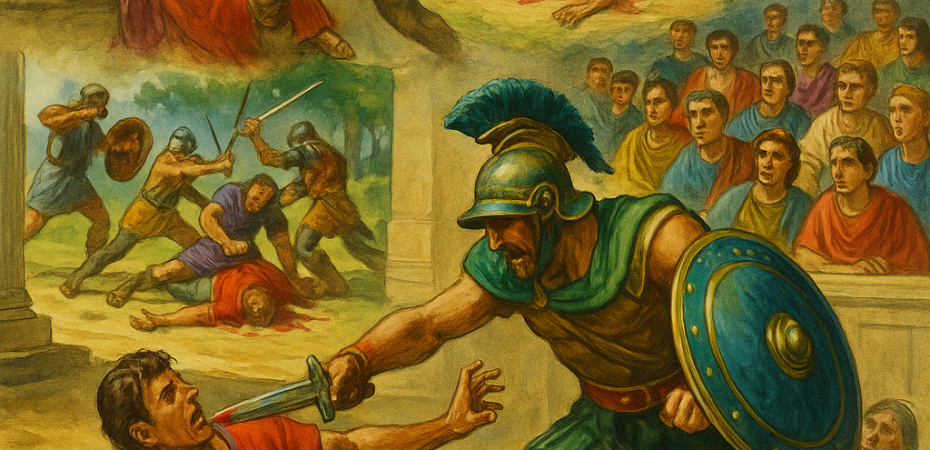
Last term, during a debate in our school’s Politics Society, a younger boy insisted that Britain today was “more dangerous than ancient Rome.” He said it with the certainty only ignorance can provide, citing knife crime statistics from London and videos he’d seen online. I did not reply at the time—Dr Gabb has taught me the value of patience—but I’ve been thinking about that moment ever since. It’s one thing to note the moral chaos of a collapsing civilisation, quite another to pretend that we live in an age of greater violence than the ancients. To believe that is to misunderstand history entirely. For the Greeks and Romans, violent death was not just a possibility. It was a routine feature of daily life.
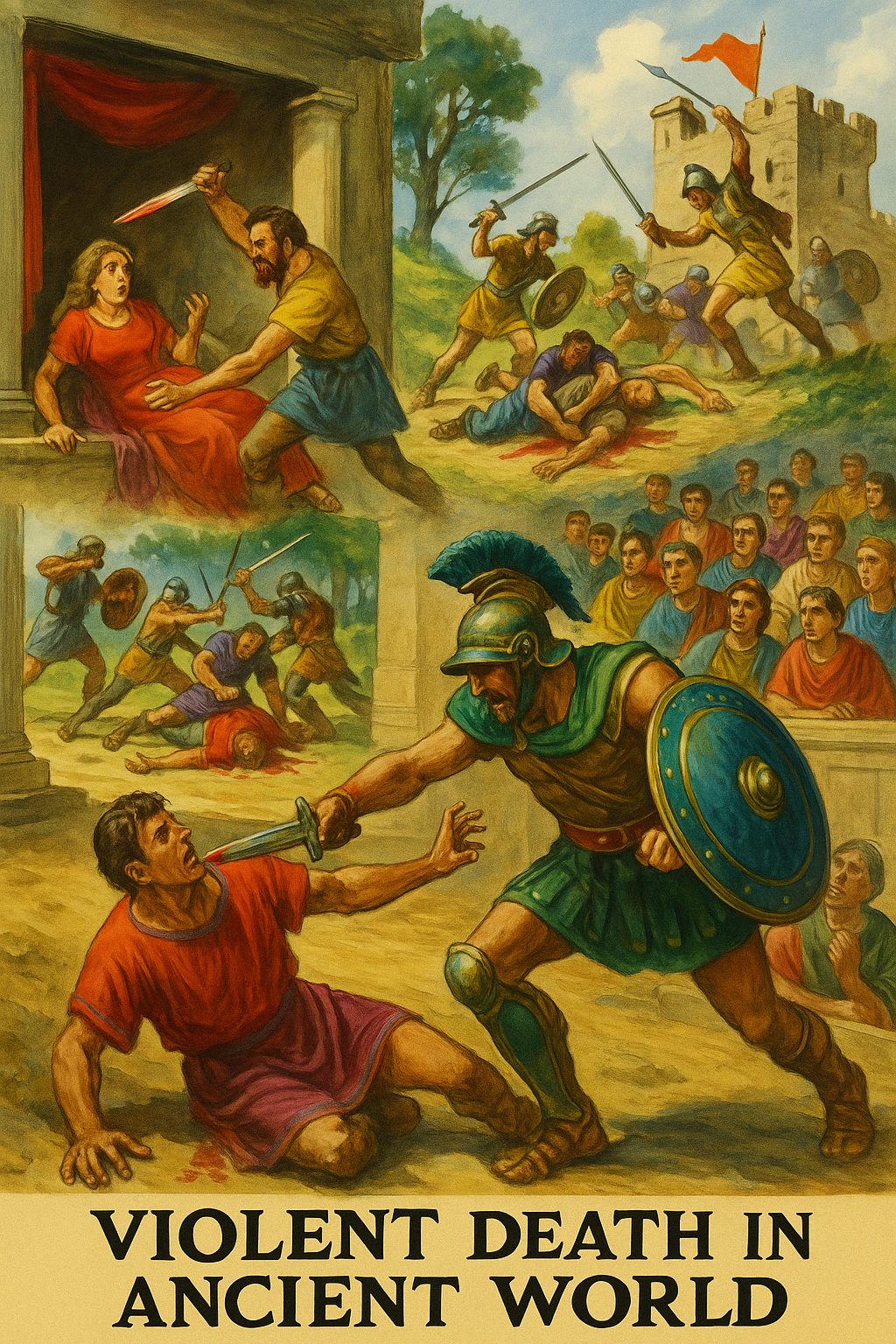
We must begin by understanding this basic truth: the ancient world was soaked in blood. Death by violence—whether in war, vendetta, piracy, execution, or domestic brawl—was neither rare nor shocking. It was part of the ordinary rhythm of things. In an age without police forces, forensic methods, or state-monopolised violence, killing was far more personal and far more common. What we today call “murder” was often seen as either honourable or inevitable.
The Greek historian Polybius, describing the Roman republic in the second century BC, noted with admiration how Roman boys were raised to see war as glorious. The daily sight of gladiatorial games only reinforced this. In contrast to our world—where even the reporting of a school stabbing leads to weeks of moral outrage—the ancients regarded the shedding of blood as normal. As the Greek tragedian Aeschylus wrote in Agamemnon, “τὸ γὰρ αἶμα πέλει δίκης ὕπήκοον” (“For blood is obedient to justice”). That is, violence was not only expected—it was a legitimate instrument of order.
And indeed, it was everywhere. One need only consider the city of Athens during the Peloponnesian War (431–404 BC). While we often romanticise this period as the height of classical civilisation, it was also a time when war, civil strife, and political assassination were everyday occurrences. The Athenian expedition to Sicily (415–413 BC) saw the annihilation of tens of thousands. At the siege of Melos, Athenian soldiers killed all the men and sold the women and children into slavery. Thucydides records that the Athenians did not pretend to justice, but told the Melians plainly: “the strong do what they can, the weak suffer what they must” (Thuc. 5.89).
It was not just foreign enemies who suffered. Within their own cities, Greek elites routinely killed one another in factional struggles. The Thirty Tyrants in Athens (404–403 BC) executed hundreds of political opponents without trial. In Rome, the situation was worse. Sulla’s proscriptions in the 80s BC listed names on public tablets—official invitations to murder. Cicero, in a rare moment of candour, called this era “a time of daggers and lists.”
It is easy for us, growing up in the soft warmth of the postwar West, to underestimate what it meant to live without a secure state. In ancient Greece, particularly before the rise of Macedon, the polis was weak, factionalised, and frequently violent. Outside the city walls, travel was dangerous and brigands common. “The sea,” says the character of the Old Man in Xenophon’s Anabasis, “belongs to pirates.” No one was safe unless they were well-armed or well-connected.
In the Roman world, despite the Empire’s later claims to universal peace—Pax Romana—the reality was still marked by casual brutality. Slaves could be beaten to death without consequence. Freedmen could be murdered by their patrons under a thin veil of legal ambiguity. Rebellions in the provinces were answered with mass crucifixions. Entire populations were sometimes exterminated as collective punishment. As the historian Tacitus put it, describing the Roman conquest of Britain: “They make a desert and call it peace” (Agricola 30).
One of the best indicators of how normal violence was in antiquity is the lack of surprise it provokes in surviving sources. An article by Pascale Brillet-Dubois provides a striking example from Menander’s Aspis (“The Shield”), where the possibility of violent death is simply expected: “He’s gone to war. Either he’ll come back alive, or he won’t. That’s just how it is.”
Menander, writing in the fourth century BC, treats military death with the same tone one might use for seasonal flu. Death was not tragic in the modern sense. It was the tax of existence. The drama lies not in whether someone dies, but in how it disrupts inheritance law.
This matter-of-fact attitude appears even in inscriptions. Epitaphs from across the Greco-Roman world routinely describe individuals as having “fallen by the sword,” “been struck by pirates,” or “killed in an ambush.” The language is formulaic, not emotional. In one famous epigram preserved in the Greek Anthology (7.248), the poet writes:
ὅπλοις ἐν πολέμῖ κταμένῖ γλυκεροῦ παρἀ φωτὸς ἔρωτα
(“To the one killed by arms in war, snatched from the sweet love of life”)
The phrase “arms in war” is not metaphorical. It was literal—and so common as to require no elaboration.
Violent death also had a public, performative dimension. In the Roman Empire, gladiatorial games were not mere spectacles but lessons in mortality. The amphitheatre taught the audience that death, even when staged, was part of the natural order. Roman boys did not grow up fearing death. They grew up clapping for it. One estimate suggests that up to 8,000 gladiators died each year under the Julio-Claudians. That figure excludes criminal executions, of which there were tens of thousands. Crucifixion, burning, and being thrown to wild beasts were all regular features of public life.
Perhaps the most chilling example is the casual execution of prisoners during victory celebrations. When Emperor Titus captured Jerusalem in AD 70, he paraded the spoils through Rome and then had the Jewish captives killed for sport. Suetonius and Josephus both describe this in tones of admiration, not horror. Today, such an act would trigger endless human rights investigations. Then, it was statecraft.
What makes all this so alien to us is not merely the frequency of violence, but the psychological framework that made it acceptable. Modern people seek therapy for trauma. Ancient people composed epitaphs. They had no crisis helplines, no grief counselling, no mental health charities. The idea that death could be prevented, or should be, would have struck most ancients as foolish. What mattered was facing it properly.
This is where we must recognise a civilisational divide. The modern West, especially since 1945, has treated violent death as anomalous. It is something to be explained, eradicated, and above all, managed. We medicalise death, judicialise it, often deny it entirely. But in the ancient world, violent death was so common that responses to it were not always about prevention. They were about acceptance.
Consider the widespread use of consolation literature. Greek and Roman elites wrote entire treatises on how to bear the deaths of loved ones. Cicero’s Tusculan Disputations and Seneca’s Letters are filled with reflections on suicide, murder, and loss. The advice is not to hope these things won’t happen, but to prepare for when they do. In one of his letters, Seneca writes: “No man has been promised tomorrow” (Ep. Mor. 101.6). That was not pessimism. It was stoic realism.
Philosophy became, in part, a coping mechanism for a violent world. The Stoics taught that death was not evil but indifferent—that “life and death are alike in the hand of nature.” Epicureans went further, arguing that death “is nothing to us,” since we will not be there to experience it. Even Plato’s Phaedo presents death as a release, a freeing of the soul. These weren’t idle theories. They were serious attempts to live in a world where the next journey could end in a fatal ambush or an infected wound.
Religious ritual also served to manage the trauma. The cults of the underworld—Persephone, Hecate, Orpheus—offered initiates hope of life after death. In Rome, the spread of Isis and Mithras worship gave new spiritual tools for facing mortality. Christianity, of course, would radicalise this even further, offering not only consolation but eternal reward for martyrdom. In the Martyrdom of Polycarp, the aged bishop walks to his death in the arena with composure, even joy. His death is staged as a triumph.
We must ask, then, why moderns find all this so unimaginable. Part of the answer is statistical. Violent death in the West today is rare. Even in the most crime-ridden cities, the average citizen is far safer than his ancient counterpart. A London teenager is more likely to die of obesity than murder. A Roman teenager was more likely to die before twenty than survive to thirty.
But another part of the answer is cultural. We are not only unaccustomed to violence. We are untrained for it. An article in Études anciennes makes this point quietly but well: “The ancient world cultivated forms of social resilience that accepted violent death not as failure, but as part of fate.” The Greek word for fate—μοῖρα—carries the sense of allotted portion. If your portion included a sword through the ribs, then so be it. You would be remembered. You might even be praised.
In contrast, the modern West treats any violent death as an institutional scandal. We hold inquiries, write reports, and demand that someone “do something.” We call for new laws, more police, better surveillance. We forget that, for most of history, no one expected to be protected from anything.
In Britain today, we are beginning to feel the ancient chill again. The Southport stabbings, the frequent knife crimes in London, the breakdown of public order—these are not signs of a strong state, but of its retreat. Yet we respond with disbelief, not understanding. We ask how such a thing could happen. The ancients would not have asked that. They would have asked only: was it just? Was it deserved? Was it done with honour?
Menander’s Aspis is titled “The Shield.” Its plot turns on a man’s shield being misinterpreted as a sign of his death. The irony, of course, is that in war, even shields lie. You can carry one and still die. You can die without one. The only thing guaranteed in the ancient world was that you would die, and probably not in bed.
Modernity has allowed us to forget that truth. But history has a way of circling back. The ancients lived with death—not in fear, but in readiness. Perhaps that is the lesson we need most today.
Bibliography
- Brillet-Dubois, Pascale. “La mort violente dans le monde grec: Fréquence, visibilité, acceptation.” Pallas, vol. 110, 2019, pp. 49–66. https://journals.openedition.org/etudesanciennes/6130
- Tusculan Disputations. Translated by J. E. King, Harvard University Press, 1927.
- Moral Letters to Lucilius. Translated by Richard M. Gummere, Harvard University Press, 1917.
- The Twelve Caesars. Translated by Robert Graves, Penguin Classics, 1957.
- Agricola. Translated by Harold Mattingly, Penguin Classics, 1948.
- The Peloponnesian War. Translated by Rex Warner, Penguin Classics, 1954.
- Phaedo. Translated by G. M. A. Grube, Hackett Publishing, 1977.
- Greek Anthology, Book 7, Epigram 248.
- Martyrdom of Polycarp, in The Apostolic Fathers, Vol. 2, edited and translated by Bart D. Ehrman, Harvard University Press, 2003.
Discover more from The Libertarian Alliance
Subscribe to get the latest posts sent to your email.
Related posts:

Powered by YARPP.
[…] By Keith Preston on May 4, 2026 • ( Leave a comment ) Skip to content […]