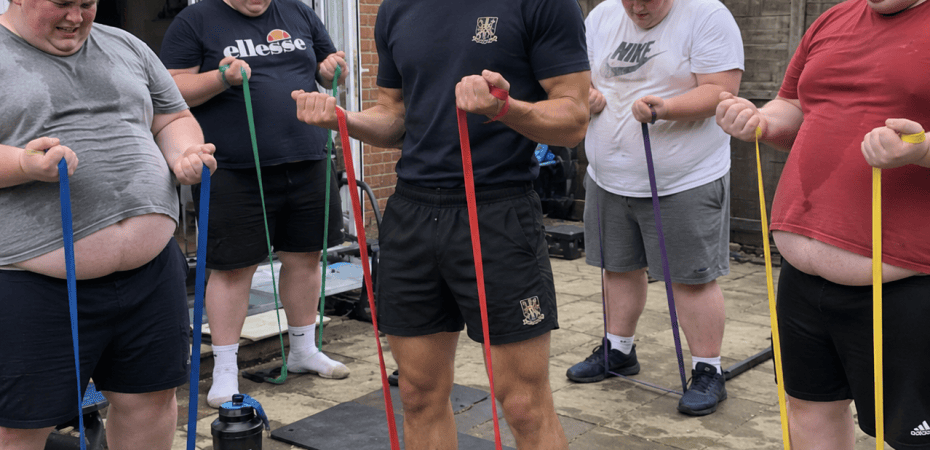
So long as you have both youth and a superb physique, as I have, a gymnasium is a glorious place to visit. There are mirrors everywhere. There are opportunities to remove most of your clothing without anyone calling the police. There are attractive people lifting heavy objects while pretending not to look at one another. Even the changing rooms offer that agreeable classical combination of nudity, narcissism and competitive judgement which must surely have made the original Greek gymnasia such cheerful institutions.
Unfortunately, modern gyms admit everyone. This means that alongside those of us who improve the scenery there are people who certainly ought to exercise but whose present condition makes the exercise itself objectionable to everyone else. You know the sort. He is usually a grossly fat Northerner with spots and ingrowing hairs. He may add the greyish complexion of something discovered behind a refrigerator. His shorts were evidently bought some years before he reached his present size. His enormous belly hangs below his T-shirt. When he bends over, regions of his body emerge that really should remain private.
Then there is the smell. Fat people sweat. This is not propaganda disseminated by Vogue. It is an observable fact. They also seem to fart continually when exercising, perhaps because their digestive systems are processing the remains of six Greggs steak bakes and a bottle of luminous orange fluid bought from a petrol station. There are few experiences more dispiriting than attempting a set of squats while trapped inside the lingering intestinal atmosphere of a man called Darren.
Yet I am not wholly without compassion. These people are in need of exercise. Indeed, judging by some of them, they need it before the ambulance arrives. Telling them merely to stay out of gyms would therefore be unkind, and I would never wish to be that. What they require is somewhere they can sweat, grunt, wheeze, expose their stretch marks and discharge whatever gases have accumulated inside them without involving innocent bystanders. Fortunately, such a place already exists. It is called your house.
This brings me to the charitable purpose of this article. If you are too embarrassed to enter a gym, cannot afford one, live nowhere near one, dislike other people or simply possess a body which ought for the moment to remain behind closed doors, you can still become fit at home. More importantly, you can do it without spending thousands of pounds on equipment. The fitness industry has persuaded millions of people that exercising requires a room filled with electrically powered machinery, seventeen varieties of protein powder and a watch capable of reporting that its owner has once again failed to move. In reality, the human body remains as it always was. It responds to resistance, movement, adequate nutrition and gradual increases in difficulty much as it did when Greek athletes trained naked and never thought to upload motivational videos afterwards.
The cheapest useful home gym therefore begins not with a treadmill, an exercise bicycle or some enormous contraption advertised by a former reality-television contestant, but with a set of resistance bands. I appreciate that coloured lengths of rubber do not look impressive. A barbell covered in iron plates appeals to the primitive male imagination in a way that something resembling equipment from a physiotherapy clinic never will. But appearances are misleading. A good set of bands with several resistance levels, proper handles and a door anchor allows you to train almost the whole body. You can perform rows and pulldowns for the back, presses for the chest and shoulders, curls, triceps extensions and several variations of squats and hip hinges. By changing the band, shortening it or combining two together, you can alter the resistance sufficiently to keep progressing for a surprisingly long time.
The door anchor is particularly important. Without one, bands remain useful; with one, they become something close to a portable cable machine. Fix the band low and you can row upwards or perform curls. Fix it around chest height and you can press or row horizontally. Fix it high and you can perform pulldowns and triceps work. The entire apparatus can then be put back into a small bag and hidden under your bed, where it will occupy almost no space among the crisp packets, lost socks and other archaeological remains of your present existence. For perhaps £30 or £40, you have removed the first great excuse for doing nothing.
I would add a set of smaller looped bands, usually called mini-bands. These are especially useful for the lower body, since resistance tubing is generally more convenient for upper-body exercises than for loading the legs heavily. Mini-bands can be used for lateral walks, glute bridges, clamshells, squats and various movements for the hips. Fabric versions tend to be stronger and less inclined than latex bands to roll themselves into narrow strips of concentrated pain around your thighs. If you are substantially overweight, strengthening the hips and legs is not an eccentric bodybuilding concern. These muscles are responsible for moving the considerable quantity of you that presently exists, and making them stronger will improve almost everything else you attempt.
At this point someone will invariably ask why any equipment is needed at all. After all, there are hundreds of bodyweight exercises. This is true. Push-ups, squats, lunges and planks all work, and anyone strong enough to perform proper pull-ups already possesses one of the finest upper-body exercises available. The difficulty is that bodyweight training becomes perversely inconvenient for the very people most in need of exercise. If you weigh fourteen stone, a push-up may be a manageable beginner’s exercise. If you have gone past the Big Two, which most people seem to manage in my town, your introductory exercise programme begins by asking you to move something approximately the weight of a washing machine. The resulting failure is then interpreted as evidence that exercise is not for you, when the real problem is that the resistance cannot easily be adjusted.
Bands solve much of this. They allow a genuinely weak beginner to start with something genuinely easy and then make it harder in small stages. Bodyweight movements can also be scaled. A person unable to perform a floor push-up can begin against a wall, then move to a kitchen worktop, then to a lower solid surface before eventually reaching the floor. Squats can begin with assistance from a chair. There is nothing shameful about such regressions. The shame, if we must have some, lies in being unable to perform these movements and deciding that the best response is to remain unable to perform them. Physical incompetence is forgivable when temporary.
I would, however, resist some of the sillier recommendations found in home-workout guides. Handstand bars, parallettes and similar devices are excellent if you are already sufficiently strong to perform L-sits, handstand push-ups or planche progressions. They are not a sensible early purchase for a man whose shoulders are already labouring under the daily burden of supporting his arms. This is the recurring disease of the fitness industry: people are encouraged to buy advanced equipment before mastering elementary movement. If ten ordinary push-ups remain beyond you, there is no pressing need to consider how best to perform them upside down.
The same principle applies to cardiovascular exercise. You do not need to buy a treadmill just because you have decided to become fit. I fail to understand the attraction of spending £1,500 on a large electrical machine which permits you to perform indoors something that evolution has allowed you to do outside for nothing. There are circumstances in which treadmills are useful, of course. Serious runners may need controlled conditions. Dreadful weather exists. Certain disabilities and practical circumstances make indoor exercise preferable. But for the average sedentary person who wishes primarily to lose fat and become healthier, the finest piece of cardiovascular equipment remains a pair of shoes.
Walking lacks glamour, which is one reason people underestimate it. Nobody becomes an Internet celebrity by walking briskly around a housing estate. Yet it is one of the easiest ways to increase energy expenditure without producing the fatigue and ravenous appetite that can follow more violent forms of cardio. The sensible approach is gradual. If you currently walk 2,000 steps each day, announcing that from tomorrow you will perform 15,000 is another form of procrastination disguised as ambition. You will do it twice, acquire blisters and spend the rest of the week explaining that your body requires recovery. Move to 3,000, then 4,000, then higher. Ten thousand steps is a reasonable eventual target for most able-bodied people, though the precise number matters less than turning movement into something habitual rather than heroic.
A skipping rope is useful later. It costs almost nothing and can produce a very hard cardiovascular workout in a few minutes. But if you are one of my morbidly obese classmates, repeatedly launching your entire mass into the air and dropping it onto your knees is not the obvious first stage of physical renewal. Walk first. Become lighter. Strengthen the legs. Then, if the desire takes you, begin skipping around your kitchen like Rocky Balboa. A small stepper can also be useful for accumulating movement indoors, particularly while watching television or talking on the telephone. None of this requires Bluetooth connectivity or a monthly payment to an American company which congratulates you for sweating.
If you continue training for several months, something important will have happened. Exercise will no longer be the new enthusiasm of the week. At this point I would consider spending more money, and the first substantial purchase should probably be adjustable dumbbells. Resistance bands can develop a great deal of strength, but their resistance is difficult to quantify precisely and increases as they stretch. Dumbbells give you an exact load. If you press 10 kilograms for ten repetitions this month and twelve next month, you know that you have improved. If twelve repetitions eventually become easy and you move to 12.5 kilograms, you have a clear means of continuing the process.
This is progressive overload, a phrase surrounded by more mysticism than it deserves. The body adapts only when repeatedly given a reason to adapt. If a weight that once allowed eight difficult repetitions eventually allows twelve controlled ones, increase it slightly and begin again. The improvement from one workout to the next may be trivial. One more repetition looks insignificant. An additional kilogram looks insignificant. But small improvements accumulated over years produce transformations that people who depend on bursts of motivation never understand. This is why keeping records matters. Write down the exercise, the weight and the repetitions. Numbers are rather useful because they cannot be persuaded by your excuses.
An adjustable bench greatly expands what can be done with dumbbells. It allows flat and inclined presses, supported rows, seated shoulder work, split squats and various other movements that become awkward without one. If space is limited, buy a folding model and put it away after training. Adjustable dumbbells, a bench and resistance bands already constitute a serious home gym. For most people they are enough to build an excellent physique, assuming the equipment is actually used rather than converted into an expensive clothes horse.
This last qualification is more important than it sounds. Buying fitness equipment gives an immediate feeling of virtue. Training does not. Training is repetitive and sometimes uncomfortable, whereas spending £600 on adjustable dumbbells allows you to feel that your life has changed before you have lifted them once. There are homes across Britain containing treadmills beneath drying laundry, exercise bicycles used as coat racks and elaborate multi-gyms slowly disappearing beneath boxes. The owners did not lack equipment. They lacked continuity. I would therefore impose a simple rule on anyone building a home gym: earn the next purchase by using what you already own.
Once you have done that, a doorway pull-up bar is one of the few inexpensive additions I strongly recommend. Get the kind that hooks securely over a substantial frame rather than one which remains in place by friction like a shower-curtain pole. There are enough ways for a fat man to injure himself without adding a sudden reunion between his coccyx and the floor. Pull-ups and chin-ups train the back, arms and grip exceptionally well, and they provide a wonderfully honest measure of relative strength. Either you can lift yourself or you cannot.
Those unable to perform one should not despair. Assistance bands can remove part of your bodyweight. Negative repetitions — beginning at the top and lowering yourself under control — allow you to develop the relevant strength. Simply hanging from the bar improves grip and begins to accustom the shoulders to supporting the body. Rows and pulldowns can build the back in parallel. Eventually the amount of assistance falls, until one day you discover that you can pull your chin over the bar without help. For someone who began unable to support his own weight, this is a genuine achievement. It is also far more satisfying than being informed by an electronic machine that you have earned a digital badge.
Kettlebells come somewhere after this. They are excellent tools, particularly for swings, goblet squats, carries and various pressing movements, and anyone who takes an interest in kettlebell training can develop an entire programme around them. But they are not essential. Nor is a stability ball. Nor is a suspension trainer, though both have legitimate uses. The important distinction is between things that broaden a training programme and things without which training supposedly cannot begin. You need almost nothing to begin. The collection can grow as your strength and interest grow.
If, after several years, you have become one of those tiresome people who organise holidays around access to weights, then a full home gym begins to make sense. A garage or suitable basement can accommodate a power rack, an Olympic barbell, weight plates and the bench you already own. This takes you into a different category of training. Squats, presses, deadlifts and innumerable variations become possible with loads limited more by your strength than by your equipment. Most racks also provide attachment points for bands and suspension trainers and include some form of pull-up bar.
A proper Olympic bar is about seven feet long and normally weighs 20 kilograms, so a rack requires more room than its own footprint. You need space at either end to load plates and enough clearance to move safely. I should also have thought it unnecessary to say that several hundred kilograms of iron should not be installed in an upstairs bedroom without some consideration of what the floor can support, but the continued existence of warning labels proves that my expectations of humanity are too high. Gravity has not yet been abolished by diversity training and will enforce building regulations with considerable impartiality.
A full home gym can easily cost several thousand pounds, especially once flooring, storage and good-quality weights are included. There is nothing wrong with spending this if strength training has become an important part of your life. It is still cheaper over many years than some expensive gym memberships, and the convenience is considerable. But the order matters. Begin with £30 of bands and discover whether you will actually train. Move to weights when the limitation is genuinely your equipment rather than your enthusiasm. Build the iron cathedral only when you have proved that you intend to worship there.
There are also objects I would not buy at all. Home fitness is filled with devices created because ordinary exercises are too difficult to patent. Squats work. Rows work. Presses work. Walking works. Unfortunately, nobody can sell the exclusive rights to bending your knees, so every year brings some new contraption promising to activate a previously undiscovered portion of the abdomen. Most can be ignored. A BOSU ball has specialised uses in rehabilitation and certain forms of training, but the average person has little reason to perform loaded exercises while standing on an inflated hemisphere. We spend our ordinary lives moving on stable surfaces. Becoming stronger on them is generally a more useful ambition.
I would also avoid installing a Smith machine in a small home gym. It takes up a great deal of space. It costs money. It forces the bar to travel along a fixed track. If you possess enough room to accommodate one, a proper power rack and free barbell are normally the more versatile purchase. The same objection applies to most single-purpose machines. A set of dumbbells can be used for dozens of movements. A barbell can train almost everything. An enormous machine designed solely to exercise one region of your legs performs one function while consuming enough floor space to accommodate a small refugee family.
Whatever equipment you own, the programme itself should remain simple. Most people require a handful of productive movements performed consistently and progressively. At home, I would organise training around the same basic patterns. You need a squat or lunge movement for the legs, a hip hinge for the hamstrings and glutes, a press, and a pulling movement for the back. Add some shoulder work and, if vanity demands it, curls and triceps exercises. A beginner can train the whole body three times each week and make excellent progress without spending two hours inventing new ways to hold a dumbbell.
The exercises themselves can change as your equipment improves. A beginner might perform assisted squats, band rows and wall push-ups. Later these become goblet squats, dumbbell Romanian deadlifts, dumbbell presses and heavier rows. Someone with a full gym may eventually use barbell squats, presses and weighted pull-ups. The underlying functions remain similar. There is no need to change an exercise because you have become bored after nine days. Change it when it hurts or when another movement offers a clear advantage. Constant novelty entertains the mind while preventing the body from becoming measurably better at anything.
Technique matters more than the amount of weight moved. Lower each repetition under control. Use a range of motion appropriate to the movement and your mobility. Do not twist, bounce or turn every final repetition into an epileptic interpretation of weightlifting so that your notebook can contain a larger number. The purpose of resistance training is to place useful tension on muscle, not to transport metal from one geographical location to another by whatever means necessary. If your form deteriorates completely, the set is finished.
Nor can any collection of equipment rescue a dreadful diet. This is particularly relevant to the people at whom this article is primarily directed. If you are substantially overweight, exercise will improve your health and help preserve or build muscle while you lose fat, but it cannot repeal arithmetic. A takeaway consumed in twenty minutes can contain enough energy to undo a depressing quantity of walking. This does not mean you must starve or spend the rest of your life weighing individual grains of rice. Eat mostly ordinary food, consume adequate protein, reduce the quantity of ultra-processed rubbish and create a sustainable energy deficit. If your average bodyweight does not fall over several weeks, you are eating too much to lose weight. There may be many reasons for this, some more understandable than others, but the bathroom scales are not engaged in a conspiracy against you.
The decisive factor in all of this is not equipment, programme design or even the precise form of exercise chosen. It is consistency. Most people fail because they mistake enthusiasm for discipline. They train ferociously for three weeks, buy supplements, tell everyone about the new regime and then vanish for three months. When they return, they begin again with another programme which is supposedly better than the first. Their lives become an endless sequence of first days.
A home gym is especially useful because it removes many excuses. There is no journey. There is no opening time. Nobody is using the bench you want. You do not need to pack a bag or expose yourself to other people. If you have forty minutes, you can train. If you have twenty, you can do something useful. The convenience that makes home training attractive does, however, create another danger: because you can exercise at any time, you can always exercise later. Later then becomes tomorrow. The answer is to establish fixed training days and treat them as appointments rather than suggestions.
There is one final advantage, and for some people it may be the greatest. You can be incompetent in private. I have joked about the spectacle presented by badly overweight people in commercial gyms because cruelty is one of the few pleasures still untaxed by the Government. But embarrassment is real. An obese teenager may genuinely dread exercising beside lean people of his own age. A middle-aged man who has spent twenty years doing nothing may feel absurd struggling with movements that everyone around him appears to find effortless. Such feelings should not prevent anyone from improving, but there is no reason they must be endured if they do.
So shut the door. Wear whatever revolting clothes you find comfortable. Sweat freely. Fart if you must. Hold the back of a chair while learning to squat. Do push-ups against the wall. Perform your first band rows badly, then learn to perform them better. Walk around the house until ten minutes no longer exhausts you. Nobody is watching and nobody needs to know. The resistance band you struggle to stretch now may become too light next year. Five push-ups may become twenty. A bodyweight pull-up may pass from unimaginable to routine. The first dumbbells you buy may eventually become warm-up weights.
This is what people misunderstand when they treat physical condition as something fixed. Your present body is nothing more than the accumulated result of what has happened so far. Unless illness or disability imposes limits, it is not a sentence. The body records repeated behaviour with extraordinary fidelity. Feed it differently, move it differently and demand progressively more from it, and over time it will become different. This is neither motivational rhetoric nor a promise of miracles. It is simply adaptation.
There may therefore come a day when the creature who first hid himself indoors to exercise has disappeared. You will find an old photograph and be startled by the size of your face. Clothes will fit differently. Stairs will cease to be an athletic event. Perhaps you will eventually decide to enter a commercial gym after all, by which time the mirrors will have become considerably less hostile. You may even discover the agreeable pleasure of looking around the room and silently judging everyone else. At that point, civilisation has done all it can for you.
Until then, train at home. And the rest of us will be grateful.

Discover more from The Libertarian Alliance
Subscribe to get the latest posts sent to your email.
Related posts:
 Lose Fat, Not Yourself: Why Structure Beats Motivation
 Junk Food for Junk People, and the Joy of Watching Them Rot
 Obesity as a Behavioural Addiction: A Study in Therapeutic Evasion
 Bodybuilders, Bulimia, and the Terror of Looking Good
 The Body Never Lies: Why Physical Excellence is One of Life’s Greatest Investments
 Some Provisional Truths About Diet and Health
 The Pill That Makes Us Thin: Orforglipron and the Medicalisation of Appetite
 Acid Without Spectacle: Reply to Bryan
 Blood Pressure, Beyond the Slogans: What the Best Evidence Really Shows
 Ultra-Processed Food and Lung Cancer: What the Evidence Really Shows
 Sugar as Sin: Why Viral Anti-Sugar Memes Mislead
 Salt and Blood Pressure: the Danger of Medical Absolutes
Powered by YARPP.