
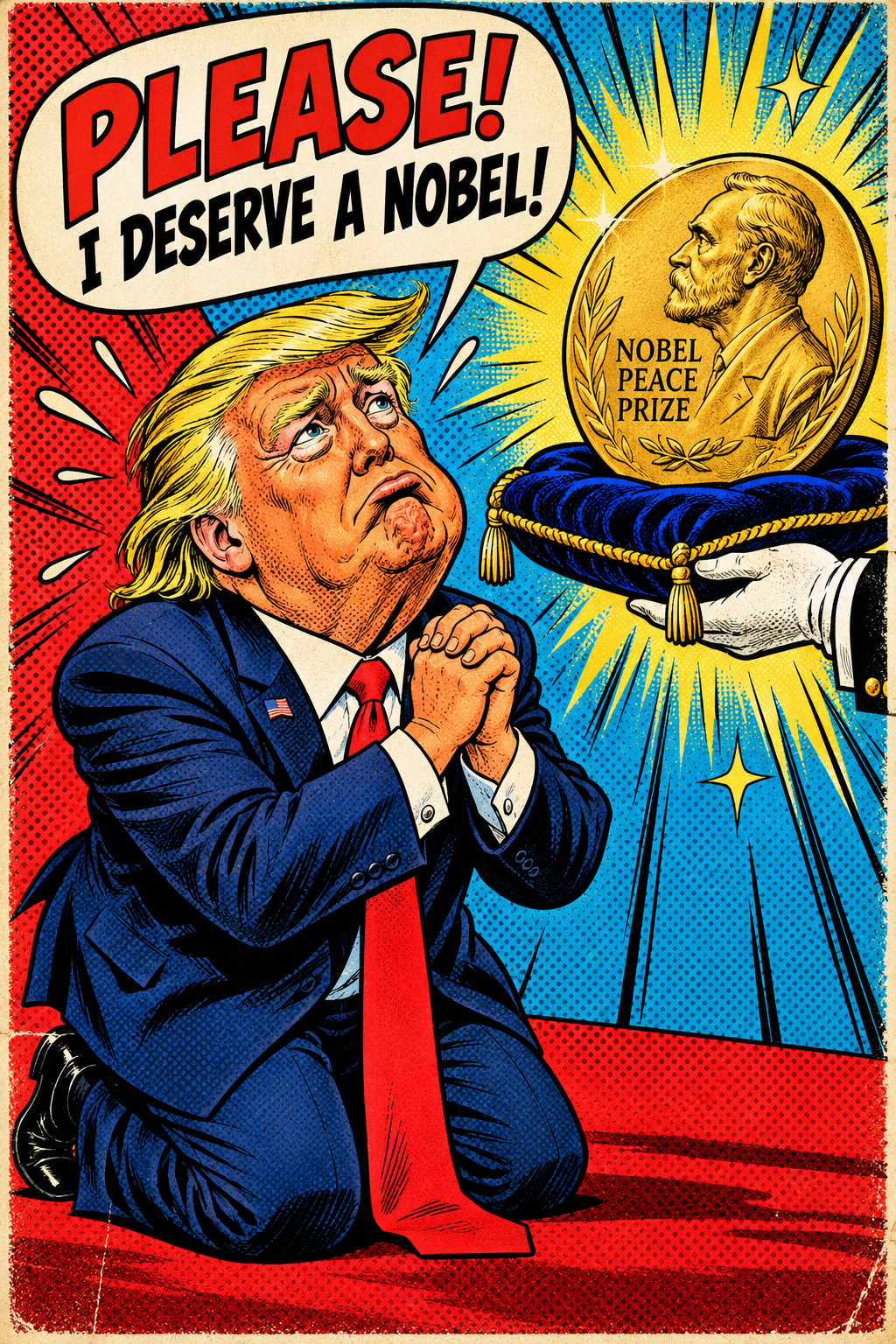
On Friday the Norwegian Nobel Committee gave its Peace Prize to Navi Pillay, a South African judge who is eighty-five years old. Before the day was out the President of the United States had published more than six hundred words on the subject. I have read them several times, which is more attention than they got from whoever was supposed to stop him. He says the prize should have gone to “the Great United States of America, whose Representative, ME, settled eight Wars, and many other things.” He says: “In actuality, I should have won 8 Nobel Peace Prizes, not just 1.” He says the award is “an indelible stain on Norway,” and that the committee is made up of “Radical Ideologues who are Anti-Democracy, and Enemies of Civilization!” He is in the eighth month of a war that he started. I bring it up at this point because he brings it up himself, and I will come to how.

First the woman, since he opens with her. “I know nothing about this woman, and neither does anyone else!” he writes, and in the next sentence he tells us that nobody ever heard of her “other than the fact that she, very obviously, hates Israel.” Anyone who followed his rally in Ohio last weekend will recognize the method. He said there that he knew nothing about Amy Acton, a few minutes after telling the crowd what she had done to the state. For the record, Pillay spent the apartheid years defending the people that government locked up, and became the first woman who was not white to sit on South Africa’s High Court. She was on the bench of the Rwanda tribunal when it handed down the first conviction for genocide by an international court, and when it ruled that mass rape could be part of that crime. She was a judge of the International Criminal Court and then, for six years, the United Nations High Commissioner for Human Rights. Her last job for the UN was to chair the commission that concluded, in September of last year, that Israel had committed genocide in Gaza. Out of a career of nearly sixty years, then, the President has retained one fact, and it is the fact that matters to the people who matter to him.
Now the eight wars. He lists them, which is a convenience, and I will take them more or less in his order.
Cambodia and Thailand fought for five days along their border in July of last year and stopped when he threatened both with the loss of their trade talks. He flew to Kuala Lumpur in October to watch them sign an accord. Thailand suspended it within weeks, and by December the two were fighting again, with air strikes this time, until a second ceasefire at the end of the month. Kosovo and Serbia have not been at war since 1999, and what he has to his credit there is an economic agreement from his first term. The Democratic Republic of the Congo and Rwanda signed papers in Washington in June of last year and again, at the level of presidents, in December. The M23 rebels, whom Rwanda backs and who do the fighting, were party to neither, and they took another Congolese city within days of the second ceremony. Pakistan and India exchanged fire for four days in May of last year. Pakistan thanked him and nominated him for the prize. The government of India, which is the larger half of that pair, has said from the start that the ceasefire was arranged between the two armies with no American mediation. That disposes of his claim that letters went to Oslo from “every President and Prime Minister” he helped, and this is the war he singles out as the one that “would be far more than necessary” to win the prize all by itself.
Egypt and Ethiopia have not fought a war. They have a quarrel over a dam on the Nile, which Ethiopia finished and opened last September without an agreement of any kind. Armenia and Azerbaijan are the best thing on the list. Their leaders came to the White House in August of last year and put their initials to a treaty, and I give him that, though the war itself was decided by Azerbaijan’s army in 2023 and the text had been agreed between the two capitals before he took an interest. Israel and Hamas accepted his ceasefire a year ago this week. The hostages came home, the living and then the dead, and he is entitled to say so. Palestinians have gone on being killed under that ceasefire by the hundred, which the word “settled” does not ordinarily cover.
So of his eight wars, two were never wars, one started up again within weeks, one continues in spite of the paperwork, one is denied him by the larger of the two parties, and two have something real behind them. That makes seven. The eighth is Israel and Iran, and it needs a section to itself.
Before I get to it, one more exhibit. Two days before the announcement he told reporters in the Oval Office that “No president has probably ever settled any wars.” Theodore Roosevelt brought the Russians and the Japanese to Portsmouth, New Hampshire, in 1905, ended a war between two great powers, and was given this same prize for it the following year. He had not asked for it. Jimmy Carter kept Begin and Sadat at Camp David for thirteen days in 1978, and the peace between Egypt and Israel has held for forty-seven years. I would have thought that a man who wanted the prize this badly might have looked up who had won it.
By Israel and Iran he means the twelve days in June of last year when Israel attacked Iran, he joined in by bombing three nuclear sites, and he then announced a ceasefire. Leave aside whether a man can be given a peace prize for ending a war he took part in. On February 28 of this year he and Israel attacked Iran again, and that war is in its eighth month. It opened, as I wrote in July, with the killing of Iran’s head of state and a strike on a school. It has since cost us the use of most of our bases in the Persian Gulf, six service members at Port Shuaiba in Kuwait, and an airfield in England that we had used since 1944. The fifth war on his list of wars settled is one he is fighting as he types.
He half knows it. Read the sentence that comes before the list: “I’m about to settle, or win, two more, Iran and, Russia/Ukraine.” Iran is therefore in the post twice, once as a war he ended and once as a war he is about to end, and on the second occasion he cannot decide between “settle” and “win.” A peacemaker settles. A belligerent wins, or in this case does not. He is applying for the prize in both capacities, about the same country, a few lines apart. As for Russia and Ukraine, that is the war he promised to end in twenty-four hours, and we are more than six hundred days past the deadline. “They’re both happening at breakneck speed,” he writes, “but, forget them.” I expect he would like us to.
There is a document that belongs beside this one. In January, when he was quarreling with Norway’s prime minister over Greenland, the President sent him a message to say that since “your Country” had decided not to give him the prize, he no longer felt “an obligation to think purely of Peace.” Six weeks later he was at war with Iran. I do not claim that the one caused the other. I observe that it is the kind of sentence a man writes when he regards peace as a service he performs for a fee, and that he has now been refused payment a second time.
The rest is padding, but the padding is instructive. His character witness is María Corina Machado, “a truly fine person,” who “gave me her Nobel Prize of last year” and told the press that he deserved it more than anyone who had ever received it. He adds: “I agree!” What happened is that American forces seized the President of Venezuela on January 3, and twelve days later the leader of the Venezuelan opposition, who needed a great deal from the man who had done it, came to the Oval Office and handed him her medal. The Nobel people pointed out that a prize cannot be transferred. He kept the medal, and I can read his “8 Nobel Peace Prizes, not just 1” in two ways, one of which is that he counts himself a laureate already. This year’s winner, told the news at a legal conference in Nuremberg, joked that if her audience clapped harder she might share hers with him. He should accept. It is the only offer he has had.
He claims the removal of Maduro itself, which was an armed raid that left eighty-three dead by Venezuela’s count. He claims to be “preventing, on a constant basis” wars between the two Koreas, between Japan and North Korea, and between China and Taiwan, none of which was in progress. By that method I have prevented a fire in every room of my motel since 1998, and the county owes me a medal. He claims credit for getting the NATO allies to promise defense spending of five percent of GDP in place of two. Alfred Nobel’s will says the prize is for those who work for fellowship among nations and for the reduction of standing armies. I doubt that anyone before him has applied for it on the strength of a promise to more than double them. He claims to have “created a soon to be very prosperous Arctic.” I do not know what this means and I would bet that he does not either. The Arctic was there before him. He claims more than nine hundred political prisoners freed in Eastern Europe and a hundred and ninety-six hostages brought home without ransom. Some of that may be so. People have walked out of prisons in Belarus on the word of his envoys, and good. But I have no way of checking the totals, and after the forty-four percent and the seven hundred percent of his Ohio speech I have stopped extending him credit on numbers.
What kind of mind produces this? I said some things in July about his psychology that I borrowed from the professionals, and I would sooner not borrow again. The page is enough. It contains the word “I” about twenty times and his own name three times. The only other Americans in it are two of his predecessors, brought on to be insulted. The six who died at Port Shuaiba are not there. Neither are the airmen who were pulled out of England that same week, or the people paying $6.36 a gallon for diesel. The commander in chief of a country at war, with an election three weeks off, spent his Friday on a medal.
Then there is the matter of who was robbed. The prize, he says, was given “over the Great United States of America,” and “The United States of America, represented by me, as your President, should have received the Nobel Peace Prize, but didn’t.” I am one of the represented. I do not recall wanting a medal from five Norwegians, and I would be surprised to learn that my guests did. He can no longer tell an injury to his vanity from an injury to the country. It follows that anyone who withholds applause from him is an enemy of the country, or, as he puts it here, of “Civilization.”
Notice also that he wants the thing and despises it in the same breath. The prize is “forever discredited.” It has acquired quotation marks and become the Nobel “Peace” Prize. And he should have had eight of them. In January he told a reporter that he did not care about it. A man who did not care would not know, to the nearest unit, how many he was owed. The reckoning itself shows how he thinks about peace, which is as a scorecard: one war, one prize, and “any one of which” would have been “far more than necessary.” Nothing in the post suggests that he has imagined what any of these wars was like for someone in it, or wondered why the Cambodians and the Thais went back to shooting. They are items. He closed them and he wants the commission.
I come back to the opening lines, because they are the worst. “I don’t know what the woman has done.” He could have found out in a minute, and it would have taken less time than typing the list. He did not, because for him the question was never what she had done. Somebody else had been given a thing he wanted, and somebody had told him the one fact he needed. I notice that the Israeli prime minister was denouncing her in much the same terms on the same day. What strikes me in the post, more than the vanity, is this incuriosity. He does not know and does not want to know, about her, about the wars on his list, or about the war he is in. I called him stupid in my last piece, and some readers will have thought the word too strong. I ask them to read the post.
I will give him one point. The prize has gone to unworthy people. Henry Kissinger got it in 1973 for a peace in Vietnam that did not hold. Barack Obama got it in 2009 for having been elected, and went on to bomb seven countries. A man of any weight who had been passed over would look at that company and shrug. Only someone who wants in very badly writes six hundred words of complaint about five people in Oslo and signs it in capital letters.
The wanting is what ought to worry us. He told Norway in January what becomes of his obligations when he does not get his prize. He has now been denied it again, with a war on and an election in three weeks, and by his own account to TIME he rules nothing “out or in.” Men have been dangerous for grander reasons. I cannot think of one who was dangerous for a smaller.
He says the committee has left an indelible stain on Norway. Norway will manage. The stain I have in mind is nearer home, and I helped to put it there three times.
Sources:
- Navi Pillay wins Nobel Peace Prize 2026 – Khaleej Times
- Trump’s message to Norway’s prime minister – PolitiFact
- Trump’s Oval Office remarks of 7 October – Deccan Chronicle/PTI
- Trump’s repost and Pillay’s joke – AlterNet
- Netanyahu’s reaction – MEAWW
Discover more from The Libertarian Alliance
Subscribe to get the latest posts sent to your email.
Related posts:
 America’s Singapore: The Iran War and Imperial Collapse
 A War Washington Cannot Win
 Trump and the Nuclear Threshold: A Man Unfit for Office
 After Trump?
 Iran: Is One Picture Worth a Thousand Words?
 America Hijacked: An Honest Indictment That Lets Trump Off the Hook
 Empire of Lies: Restoring the History the Warlords Need Us to Forget
 What the @#!* is Going Going on?
 The War That Exposed the End of American Power
 The American Political Class as Grifting Trailer Trash
 The Real Defeat of America
 For a New New World Order
Powered by YARPP.