
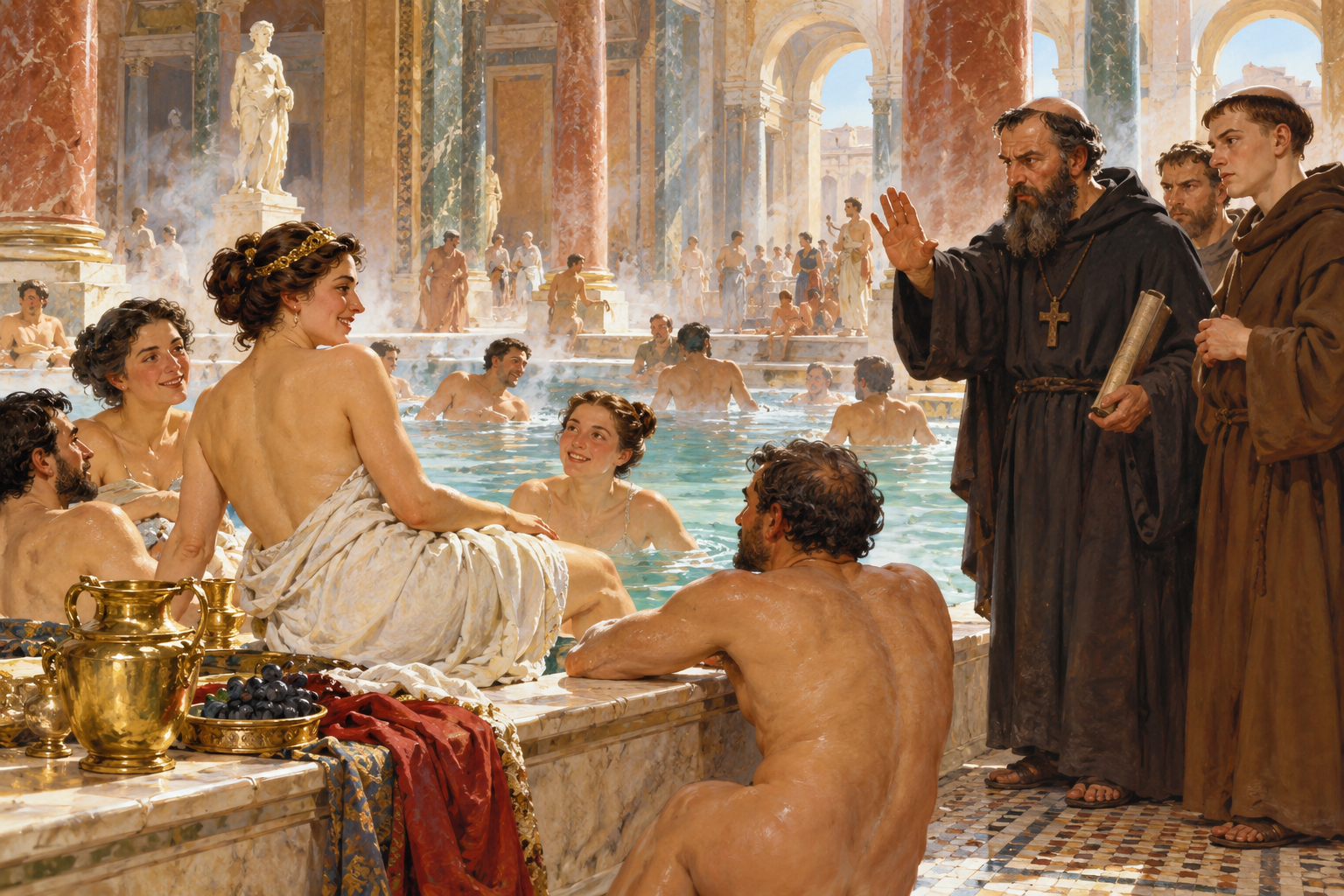
Bryan Mercadente and I disagree about a good many things, and usually we do it amiably. Last week we found a new matter on which to disagree. He had been reading Gibbon again – the fifteenth and sixteenth chapters, which is where most people start and many stop, though Bryan has read it all – and he announced, with the satisfaction of someone who has a great writer on his side, that the Church Fathers were a collection of unwashed fanatics. They hated the body and they hated women, and in the course of a few centuries they turned the cleanest civilisation in history into the dirtiest. The Romans, he said, built the Baths of Caracalla, and the Christians produced a man who sat on a pillar for thirty-odd years and was admired for his sores.
It is not a subject on which Bryan is neutral. He takes exercise more seriously than anyone I know, and regards a religion that despises the body as something close to a personal insult. I am a Christian, and I did not enjoy hearing any of this. But not enjoying an argument is no answer to it, and I had to admit that I had never read a word of what the Fathers said about washing. Nor, as it turned out, had Bryan. He had read Gibbon, and had read Lecky. So I went to look.
The best short collection of the evidence that I found is a paper called “A Curiosity Which Has Many Eyes”, given at the Young Historians Conference at Portland State University in 2017 by Lilian Chan, who was then at Clackamas High School in Oregon. In a dozen pages it brings together the main texts on the Fathers and the public baths, and the modern scholars who have written about them. Chan’s conclusion is nearer to Bryan’s than to mine: the Fathers, she says, condemned bathing as “an immoral, promiscuous, and disease-causing act”. But she quotes her sources fairly and tells the reader where to find them, and when I followed her references and read the passages in full, I found that they do not say what Bryan thinks they say. I do not think they quite say what she thinks either.
The indictment
Bryan’s case deserves to be stated properly, because he got it from good writers. In the fifteenth chapter of the Decline and Fall, published in 1776, Gibbon observes that the Fathers went into great detail in their censures of luxury, and he supplies a list of the things that roused their indignation: false hair, coloured clothes, musical instruments, gold and silver plate, soft pillows, white bread, foreign wines, warm baths and the shaving of the beard. His footnote sends the reader to the Paedagogus of Clement of Alexandria. By the thirty-seventh chapter, on the monks, he has warmed to the theme. The look of a true hermit, he says, was horrid and disgusting, because whatever offended men was supposed to please God, and he notes that the rule of Pachomius condemned the bathing and oiling of the limbs.
Gibbon was not alone. Hume had already dismissed fasting, celibacy, mortification and the rest as “monkish virtues”, rejected by men of sense because they serve no purpose in the world. In 1869 Lecky, in his History of European Morals, collected the unwashed saints into a few famous pages and wrote that the most admired of them had become “one hideous mass of clotted filth”. Five years later the chemist and politician Lyon Playfair told an audience in Glasgow that, for a thousand years after the ancient civilisations faded, not a man or woman took a bath. From platforms of this kind the idea passed into what everybody knows, which is how an intelligent teenager comes to hold it today without being sure where he got it.
There are three separate claims here. The first is that the Fathers condemned bathing. The second is that they did so because they despised the body, and women’s bodies in particular. The third is that their teaching destroyed the bathing culture of the ancient world. It is also worth noticing a matter of dates before going further. “The Fathers” covers five centuries. The men Gibbon draws on in his fifteenth chapter – Clement, Tertullian, Cyprian – wrote in the second and third centuries, when the Church was an illegal body with no power over anyone who did not choose to belong to it. The monks belong to the fourth and fifth. Bryan had run the two together, and Gibbon rather encourages his readers to do so.
What Clement says
Clement taught in Alexandria in the last years of the second century, and the Paedagogus – the “Tutor” or “Instructor” – is his manual of everyday conduct for converts. To judge from its contents they were mostly people of means, since nobody else needed to be told how many silver vessels to take to the baths. He deals with bathing in two chapters of the third book.
The first is a description of abuses. Rich women, he says, arrive with gold and silver utensils and with braziers, so that they can dine and get drunk while they bathe. They will hardly undress before their husbands, but they strip before their male slaves and are rubbed down by them. The public baths are open to men and women together, and “from looking, men get to loving”. This is the passage Chan quotes, and it is plainly hostile. But what it is hostile to is display, drunkenness and mixed bathing. In the middle of it Clement remarks that poor women, who have none of this apparatus, enjoy their baths just as much, which is hardly the remark of a man who thinks that bathing is wicked. He ends by telling the men that it is for them to set the women an example of modesty.
The second chapter is headed “Why we are to use the bath”, and the title alone should have given Gibbon pause. Clement says that people go to the baths for four reasons: cleanliness, warmth, health and pleasure. Pleasure (ἡδονή) he rules out as a motive. Warmth he thinks superfluous, since there are other ways of getting warm. Women may bathe for cleanliness and health, and men “for health alone”. Taken by itself that last phrase looks like a licence for men to be dirty, and Chan concludes that for Clement it is better not to bathe at all than to bathe for pleasure. But a few lines later he says that the body must sometimes be washed because of the dirt that collects on it, and sometimes to relieve tiredness, and that in the country, where there is no bath-house, plain water does the job. His subject is the heated public bath-house, with its hot rooms and its loungers. Washing he takes for granted.
What follows is medical advice. Too much hot bathing, Clement says, weakens the body and can bring on fainting. The ancients called bath-houses ἀνθρωπογναφεῖα, “fulling-shops for men”, because they wrinkle the skin and age the bather before his time. Flesh softened by heat is like iron and needs cold to temper it. Nobody should bathe when exhausted or when stuffed with food, and age and season must be considered. For all this he appeals to the experts, by which he means the doctors, and his rule is the one he applies to food and drink and everything else: due proportion. He adds a point of manners. A bather should not need an attendant, and to have several slaves pouring water over you is an offence against your neighbours, because the bath belongs equally to everyone in it.
The chapter after that is about exercise. Boys, Clement says, need only the gymnasium, and grown men would do well to prefer it to the baths. He recommends wrestling – upright, and without showing off – ball games in the sun, long walks, and digging. The purpose is health and honest sweat. I sent this chapter to Bryan without saying who wrote it. He replied that it was the most sensible thing he had read all week, and asked which of the Stoics it was.
What the pagans said
It was a better guess than he knew. Clement’s ethics are largely Stoic, and it has long been recognised that whole stretches of the Paedagogus follow Musonius Rufus, the teacher of Epictetus. What he says about the baths is what educated pagans had been saying for a century and a half.
Seneca, in his eighty-sixth letter, describes a visit to the villa of Scipio Africanus at Liternum. The great man’s bath was small and dark. Seneca compares it with the baths of his own day, in which a man thinks himself poor unless his walls shine with marble and his water runs from silver taps. Scipio, he says, washed his arms and legs every day and the rest of himself on market days. No doubt someone will say that such men must have stunk. Seneca’s answer is that they smelt of the army, of hard work and of manhood. Marcus Aurelius, whose reign closes the period that Gibbon thought the happiest in human history, puts it more bluntly in the Meditations: bathing is oil, sweat, dirt and greasy water, all of it disgusting. If contempt for the pleasures of the bath is a Christian vice, the philosopher-emperor had it worse than Clement.
The mixing of the sexes was a grievance of the same age. According to the Historia Augusta, Hadrian ordered men and women to bathe separately, Marcus Aurelius had to forbid mixed bathing again, and Severus Alexander did it a third time after Elagabalus had allowed it. The Historia Augusta is not a source to lean on by itself, but Cassius Dio confirms Hadrian’s order. Quintilian, a century before Clement, gives as his specimen of a doubtful inference the claim that a woman who bathes with men must be an adulteress, which shows that the inference was commonly drawn. Roy Bowen Ward, whose article on women in the Roman baths is Chan’s main modern authority, sets out the evidence for mixed bathing and for the disapproval it attracted from writers such as Martial and the elder Pliny. So when Clement complained in about the year 200 that the baths were open to both sexes together, he was complaining of something that at least one emperor, and probably two, had already tried to stop by law. He had no law to invoke, and could only tell his own pupils to stay out of it.
The same is true of extravagance. Chan cites Katherine Dunbabin for the picture of Roman aristocrats sweeping into the baths with fifty attendants, and sets it beside Clement’s silver vessels as a favourite theme of the Fathers. But the author of that picture is Ammianus Marcellinus, who was a pagan and an admirer of the emperor Julian. Complaints about showing off at the baths were a commonplace of Roman moralising long before any Christian took them up.
As for health, Chan ascribes the Fathers’ doubts to “misguided medical beliefs”. I think this is the weakest part of her case, and she half sees it herself. She cites Garrett Fagan’s count of how often the medical writers prescribe baths: eighty-one references in Celsus, and forty-seven in the later books of the elder Pliny. But think what that means. If the doctors sent their patients to the baths for everything from fevers to skin complaints, then the baths were full of sick people, sitting in the same warm water as the healthy. That water was not disinfected, and nobody knows how often it was changed, though Marcus Aurelius’s description suggests an answer. Celsus himself warns that a bath is one of the worst things for a wound that is not yet clean. Fagan, in his book on the subject, doubts whether the baths were the hygienic institutions we like to imagine, and thinks they may have spread disease as readily as they prevented it. A teacher who advised moderation in the hot room and cold water afterwards was repeating the cautious medical opinion of his day, and it was not bad advice.
What Christians did
If the Fathers had forbidden the baths, we should expect to find Christians staying away from them. We find the opposite. Tertullian is the fiercest of the early Latin writers and the one Gibbon most enjoys quoting. In his Apology of 197 he answers the charge that Christians are useless to society by pointing out that they live exactly as their neighbours do: non sine foro, non sine macello, non sine balneis – not without your forum, your meat-market or your baths. He will not bathe at the hour the Saturnalia requires, he says, but he bathes at a decent and healthy one. In another work he mentions that the newly baptised give up the daily bath for a week afterwards. The custom tells us what a Christian in Carthage did during the other fifty-one.
Irenaeus, writing in Gaul about 180, has a story that he says came from Polycarp. The apostle John went one day to the baths at Ephesus, saw the heretic Cerinthus inside, and ran out again without washing, shouting that the building might fall down with such an enemy of the truth in it. The point of the story is the heretic. But it was told and retold by people who saw nothing odd in an apostle going to the public baths.
Chan’s other main witness is the Apostolic Constitutions, which supplies her title. She treats it as a document of the period before Nicaea. It was in fact compiled in Syria about 380, but its first six books rework a third-century church order called the Didascalia, and the rules about bathing are already in the older text. They tell a Christian woman not to bathe with men. If there is a women’s bath she is to use it, modestly and in moderation, preferably at the tenth hour, and so avoid “a curiosity which has many eyes”. Chan reads this as evidence of prejudice against women, and I shall come to that. But a few paragraphs earlier the same book gives the same instruction to men: when a man wants to bathe he is to use the men’s bath, so that he neither tempts nor is tempted. The rule for both sexes is to bathe, and to do it apart.
Cyprian, writing in Carthage in 249, rebukes consecrated virgins who went to the mixed baths and pleaded that they went only to wash. His answer is that they may not look at anyone, but they are looked at. It is a stern passage. It is also evidence that even the women under vows in his congregation were to be found at the baths, and that their bishop’s complaint was about the company.
After Constantine the evidence is plentiful, and some of it is funny. Sisinnius, who about the year 400 was bishop in Constantinople of the Novatians – a sect that had split from the Church because it thought the Church too lax – bathed twice a day. Asked how a bishop could justify this, he said it was because he could not manage a third time. Augustine, on the day he buried his mother, went to the baths because he had heard that the Greek word for a bath meant something that drives grief from the mind. He records that it did not work. Pope Symmachus, at the beginning of the sixth century, built baths beside the basilicas of St Paul and St Pancras. A hundred years later Gregory the Great heard that some in Rome were preaching that it was sinful to wash on a Sunday. He wrote to the city that bathing for luxury and pleasure was not allowed on any day, and that bathing for the needs of the body was not forbidden on Sunday either. That is Clement’s distinction, four centuries on, and it is a distinction between two reasons for doing something that everybody did.
Chan allows at the end of her paper that the Fathers “had limited influence in changing long-held traditions in Rome”. I would put it more strongly. On this evidence most of them were not trying to end the tradition at all.
What has to be conceded
The evidence is not all on one side, and there are two things I ought to concede to Bryan. The first is about women. Clement holds them to a stricter account than men, and so do the others. Ward observes that female sensuality is the chief preoccupation of everything Clement says about the baths, and anyone who reads the chapter will agree. The assumption running through all these texts is that a woman is answerable for the eyes that are turned on her. Cyprian’s virgins are blamed for being seen. Chan calls this sexism. The word is ours and would have meant nothing to them, but what it points to is there in the texts, and I do not think a modern Christian is obliged to pretend otherwise. Two things should be said in mitigation. The pagan moralists made exactly the same assumption, as Quintilian’s adulteress shows, and Roman practice was no kinder: Ward notes that in the Forum baths at Herculaneum the women’s changing-room is less than a third the size of the men’s. And Clement, who in this chapter allows women one more reason for bathing than he allows men, says elsewhere in the same work that men and women have the same virtue and the same Instructor. That is some way from hatred.
The second is about the ascetics, and here Bryan’s evidence is real. Athanasius, in his Life of Antony, says with admiration that the saint never bathed and never so much as washed his feet. Jerome told a friend that a man who has once been washed in Christ has no need to wash again. He advised a mother that her daughter, once grown, should not bathe at all. He records that his friend Paula warned her nuns that a clean body and clean clothes meant an unclean soul. These are the passages Gibbon and Lecky draw on, and they do not misrepresent them.
But consider what they show. They belong to the fourth and fifth centuries. They are addressed to monks and consecrated virgins, people who had chosen to leave the ordinary world and wanted to be told how to do it thoroughly. Going unwashed was one of their disciplines, alongside fasting and going without sleep, and it counted as a discipline because the thing given up was good. Nobody makes a sacrifice of what he thinks worthless. The hermit who renounced the bath was paying it the same compliment he paid to food and to marriage. When monasticism settled into an institution the rule became milder: Benedict allows baths to the sick as often as they need them, and to the healthy and the young more seldom. To take Antony’s feet as the Church’s teaching on hygiene is like taking a Trappist’s silence as its teaching on conversation.
I will admit that I do not find the unwashed saints attractive, and that some of Jerome’s letters read like the work of a man who has mistaken his own disgust for holiness. A Christian is not bound to defend everything said by every Father. He is bound, as anyone is, to be accurate about what they said.
Preaching and compelling
That leaves the third charge, that the Church killed the bath. Here it helps to ask how a Roman bath-house was kept going. It needed an aqueduct, a great deal of fuel, a staff to stoke and clean, and a city council or a rich benefactor to pay for all of it. In Rome these things lasted until 537, when the Goths besieging the city cut the aqueducts. By then, Julian apart, the emperors had been Christian for more than two hundred years, and for the whole of that time Christian magistrates had kept the baths open and bishops had been building new ones. In the East the baths never closed. They passed from the Byzantines to the Arabs, and the hammam is their descendant. Fikret Yegül, who has written the standard history, attributes the end of public bathing in the West chiefly to the failure of money and water. Three centuries of sermons had not emptied the pools.
There is a further point, which I should have expected Bryan to see before I did. Until 313 the Church could not forbid anything to anyone. A bishop in the year 200 was the head of an illegal association and liable to be put to death. The most he could do to a member of his flock was to rebuke him or exclude him from communion. Clement was not even a bishop. He was a teacher whose pupils came because they wanted to and could leave when they liked. The people who legislated about the baths were the emperors Bryan admires. Hadrian separated the sexes by edict, for everyone, whether they agreed with him or not. Clement tried to persuade those who had chosen to listen to him. Garrett Fagan says that the early Church did not dare to ban the baths. I see no sign that it wished to; but if we are to complain of interference with the pleasures of the bath, the complaint lies against Hadrian. A moralist who tells willing hearers that they ought to live differently is using the same liberty that Bryan and I use on this site. Bryan tells his readers what to eat and how to train. They are free to ignore him, and I usually do.
What is really at issue between us is whether self-restraint is a fault. Gibbon found the Fathers ridiculous because they asked of each pleasure whether it was good for the person taking it. Bryan asks that question of every meal. He and Clement would disagree about what a body is for, but they agree that it has to be governed, and that a man who cannot do without his comforts is not free. Clement would add that the body is governed for the sake of something beyond it. On that Bryan and I shall go on disagreeing.
What I have learned from the exercise is how the Enlightenment case was made. Its authors took the extreme examples, removed the dates and the audiences, and presented what was left as the mind of the Church. It was excellent polemic, and Gibbon writes better than nearly all the men he mocks. But the texts are there to be read. Around the year 200 a Christian teacher in Alexandria told his pupils to wash when they were dirty, to bathe for their health, to keep their eyes off other men’s wives, and to finish with cold water and take some exercise. Bryan has agreed to read the Paedagogus. I have agreed to finish Gibbon.
Further Reading
The paper
- Lilian C. Chan, “‘A Curiosity Which Has Many Eyes’: Ante-Nicene Church Fathers’ Attitudes Towards Bathing”, Young Historians Conference, Portland State University, 2017. Free to read, and the source of most of the references below.
The Fathers
- Clement of Alexandria, Paedagogus, Book III. Chapters 5, 9 and 10 are the ones on the baths and on exercise. The translation is the Victorian one in the Ante-Nicene Fathers; the Greek is in the Sources Chrétiennes edition (vol. 158), where the passage on the four reasons for bathing is III.9.46.
- Tertullian, Apology, chapter 42, and De Corona, chapter 3.
- Irenaeus, Against Heresies III.3.4. John and Cerinthus at the baths of Ephesus.
- Didascalia Apostolorum, translated by R. Hugh Connolly (Oxford, 1929), chapters 2 and 3; and the fourth-century reworking in the Apostolic Constitutions, Book I, sections 6 and 9.
- Cyprian, On the Dress of Virgins, chapter 19.
- Socrates Scholasticus, Ecclesiastical History VI.22. Sisinnius and his two baths a day.
- Augustine, Confessions IX.12.
- Athanasius, Life of Antony, chapter 47; Jerome, Letters 14, 107 and 108. The ascetic case at its strongest.
- The Rule of St Benedict, chapter 36; Gregory the Great, Register XIII.3 (XIII.1 in the Nicene and Post-Nicene Fathers translation), to the citizens of Rome.
The pagans
- Seneca, Letters to Lucilius 86. Scipio’s bath.
- Marcus Aurelius, Meditations VIII.24.
- Historia Augusta: Hadrian 18, Marcus Aurelius 23, Severus Alexander 24; Cassius Dio LXIX.8. The imperial bans on mixed bathing.
- Quintilian, Institutio Oratoria V.9.14; Ammianus Marcellinus XXVIII.4; Celsus, De Medicina V.26.
The accusers
- Edward Gibbon, The History of the Decline and Fall of the Roman Empire, chapters 15 and 37. The footnote citing the Paedagogus is note 89 to chapter 15 in most editions.
- David Hume, An Enquiry Concerning the Principles of Morals (1751), section IX.
- W. E. H. Lecky, History of European Morals from Augustus to Charlemagne (1869), vol. II, chapter 4.
Modern scholarship
- Roy Bowen Ward, “Women in Roman Baths”, Harvard Theological Review 85 (1992). The fullest treatment of mixed bathing and of what Christians said about it.
- Katherine M. D. Dunbabin, “Baiarum grata voluptas: Pleasures and Dangers of the Baths”, Papers of the British School at Rome 57 (1989).
- Garrett G. Fagan, Bathing in Public in the Roman World (University of Michigan Press, 1999), and “Bathing for Health with Celsus and Pliny the Elder”, Classical Quarterly 56 (2006).
- Fikret Yegül, Baths and Bathing in Classical Antiquity (MIT Press, 1992). The standard history, including the end of the baths in the West and their survival in the East.
- Johannes Zellinger, Bad und Bäder in der altchristlichen Kirche (Munich, 1928). The older German monograph on the subject, which I know only through reviews and through those who cite it.
Discover more from The Libertarian Alliance
Subscribe to get the latest posts sent to your email.
Related posts:
 Pope and Patriarch: A Review of Their Joint Declaration
 Reclaiming a Better Future: A Christian Vision for True Environmental Stewardship
 Greek Fire: The Secret Weapon That Saved Constantinople and the Civilised World
 Dietrich Bonhoeffer—The Christian Fighter For Freedom
 Sex and the Ancient City: Reading About Sex Is Almost as Good as Having It
 The Basis of the Culture and Institutions of Britain
 The Reformation and Its Ironies: How the First Protestants Were More Catholic than Many Catholics Today
 Greek History and Civilisation: Lecture One
 Dissident Chronologies and Why the Past Refuses to Move
 Iran: Is One Picture Worth a Thousand Words?
 The Folly of Crassus: A Lesson from Plutarch
 Distributivism: Property, Liberty, and the Common Good
Powered by YARPP.